Threat intelligence
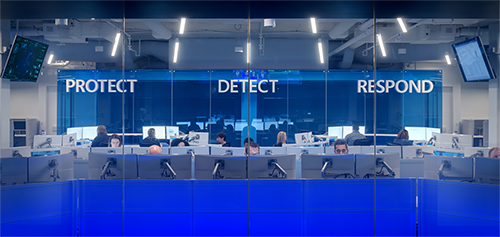
The Microsoft Threat Intelligence community is made up of world-class experts, security researchers, analysts, and threat hunters who analyze 100 trillion signals daily to discover threats and deliver timely and timely, relevant insight to protect customers. See our latest findings, insights, and guidance.
Refine results
Topic
Products and services
Publish date
-
Introducing Kernel Data Protection, a new platform security technology for preventing data corruption
Kernel Data Protection (KDP) is a set of APIs that provide the ability to mark some kernel memory as read-only, preventing attackers from ever modifying protected memory. -
Seeing the big picture: Deep learning-based fusion of behavior signals for threat detection
Learn how we’re using deep learning to build a powerful, high-precision classification model for long sequences of wide-ranging signals occurring at different times. -
Inside Microsoft 365 Defender: Solving cross-domain security incidents through the power of correlation analytics
Through deep correlation logic, Microsoft Threat Protection automatically finds links between related signals across domains. -
Taking Transport Layer Security (TLS) to the next level with TLS 1.3
TLS 1.3 eliminates obsolete cryptographic algorithms, enhances security over older versions, and aims to encrypt as much of the handshake as possible. -
Stopping Active Directory attacks and other post-exploitation behavior with AMSI and machine learning
Microsoft Defender ATP leverages AMSI’s visibility into scripts and harnesses the power of machine learning to detect and stop post-exploitation activities that largely rely on scripts. -
Force firmware code to be measured and attested by Secure Launch on Windows 10
For important security features on Windows to properly do their jobs, the platform’s firmware and hardware must be trustworthy and healthy. -
Industry-wide partnership on threat-informed defense improves security for all
MITRE Engenuity’s Center for Threat-Informed Defense has published a library of detailed plans for emulating the threat actor FIN6 (which Microsoft tracks as TAAL). -
Sophisticated new Android malware marks the latest evolution of mobile ransomware
We found a piece of a particularly sophisticated Android ransomware with novel techniques and behavior, exemplifying the rapid evolution of mobile threats that we have also observed on other platforms. -
Trickbot disrupted
Microsoft took action against the Trickbot botnet, disrupting one of the world’s most persistent malware operations. -
System Management Mode deep dive: How SMM isolation hardens the platform
Key to defending the hypervisor, and by extension the rest of the OS, from low-level threats is protecting System Management Mode (SMM), an execution mode in x86-based processors that runs at a higher effective privilege than the hypervisor.