Microsoft Threat Intelligence Center (MSTIC) is raising awareness of the ongoing activity by a group we call GALLIUM, targeting telecommunication providers.
We adopted a deep learning technique that was initially developed for natural language processing and applied to expand Microsoft Defender ATP’s coverage of detecting malicious PowerShell scripts, which continue to be a critical attack vector.
Microsoft Defender ATP instruments memory-related function calls such as VirtualAlloc and VirtualProtect to catch in-memory attack techniques like reflective DLL loading.
A complex attack chain incorporating the CVE-2018-20250 exploit and multiple code execution techniques attempted to run a fileless PowerShell backdoor that could allow an adversary to take full control of compromised machines.
Microsoft Defender ATP, Microsoft’s endpoint protection platform, addresses this challenge by integrating with Azure Information Protection, Microsoft’s data classification, labeling, and protection solution.
In MITRE’s evaluation of endpoint detection and response solutions, Windows Defender Advanced Threat Protection demonstrated industry-leading optics and detection capabilities.
Several weeks ago, the Windows Defender Advanced Threat Protection (Windows Defender ATP) team uncovered a new cyberattack that targeted several high-profile organizations in the energy and food and beverage sectors in Asia.
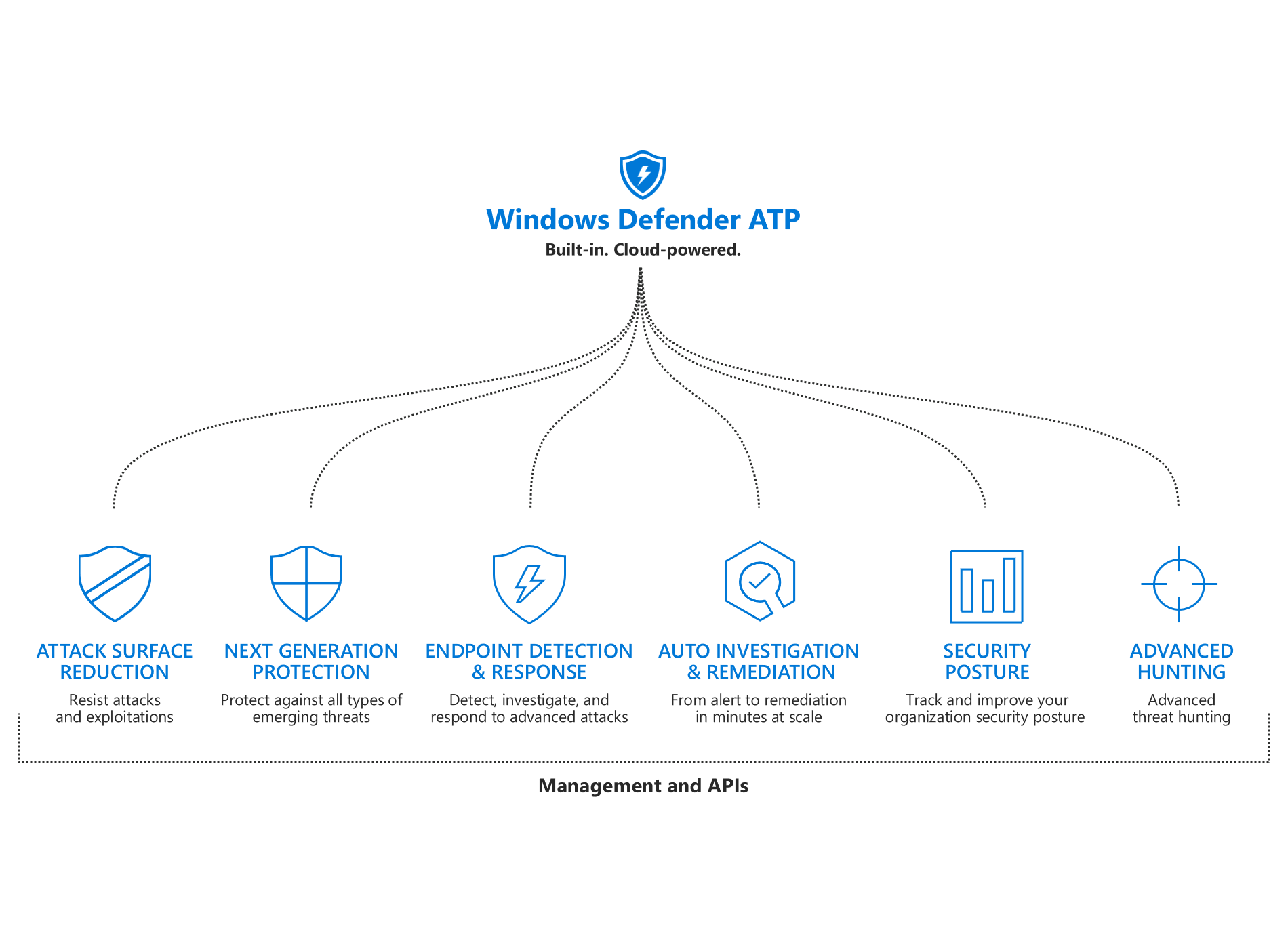
We added new capabilities to each of the pillars of Windows Defender ATP’s unified endpoint protection platform: improved attack surface reduction, better-than-ever next-gen protection, more powerful post-breach detection and response, enhanced automation capabilities, more security insights, and expanded threat hunting.