

Deploying Microsoft 365 Copilot: A next-generation business tool
Welcome to the new era of productivity
Generative AI has captured the world’s attention, and businesses are taking notice.
According to our Work Trends Annual Report, 70% of people would delegate as much work as possible to AI to lessen their workloads.

“I’m inspired by the transformative power of AI. I’ve been impressed with how quickly our employees have put it to work for them.”
Andrew Osten, general manager, Microsoft Digital
Capitalizing on this trend will mean the difference between surging ahead or getting left behind, including here at Microsoft, where we’re the first enterprise to deploy Microsoft 365 Copilot fully.
“I’m inspired by the transformative power of AI,” says Andrew Osten, general manager of Business Operations and Programs in Microsoft Digital, the company’s IT organization. “I’ve been impressed with how quickly our employees have put it to work for them.”
He would know. His team is responsible for driving usage and adoption of Copilot and any new features to more than 300,000 employees and vendors across the world.
“Customers are looking to us to share what we’ve learned as the first enterprise to deploy Copilot,” Osten says. “Our team has a unique opportunity to help them deploy and get to value as quickly as possible.”
Meet Microsoft 365 Copilot
Copilot combines the power of large language models (LLMs) with your organization’s data to turn your employees’ words into some of the most powerful productivity tools on the planet—all within the flow of work. Employees can access intelligent assistance through Microsoft 365 Copilot Chat or the apps they use every day, including Word, Excel, PowerPoint, Outlook, Teams, and more, to provide real-time intelligent assistance. It also forms the foundation for new, agentic capabilities that apply the power of Copilot orchestration to more specific knowledge sources and tasks.
According to our Work Trends annual report, employees who use AI are seeing significant benefits.
75%
of knowledge workers reported that they use AI at work today.
90%
shared that AI helps them save time.
85%
said AI helps them focus more on their work.
84%
reported that AI helps them be more creative.
Organizations like ours that are unlocking AI assistance within employees’ everyday workflows are poised to gain a distinct advantage in terms of productivity, engagement, and innovation.
“We’re using it to reduce our IT expenses and enhance our productivity,” Osten says. “We’re also excited by its potential to create a lasting competitive advantage for us here at Microsoft and for our customers.”
Our mission in Microsoft Digital is to empower, enable, and transform the company’s digital employee experience across devices, applications, and infrastructure. We also provide a blueprint for our customers to follow in the form of this guide for deploying and adopting Copilot.
“The contents of this guide are based on the lessons we’ve learned deploying Copilot,” Osten says. “The tips and ideas you’ll read here will help you accelerate your own time to value with Copilot so you can realize the same benefits as our employees.”

Are you an executive?
Chapter 1: Getting governance right
Maintaining privacy, security, and compliance while respecting regulatory frameworks.
Before you begin your Microsoft 365 Copilot implementation, you’ll want to consider how this tool impacts your data. Copilot employs LLMs that interact with data and content across your organization. It uses information your employees can access to transform user prompts into personalized, relevant, and actionable responses throughout Microsoft 365 apps.
Giving your employees this level of access means proper data hygiene is essential. At Microsoft Digital, we use sensitivity labeling to empower our employees with access while also protecting our data. Our colleagues on the product side designed Copilot to respect labels, permissions, and rights management service (RMS) protections that block content extraction on relevant file labels. By implementing effective sensitivity labeling practices, you can rest assured that anything you intend to remain private or confidential will stay that way.
Pick the governance path that’s right for you
This chapter outlines the highly robust, best-case scenario we created at Microsoft, but we know not every organization has a fully deployed data governance system and strategy. If you’re in that position, don’t worry! You can use techniques like Restricted SharePoint Search that provide value and protection without exposing Copilot to your internal resources.
Laying the groundwork with proper labeling
Throughout our internal governance efforts within Microsoft Digital, we’ve developed four labeling practices that make up our foundation for appropriate policies and settings.

Responsible self-service
Support and enable your employees to create new workspaces like SharePoint sites, ensuring your company data is on your Microsoft 365 tenant and employees don’t simply re-use and overload existing spaces with mismatching permissions. That enables your employees to take full advantage of Copilot in ways that align with your organizational data hygiene while you keep your company’s information safe.

Top-down defaults
Label containers for data segmentation by default to ensure your information isn’t overexposed. At Microsoft, we default our container labels to “Confidential\Internal Only.” That ensures alignment with our policies and settings that limit external sharing. We use Microsoft Purview to manage this process.

Consistency within containers
Derive file labels from their parent containers. Being consistent here boosts security across every layer and reduces the administrative burden on your employees to label every file they create. Copilot will reflect file labels in chat responses, so employees know the level of confidentiality behind each portion of AI-created responses.

Employee awareness
We train our employees to understand how to handle and label sensitive data. By making your workers active participants in your data hygiene strategy, you increase accuracy and your overall security posture.
Self-service with guardrails
The data hygiene practices we outlined above form a foundation for compliance and security, but backstopping those efforts through Microsoft 365 features adds an extra layer of protection. That’s a core principle of Zero Trust.
At Microsoft Digital, we use Microsoft Purview Data Loss Prevention (DLP) policies to define the rules and actions for detecting and protecting sensitive data across Microsoft 365, SharePoint, OneDrive, and Teams. DLP policies support vulnerable data types and scenarios that require protection. Those include any kind of information that might introduce inappropriate access to company data or intellectual property. Examples include access to credentials like keys or tokens, personally identifying information, financial data, or non-public source code.
Sign-in information, reports, and dashboards are available via Purview to help our team monitor and analyze content activity and compliance across the organization. They also provide insights into the volume, location, and usage of sensitive data, as well as any incidents and alerts that indicate potential data breaches or violations.
For example, an employee might label something as “General,” but it contains credentials or other sensitive end-user identification information (EUII). In those instances, Purview will automatically block the file from access beyond its owner or reapply a more appropriate label.
Between proper labeling and backstopping self-service through DLP guardrails, we’re able to keep Copilot Chat from surfacing documents it shouldn’t share in the wrong context or to the wrong people. Using Purview and other tools at our disposal, the five practices below help us keep our employees and our company’s data safe.
Trust, but verify
Empower self-service with sensitivity labels, but verify them by checking against DLP standards, then use auto-labeling and quarantining when necessary. Internally, we’ve configured Microsoft Purview DLP to detect and control sensitive content automatically.
Expiry and attestation
Put strong lifecycle management protocols in place that require your employees to attest containers to keep them from expiring. We don’t keep items that don’t have an accountable employee or that might not be necessary for our work.
Controlling the flow
Limit oversharing at the source by enabling company-shareable links instead of forcing employees to grant access to large groups. At Microsoft, we add an extra layer of highly confidential items that users can only share with specific people on a need-to-know basis. To enforce these behaviors, you can set default link types based on labels through Purview.
Oversharing detection
Even under the best circumstances, accidents happen. When one of our employees does overshare sensitive data, we use Microsoft Graph Data Connect extraction in conjunction with Microsoft Purview to catch and report oversharing.
International compliance: No size fits all
Europe has extra requirements in the form of EU Data Boundary regulations and works councils, internal organizations that provide employee co-determination on workers’ rights or regulatory issues, including performance management or monitoring. Our Copilot deployment meant we needed to partner closely with our Microsoft works councils when launching AI technology with complex data and privacy implications.
Your experience will vary depending on your industry and where you operate, but we’ve learned that it’s best to work closely with local subsidiaries to ensure you have a complete picture of a region’s regulatory situation. Local insiders are poised to liaise with their works councils, as we’ve done at Microsoft, or other bodies through direct relationships. Start the process early so you can manage feedback cycles effectively, make adjustments, synthesize any answers that works councils need, and resolve any concerns through configurations that make sense for your employees.
Learning from Microsoft’s governance, security, and compliance practices

Bring the right people into the conversation
Don’t keep this conversation in the IT sphere alone. Bring in all the relevant security, legal, and compliance professionals.

Build a foundation for automation
Microsoft Purview DLP has powerful intelligent detection, but it relies on establishing good defaults.

Think about how your employees will use Copilot
Determine the primary use cases for Copilot. The kinds of collaboration and access employees need will affect your default labeling architecture.

Take this opportunity to train employees
If you’ve been looking for an excuse to refresh employee knowledge around data privacy, let this moment be your milestone. It will be far easier to start with a clean data estate.

Don’t overwhelm your users
Make labeling simple and intuitive and ensure it isn’t overwhelming. Employees should have a limited set of choices to keep things comprehensible. It’s also valid for different employees to see different choices.

Balance good governance with time to value
Because of the scope and complexity of our deployment, we took a very thorough approach to governance. If speed is your priority, you might consider a faster deployment with a less comprehensive governance approach, for example, using Restricted SharePoint Search to constrain both Enterprise Search and Copilot experiences to a curated set of SharePoint sites of your choice.

Key takeaways
Use these tips to tackle governance, security, and compliance at your company. It’s based on what we learned deploying Copilot internally here at Microsoft.
1) Labeling
- Develop a labeling taxonomy. This should include:
- Classification levels, not exceeding five primary labels and five sub-labels
- Descriptions clearly outlining a label’s meaning for employees
- Examples to clarify usage for employees
- Determine policies and settings that correspond with labels. Consider the following:
- Storage type and location
- External allowance
- Encryption
- Access control
- Data destruction
- Data loss prevention
- Public disclosure
- Logging and tracking access
- Establish container defaults
- Configure container labels to set the default file label in document libraries
- Initiate an employee education initiative
2) Data loss prevention
- Configure Microsoft Purview DLP standards and quarantining protocols
- Establish lifecycle management and attestation protocols
- Configure Microsoft Graph Data Connect to discover where you’re oversharing
3) International compliance
- Initiate conversations with local subsidiaries
- Engage works councils or other advocacy bodies
- Address concerns
- Determine the feasibility of regional deployment and segment if necessary

Key actions:
How we did it at Microsoft
- Read our guide to governing Microsoft 365 Copilot. This step-by-step resource, based on our internal experience at Microsoft, will help you adapt your existing governance standards to reflect the new realities of AI.
- Check out how we’re using sensitivity labels to empower our employees while making Microsoft more secure. This article shows you how having a pre-established plan for labeling helped our Microsoft Digital team quickly deploy Copilot with proper guardrails.
- See how we’re riding the wave of agents that’s washing over Microsoft through good governance. This post talks about the ways good governance also pertains to enterprise AI extensibility through agents.
Further guidance for you
- Conduct the Microsoft 365 Copilot Optimization Assessment to understand your level of AI adoption and chart your course.
- Access Microsoft Learn documentation to read more about data, privacy, security, and Zero Trust principles.
- Follow the company’s governance and security overview for Copilot Studio to ensure your agents are managed safely and efficiently.
Chapter 2: Implementation with intention
Building a strategy for licensing, administration, and rolling Microsoft Copilot out to different groups within your organization.
Implementing Microsoft 365 Copilot isn’t as easy as just turning on licenses and alerting your users. It takes organizational partnerships, early assessments of your concrete business needs, and careful planning.
Design for the “who”
Copilot is a new concept in business software. At the time of our implementation, we were the first company to roll it out anywhere in the world, and our Microsoft Digital implementation team had to choose from countless ways to approach a licensing strategy—different mechanisms of licensing, automation, management, and the list goes on. Regardless of your overall approach, we’ve learned from experience that it almost always makes sense to start with pilot groups who can validate the tool and enable the rest of your organization.
For us, that looked like this:

Phase zero
We gave our Copilot engineering team early access so they could test Copilot from an insider’s perspective. We shared our early feedback with the product team.
- Product engineers

Phase one
We issued a limited number of on-demand licenses in core scenarios to get validation and feedback for key use cases.
- Sales
- Marketing

Phase two
We extended licenses to teams who needed to understand and support Copilot or provide approval for use.
- Support
- HR
- Legal
- Security
- Works councils

Phase three
We deployed Copilot and started working on adoption across the entire company.
- Advancing in phases, we deployed Copilot to more than 300,000 Microsoft employees and external staff.
Scaling out your licenses
After you decide on the general shape of your rollout, you can begin building your licensing strategy. Fortunately, if your organization uses Microsoft 365, you’ll already have access to most of the apparatus you need. The inherent flexibility of Microsoft 365 licensing means you can easily adjust your strategy as you progress based on scale, organization changes, or any other factors.
At Microsoft Digital, we started with individual licenses at the single-user level. As our implementation scaled, we tied licensing automation to Microsoft 365 security groups to implement targeted licensing changes at scale. Those groups could include tailor-made subsets of employees or entire organizations within Microsoft, and we keyed our automation logic to their expanding and contracting eligibility.
We highly recommend defining a phased rollout strategy and structuring your groups accordingly. That creates accountability and gives your IT admins a crucial point of contact for understanding the licensing needs of different groups within your organization.
Based on our implementation experience, there are three main benefits to using security groups:

Optimize licensing costs: Create groups that reflect your business needs and goals that align with your respective business sponsors. Sync your licensing status changes with group membership changes. That way, you can assign the right licenses to the right users and adjust easily if you require frequent changes, for example, in your early initial validation phase, to avoid paying for licenses you don’t need or use.

Refine admin costs: Group-based licensing lets your admins assign one or more product licenses to a group. This depends on your rollout strategy and progress. Your admins will be able to streamline your group setup at scale, reducing your admin overhead. This strategy is helpful, considering all the licenses you likely need to manage.

Enhance compliance and security: This ensures that only authorized users receive licenses and get access to resources, enhancing your security and compliance. Your admins can use audit logs and other Microsoft Entra services to monitor and manage your group-based licensing activities.
Pre-adoption communications
Given the excitement around AI tools, one of the biggest challenges during our phased implementation was support requests from employees outside our initial pilot groups. Most of our support requests at this stage were essentially asking, “Where’s my license?” It was a key learning for our Microsoft Digital implementation team.
You can easily avoid the issue through clear and honest communication. For example, when you alert your initial implementation groups about their Copilot access, you could simultaneously deploy “Coming soon” emails to the rest of your organization. That will help you avoid any confusion while simultaneously generating excitement and boosting general adoption when the time comes.
In the end, what’s most important is building a strategy for getting all users access to Copilot, structuring your rollout, and helping people build the daily habit of using AI. While leadership sponsorship is especially important in later phases of adoption, it’s also crucial here as a way of identifying who should be part of pilots and subsequent cohorts. Leaders can help communicate those decisions.
The bottom line is that your IT implementation team can’t work in isolation. Communication—especially from organizational leadership—will be a key part of your licensing and implementation strategy.
Learning from our implementation

Design for the “who”
When you determine your initial cohorts, base your decisions on which roles have the largest coverage and will provide the most relevant feedback.

Get your groups in place
Be thoughtful about your Microsoft 365 groups and make sure everyone knows who owns them and who’s responsible.

Engage your support team from the start
This is a new technology, so your support teams will receive requests. Ensure they’re ready by giving them early access.

Manage expectations to minimize blowback
Proactively help users understand why they have licenses or don’t. Note that your rollout strategy might be subject to change.

Bring leadership on board early
Executive sponsorship isn’t just useful for adoption. Leaders will also help you identify the key use cases within their organizations to determine if they belong in early rollout phases.

Product feedback at every level
Encourage feedback for employees in your early implementation phases, because that will guide your wider adoption efforts.
Key takeaways
Use these tips to help you with your internal implementation and admin process. They are based on our experience here at Microsoft.
1) Get ready
- Perform the Microsoft 365 Copilot optimization assessment
- Identify key implementation phases and groups
- Secure leadership involvement
- Build out your implementation plan and map it to a licensing strategy
2) Onboard and engage
- Assemble security groups and assign responsibilities
- Build an automated Microsoft 365 licensing management workflow
- Enable roles for Copilot reports and the Copilot dashboard
- Assign licenses and configure them using the setup guide
- Analyze pilot data:
- Access in-app feedback
- Facilitate feedback sessions
- Analyze usage reports
- Deploy communications: For strategy around this element, see the next section
Key actions
How we did it at Microsoft
- Learn about the councils steering our AI projects here at Microsoft.
- Find out how we’re unlocking the value of Microsoft 365 Copilot at Microsoft.
Further guidance for you
- Use the Microsoft Copilot Success Kit to accelerate your implementation with templates, onboarding guides, and technical readiness resources.
- Follow step-by-step instructions for assigning licenses and onboarding users in the Microsoft 365 admin center.
Chapter 3: Driving adoption to capture value
Effective adoption: From readiness to empowerment
The fact that your employees are excited to try out a powerful new technology platform isn’t enough. We found that you need strategic, coordinated change management efforts to drive Microsoft 365 Copilot adoption.
That way, you can be sure to get your employees onboard at the right time in the ways that you want. The idea is to give them the freedom to be themselves with proper guardrails.
Consider breaking your company-wide adoption into cohorts, for example, subsidiaries or business groups. We divided our adoption along two vectors: internal organizations like legal or sales and marketing, and regions like North America or Europe. Different cohorts have different focuses, but the strategy is similar.
Microsoft 365 Copilot change management
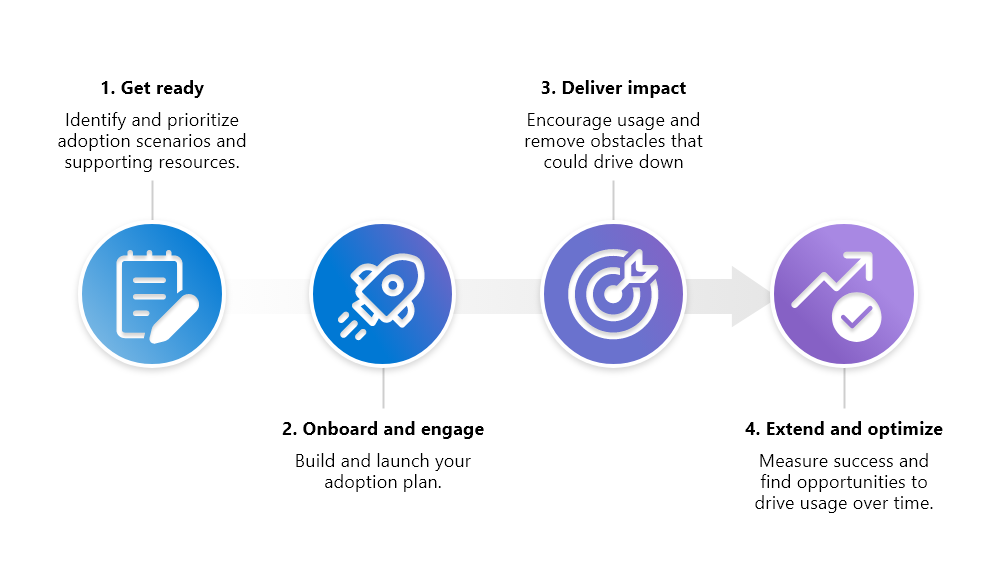
Effective change management needs careful planning. Our adoption efforts took inspiration from the Microsoft Engagement Framework, which we’ve developed specially for driving adoption of our products. If you’re an adoption specialist or change manager, you might notice similarities with Prosci’s ADKAR model, which progresses through awareness, desire, knowledge, ability, and reinforcement.
Whichever framework you choose, the techniques we use here at Microsoft will apply. Either way, the process starts with your people.

Get ready
Begin by working with your company-wide adoption leads, then identify members of your target cohorts who will support the adoption, including change managers, leadership sponsors, and employee champions.
Champions boost adoption by filling several important roles:
- Pinpointing key usage scenarios for Copilot based on their cohort’s culture or processes.
- Deciding on the best methods of communication.
- Providing insights that help adoption leaders build out their rollout plans.
- Extending the reach of our adoption team through peer-to-peer support and guidance.
- Most importantly, demonstrating the value of Copilot and showing their peers how powerful this tool can be in their day-to-day work.
When champions socialize their tips and tricks, our experience at Microsoft Digital has revealed that it’s best to share specific prompts and the value they provide as a concrete entry point for users. For example, a champion could say, “I saved three hours drafting this sales script in Microsoft Word using this prompt,” then share their Copilot prompt as a place for peers to start. You’ll find advice below for how you can effectively incorporate champs into your adoption efforts.
Works councils also play a key role at this stage. They offer the benefit of local cultural expertise and can help you identify challenges employees face in their jurisdictions. Even something as simple as understanding proper modes of address helps smooth the road to adoption through effective communication.
Each of these sets of stakeholders has a role to play in your rollout. We recommend using Microsoft Copilot adoption resources to build out your adoption plan.

Onboard and engage
At Microsoft, we implemented this phase across each adoption cohort. Because every group will have its own champions and leadership sponsors, it’s important to treat each of them as its own organization, with its own unique adoption needs.
In advance of our general rollout, we deployed jump-start communications with links to learning opportunities:
- Localized training took the form of Power Hours in different languages and time zones. These training sessions demonstrated key Copilot scenarios across Microsoft 365 apps.
- Self-learn assets included user quick-start guides, demo videos, and the Microsoft Copilot Academy to accommodate different learning styles and preferences.
From our experience at Microsoft Digital, pre-rollout communications fulfill two needs. First, this messaging is a great opportunity to launch your champion communities because early access to Copilot licenses and learning material helps peer leaders build their expertise. Second, these communications build your general adoption population’s desire and excitement for their incoming Copilot licenses, then prepare them to hit the ground running when they finally get access. Clear messaging also helps ward off questions from eager employees asking why they don’t have licenses yet.
After your Copilot licenses are live, your launch-day welcome communications are relatively simple. Just invite employees to access Copilot, play with this new tool, and start to experiment with how it can fit into their daily workflows. It’s also helpful to include information about where employees can get support. There are many possible vectors for deploying these communications, but a multi-pronged effort that includes Microsoft Viva Amplify will deliver the maximum impact.
For support in building out your own communication plan, our adoption team has created a user onboarding kit for Copilot. These ready-to-send emails and community posts can help you onboard and engage your users.

Deliver impact
After everyone has access, it’s time to promote Copilot usage and ensure your employees are getting the best possible experience and the most value. For Microsoft’s cohorts, employee champions and leadership sponsors were essential levers.
It’s important to remember that Copilot isn’t just another tool. It introduces a whole new way of working within employees’ trusted apps. At Microsoft Digital, we took great care to encourage employees to be adventurous and lean into a mindset shift to see it as part of their daily work—not just something they play with when there’s time.
Microsoft Viva Engage or a similar employee communication platform is a helpful forum for peer community support. In our case, it provided an organic space for champions to share their expertise and change managers to provide further recommendations and adoption content. For employees who explore best on their own, Copilot Lab provides in-the-flow learning opportunities to build their prompt skills.
Meanwhile, leadership sponsors diversified our communications strategy by deploying and amplifying messaging through executive channels like org-wide emails or Microsoft Viva Amplify. Because we broke our adoption out by both organization and region, employees benefited from two sets of communications, each focusing on the scenarios that are most relevant to them.

Extend and optimize
Finally, successful adoption depends on measurement, feedback, and listening.
Understanding overall usage patterns and impact is crucial to optimizing adoption. Our Microsoft Digital team employed a combination of controlled feature rollout (CFR) technology while tracking usage through Microsoft 365 Admin Center, the Copilot Dashboard, and Viva Insights. Together, these tools gave us the visibility and tracking we needed to establish and communicate adoption patterns. Meanwhile, IT admins and user experience success managers accessed simple in-app feedback through Microsoft 365 admin center. But to really maximize value, our Microsoft Digital employee experience teams conducted listening sessions and satisfaction surveys.
All of these insights are helping us establish a virtuous cycle to drive further value and better adoption for future rollouts, extend usage to new and high-value scenarios, incorporate Copilot into business process transformation, and understand custom line-of-business opportunities.
Driving user enablement with Microsoft Viva
We used Microsoft Viva to help enable our 300,000+ global users. Microsoft Viva is an Employee Experience Platform that brings communication and feedback, analytics, goals, and learning into one unified solution. Our team in Microsoft Digital used Viva across a range of change management scenarios, including building awareness, communicating with our employees, providing access to readiness and learning resources, and measuring the impact of our deployment.

Accelerating Microsoft 365 Copilot with Viva

Viva Connections
Sharing key news related to deployment and enablement, generating “buzz,” and tying Copilot to Microsoft culture.

Viva Amplify
Producing and efficiently distributing employee communications to build awareness and excitement.

Viva Learning
Courses and training for our employees on how to maximize value from Copilot, inclusive of building effective prompts.

Viva Engage
Actively engaging employees, providing leader updates, listening to feedback, and enabling Champs community.

Viva Insights
Using the Microsoft 365 Copilot Dashboard beta to identity actionable insights and usage trends.

Viva Pulse
Instant feedback from employees on their Copilot experience to fine-tune our landing and adoption approach.

Viva Glint
Understanding employee sentiment and gauging the overall effectiveness of our Copilot deployment effort.
Consider these examples:
- A human resources professional might use Copilot to create job descriptions by prompting it to suggest essential skills, qualifications, and responsibilities for a prospective role.
- A salesperson could ask Copilot to generate a table comparing their company’s flagship product with a competitor’s to address customer questions more efficiently.
- A finance professional might prompt Copilot to review and summarize a new contract to reduce the time it takes to search for key data.
Any single approach would never be adequate to address every different discipline and use case. With the rise of agents, specialized AI-powered assistants that customize and focus the capabilities of Copilot, certain roles derive the most value from tailored assistance for specific tasks.
So, we created a playbook that our employees can use to construct their own role-based scenarios according to their individual teams’ unique needs.
We designed it to help adoption professionals accomplish the following objectives:
- Understand the top responsibilities, challenges, needs, and wants of prioritized roles.
- Articulate and communicate hero scenarios by clearly depicting how Copilot can enable them.
- Share deliverables that include roles, scenarios, and prompts with the wider organization to drive awareness, adoption, engagement, and value.
Through internal testing and scenario crafting, we developed a four-part framework for creating, delivering, and socializing hero scenarios across any organization. These are the steps you can follow to create Copilot support content for adoption efforts tailored to specific roles.
Phase 1: Ready
This phase will help your organization, department, or team prepare for the process. It involves aligning with leadership and sponsors who will be accountable for driving value using Copilot. It’s also where you’ll select the priority roles, draft outlines of those roles so you can clarify your understanding of their needs and wants, and seek out feedback from leaders, managers, and subject matter experts.
Phase 2: Engage
Engaging with employees is the key to uncovering Copilot’s core value. In this phase, you’ll identify participants from your priority roles who demonstrate enthusiasm and early aptitude with the tool. From there, you can choose an approach, which might include in-person group sessions, virtual Microsoft Whiteboard sessions, one-on-one interviews, Microsoft 365 Loop collaboration, or whatever modality works best, then communicate the process to participants. Whatever you choose, the final step in this phase is conducting your employee engagements to document existing and aspirational Copilot usage scenarios.
Phase 3: Deliver
Ideating hero scenarios is how you discover value. The delivery phase defines that value and organizes it into a useful, consumable format. It starts with reviewing and analyzing the outcomes of your sessions to gain insights and identify themes. Now is the time to document your hero scenarios and the value they add, as well as blockers and accelerators. Finally, you’ll provide your output: a comprehensive deck that includes your priority roles, hero scenarios, next steps, and more.
Phase 4: Share
The final phase of this process involves socializing your scenarios across your team or organization to realize value. If you’re part of a large organization, it’s helpful to radiate these outputs beyond the target group as an opportunity for further Copilot momentum. This stage includes diving deeper into blockers and accelerators that can help your organization as a whole speed time to value.
Learning from our adoption of Copilot

Cascade adoption efforts through localization
Regional differences, priorities, even time zones—they can all block your centralization efforts. Your insider adoption leaders within each adoption cohort can help.

Empower your employee champions with trust
Monitor your user-led adoption communities at the start to provide support. As this community of power users becomes product experts, they’ll take over.

Empower employees as innovators
You’ll be surprised by what your employees dream up. Provide every opportunity for them to share their favorite tips and usage scenarios.

Create excitement, but set expectations
Encourage a healthy mindset around what Copilot can accomplish and where it fits. Don’t overpromise.

Gamify learning to build engagement and experience
Friendly competitions or cooperative challenges like prompt-a-thons generate excitement and invite creativity.

Understand that for many, AI is emotional
Overcome AI hesitancy by encouraging employees to tackle easy tasks with Copilot assistance. That will help minimize reluctance through practice.
Key takeaways
Use these tips as your guide as you build out and implement your adoption plan. They are based on our own experience internally at Microsoft.
1) Get ready
- Identify and ramp up the person who will lead adoption for your organization
- Create an adoption team and identify who will lead each workstream within each cohort, including:
- Change managers
- Executive sponsors
- Employee champions
- Conduct a kickoff meeting with your adoption team and set up a meeting cadence and workflow
- Identify users and usage within your cohorts:
- Pinpoint key usage scenarios, for example, CRM-connected email communication for salespeople or customer-facing copy support for marketers
- Identify cohort-specific personas, for example, software engineers, customer support specialists, and business operations project managers
- Determine communication preferences for each cohort and their personas and optimize messaging for each
- Define success criteria with KPIs and a success measurement plan
- Examples include usage by app or feature and user sentiment
- Complete user enablement strategy training
- Define a user experience and feedback strategy
- Build deployment communications and an enablement asset library
- Localize for international audiences
2) Onboard and engage
- Deploy readiness communications with onboarding content:
- Led by cohort adoption team
- Led and amplified by leadership sponsors
- Launch champion communities
- Deploy launch communications
- Led by cohort adoption team
- Led and amplified by leadership sponsors
- Socialize employee engagement communities
- Run live learning sessions
- Provide self-learning opportunities
- Upscale the working environment with digital banners, posters, and other promotional materials to help employees visualize Copilot
3) Deliver impact
- Promote usage through internal cohort channels
- Follow-up communications
- Viva Engage champion posts
- Report on KPI success at predetermined intervals
- Facilitate listening
- Satisfaction surveys
- Listening sessions
- Gather and amplify success stories
- Apply learnings to further adoption activities
- Nurture existing champions through a technical training track
- Develop reinforcement, resistance, and maintenance plans
4) Extend and optimize
- Explore new high-value scenarios
- Investigate business process transformation via agents, Copilot Studio, plugins, and connectors
- Source custom line-of-business opportunities
Key actions
How we did it at Microsoft
- Learn how we’re unlocking the value of Copilot at Microsoft. This post shares our overall journey from planning to measuring impact.
- Discover ways we’re approaching change management around Microsoft 365 Copilot. This story identifies the challenges and opportunities around adopting a new and revolutionary technology.
- See how we’re using Microsoft Viva to drive Copilot adoption. This article shares how Microsoft Viva acted as a comprehensive adoption tool during our Copilot rollout.
- Find out how we made Microsoft 365 Copilot adoption fun with Camp Copilot. This post shares how a grassroots, gamified community initiative became one of our most effective adoption drivers. Pair that story with this one that shares our seven tips for driving a successful virtual Copilot skilling event, and check out this article about our three-week Copilot Expo.
- Find out how a Copilot Champs community can help you drive adoption. This post shares how peer-to-peer adoption support helps drive greater engagement for employees.
- Learn how we’re helping our employees build daily Copilot habits with these 10 tips and check out our tips list for engineers.
- Explore how we created a Center of Excellence to guide our adoption and use of AI.
- Learn how we’re applying the Microsoft Responsible AI Standard here in Microsoft Digital and across the company.
Further guidance for you
- Explore the company’s essential guide to Copilot adoption for practical steps to onboard, engage, and measure impact across your organization.
- Use the Microsoft Customer Hub to access community resources and skilling events that can help you build a champions network and foster peer-to-peer support.
Support for adoption leaders
- Access the Copilot scenario library to understand different user needs and opportunities.
- Gain insights from your Microsoft Copilot Viva Insights dashboard.
- Deepen Copilot engagement through the Microsoft Modern Collaboration Architecture (MOCA).
- Help users build daily habits around Copilot using our suite of user engagement tools and templates.
Resources for IT practitioners
- Offer your employees training opportunities through a Microsoft Learn training module.
- Access different Copilot user help and learning resources.
- Give your employees a leg up on creating AI prompts with this blog post.
Chapter 4: Building a foundation for support
Setting your Support team up for success
Empowering employees means making sure they have access to the right support channels, especially if they have concerns with a new technology. The fact that Microsoft 365 Copilot operates across a wide spectrum of Microsoft 365 apps adds complexity to your support apparatus.
As a result, it’s important to give your support teams early access along with your earliest pilot implementations. For Microsoft Digital, that included members of our internal support teams who help Microsoft employees when they run into technical issues, as well as our Customer Experience and Support team that engages with external customers to troubleshoot problems with new Microsoft products. We also invited subject matter experts for Microsoft 365 apps featuring Copilot experiences, including Teams, Outlook, and more.
A small group of users across both internal and external support teams, as well as our Microsoft 365 subject matter experts, gained access at first, and we encouraged them to experiment and try to break features. This was a crucial learning phase for Microsoft Digital because it surfaced interesting issues that wouldn’t come up if our teams didn’t have access and an opportunity to experiment.
Building insights and product experience was step one, but we needed to collect that knowledge so it would be actionable in real situations. To accomplish that, we created a special Teams channel where our support team members collaborate with pilot users of Copilot and representatives of the product group. From there, we worked with marketing and communications professionals to start building our support team’s knowledge base, which would also serve as the foundation for our user-facing content.
Eventually, the time came to provide access to our wider support team. At that point, our support pilot members operated as learning leaders. When it came time to share their knowledge, it took the form of informal brown-bag sessions. We also engaged in shadow/reverse-shadow role-playing exercises so our support agents could practice addressing common issues.
Principles of good support

Available
Highly available and in-context support should deliver both self-help and assisted experiences wherever and however the user needs them.

Consistent
Coherent and seamless access to support across the entire journey eliminates frustration and keeps the experience consistent.

Contextual
Base your support experience on where the user is and what they’re trying to accomplish.

Personal
Anchor support in a user’s goals and preferences.
Strategizing for support
Building experience and knowledge is one thing, but coming up with your approach to support requires planning and a strong idea of your users’ ideal experience. At Microsoft Digital, we take a “shift-left” approach. That means we save our human support staff time by attempting to create excellent self-service options for our users. As a result, they won’t need to access a human agent unless they’re at a genuine impasse.
Shift-left principles can apply to many different support contexts, but with Copilot, we’ve found that the most important upfront action is ensuring your employees have accessible self-service support channels and communicating their availability. That might come through in-app support or access to knowledge bases.
Work with your adoption teams to ensure they include those self-service support vectors in their rollout communications. For us, self-service was able to answer many of our users’ questions, and for any extra-tricky issues, we had them access human-led support.
Seven things we learned preparing our Microsoft 365 Copilot support
Preliminary access
Select your initial support specialists. Include people with different Microsoft 365 app focuses, support tiers, and service audiences.
Communication hub
Establish a community space where your support team can connect and collaborate on issues. Invite non-support professionals as needed.
Knowledge base
Start a collaborative document and add learnings. This will eventually evolve into your knowledge base for internal support.
Widen access
Host information sessions with the wider support team and extend access so all relevant support professionals can ramp up.

Rehearse
Conduct role-playing and shadowing sessions so support teams can build practical knowledge and confidence.

Support go-live
Get your support resources and processes ready and push them live in advance of your Copilot deployment. Consider a dry run.

Track
Determine a tracking cadence and gather data on Copilot issues that arise so support teams can identify trending issues and tickets.
Common questions, issues, and resolutions
As the first enterprise organization to go through the Copilot deployment process, we’ve identified a few challenges and questions you might have. Feel free to add these to your support knowledge base and employee-facing communications.
We’re getting questions about why particular employees don’t have licenses.
Ideally, your adoption communication waves solve this issue by alerting employees when to expect their licenses and when they receive them. Otherwise, consider having a readily available link that answers licensing questions for users or directs them to their relevant managers or admins. You can also automate this process.
Users are coming to us with questions that would be better served by adoption and employee material, and that isn’t our role as support.
Work with your adoption team to preempt these issues with proactive communications. Update your self-help content and provide your support agents with ready access to different employee education resources, including your user-facing knowledge base, self-help videos, and Viva Engage communities focused on Copilot.
Teams are looking for integration support. Where do I send them?
Share this list of pre-built connectors to help your users integrate various data sources into your Microsoft Graph. This list shares the types of content supported.
Can employees put confidential information into Copilot?
As long as your employees are signed in to Copilot with their Entra ID, they can enter confidential information.
My organization has concerns about who owns the IP that Copilot generates. Does the Microsoft Customer Copyright Commitment apply to Copilot?
Microsoft does not own the IP generated by Copilot. Our universal terms state, “Microsoft does not own customers’ output content.” Those terms also include our Customer Copyright Commitment.
What’s the best way to verify the accuracy of the information Copilot provides?
Where possible, Copilot is transparent about where it sources responses from. It answers complex questions by distilling information from multiple web sources into a single response. Copilot provides linked citations to these answers so the user can verify further.
Key takeaways
Use these tips as your guide as you build out and implement your adoption plan. They are based on our own experience internally at Microsoft.
1) Onboard and engage your support team
- Start with a small set of support leaders:
- General support
- Microsoft 365 product specialists
- Establish a Teams channel for communication and knowledge sharing
- Create a collaborative knowledge base foundation
- Widen access to the full Copilot support team
- Train your full support team:
- Conduct information sessions
- Conduct role-playing exercises
- Establish your escalation process
- Engage your internal communications team:
- Finalize your user-facing knowledge base
- Discuss the inclusion of knowledge base material and the support process in rollout communications
2) Deliver impact for your users
- Signal support availability in user communities on Viva Engage and other platforms
- Publish your user-facing knowledge base
- Establish self-service automations if applicable
3) Extend and optimize your services
- Review support issues and product feedback
- Calibrate the optimization of your support workflows
Key actions
How we did it at Microsoft
- Read how we’re using AI to transform our Support business at Microsoft. This article shares how our Support team in Microsoft Digital is using AI to overhaul the business from end to end.
- Learn how we deployed the Employee Self-Service Agent here at Microsoft. This blog post shares how we’re using this agent to help our employees with their support needs in the flow of where they work in Copilot.
- Discover ways that AI is revolutionizing support for corporate functions at Microsoft. This post shares an overview of areas where AI can help support teams do their work more effectively.
- See how we’re supercharging our support experience with Microsoft Dynamics 365 and AI. This story outlines ways that AI is boosting our HR team’s support for employees.
Further guidance for you
- Follow the Microsoft IT admin guide for Copilot onboarding, enablement, and support resources to ensure a smooth rollout.
- Access the Copilot Success Kit for launch day assets, support templates, and troubleshooting guides.
Chapter 5: Extending Copilot through agents
Unlocking more tailored experiences by enabling employees and teams to create agents
As organizations and employees have matured with respect to AI, agentic extensibility is expanding the frontiers of this technology. By using and even creating agents that surface knowledge, take actions, and reinvent workflows, employees can personalize AI’s capabilities to fulfill more specific needs.
What is an agent?
Agents are specialized AI-powered assistants that automate and execute business processes, working alongside or on behalf of a person, team, or organization. They range from simple prompt-and-response agents to more advanced, fully autonomous agents. Through specific instructions, grounding, connectors, APIs, and custom orchestration, creators can tailor agents to more focused workflows than a comprehensive AI solution like Microsoft 365 Copilot.
At Microsoft, we’re leaning into the agentic future by empowering employees and teams to create agents of their own. Agents and their capabilities are incredibly varied. They range from pre-made out-of-the-box agents in Microsoft 365 embedded directly into Copilot Chat; to straightforward agents that employees create themselves using a simplified process also available through Copilot Chat; to Copilot Studio agent builder or SharePoint agent builder; all the way up to complex agents that can take action on behalf of users, designed using tools like Microsoft Copilot Studio and Azure AI Foundry.
Our goal has been to provide access and enable their use at appropriate levels for our employees and the company as a whole. To make that happen, we’ve adopted a maturity model for agentic AI deployment. Early phases focus on using Copilot, grounded in enterprise data, to enhance knowledge discovery and retrieval. Later phases will enable our employees to act on that knowledge and even fully automate business workflows.
Phases of maturity
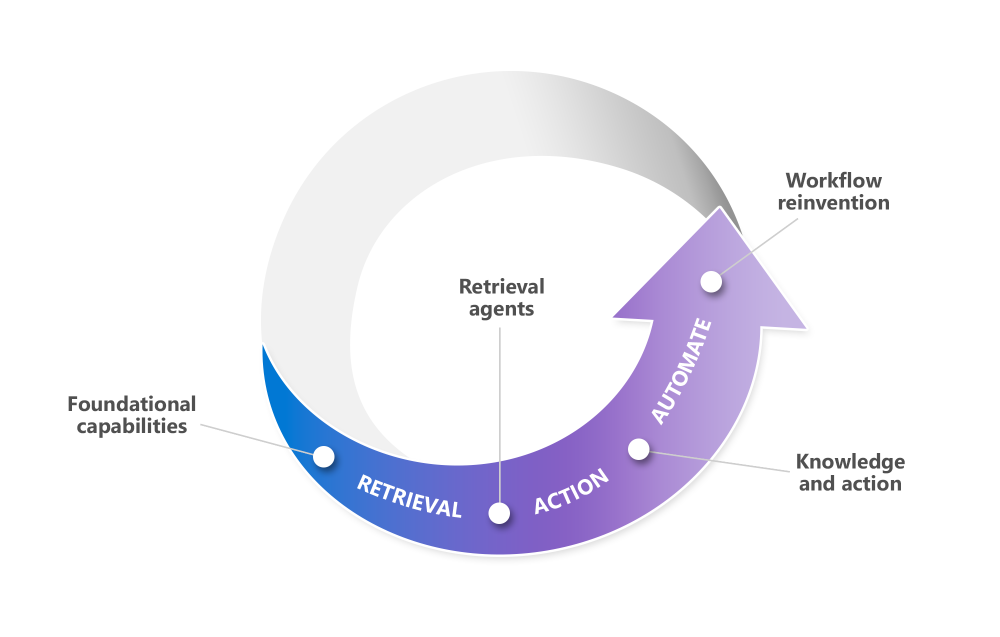
Each of these levels of agentic capability requires different tools to create and depends on different policies to govern. In the simplest terms, this involves three levels of agent, each of which can handle progressively more complex tasks:

Retrieval agents
Employees use low-code solutions like Copilot Chat or Copilot Studio agent builder, or they can access ready-made agents in Microsoft 365 or SharePoint to quickly train models and retrieve knowledge for specialized scenarios.

Knowledge and action
Powered by built-in connectors in Copilot Studio, agents go beyond simple knowledge retrieval, offering next steps and actions that help employees defragment their day-to-day experience.

Workflow reinvention
Human-led, agent-operated teams perform fully autonomous actions to complete end-to-end workflows, enabling employees to focus on the highest value work while agents take care of repetitive tasks.
While the third level of maturity is still in its initial stages, our employees and teams are already creating retrieval agents and knowledge and action agents. Because retrieval agents don’t require special tooling, we allow employees to create them at will through Copilot Chat and simplified agent builders in Copilot Studio and SharePoint.
For more complex agents intended to meet enterprise needs across lines of business or the company as a whole, our developers use more full-featured tools like Copilot Studio or Azure AI Foundry. For these kinds of agents, we apply the same rigor, reviews, and software development lifecycle (SDL) we use as part of our standard internal app development.
As you explore the different kinds of agents available to your users and decide how and where to enable them, adoption.microsoft.com provides an excellent place to start. It provides three different approaches to creating agents: Microsoft 365 Copilot, Azure AI Foundry, and Copilot Studio. Once you determine who should have access to each of these creation methods, you can follow our advice on driving adoption for this new practice.
Of course, all of this choice adds complexity, so maintaining visibility and control over the agents your employees create can be a challenge. As a result, we take a matrixed approach to creating and governing agents based on different parameters. They include the type of agent, how the user creates it, its knowledge sources, the need for custom tooling, sharing and publishing permissions, and more. It will be helpful to review our strategy in full to help you think through the different parameters behind your agents, in addition to the processes and policies you’ll need to put in place to govern them.
Keeping agents safe and effective through good governance
As you enable your employees and teams to create and use agents, you’ll need structures in place to govern these tools. At Microsoft, we incorporated elements of our tenant’s minimum bar for governance into our policies for managing agents. These measures include Microsoft Information Protection, a functional inventory, activity logging, lifecycle management, and the ability to properly isolate agents against crossing data boundaries.
Our general governance strategy operates at the container level, but agents bring extra functionality to the table. To govern these capabilities, we introduced further controls like sharing limits, breadth of knowledge sources, agent metadata, and information about an agent’s behaviors. The result is a proactive approach to governance backstopped by reactive structures that catch any issues.
As you think about governing your own agents, consider the four core principles we’ve established at Microsoft Digital.
We empower employees to create and share simple, low-risk agents
We provide a safe space and personal flexibility that allows individual employees to experiment without implicating company data or content users don’t own.
We capture and vet sensitive data flows at the enterprise level
More complex or far-reaching agents owned by teams or lines of business need enterprise documentation to account for external audits or security and privacy validation. Builders need to demonstrate that they’ve thought through the security and privacy implications of their agents, so these projects go through approval process flows similar to other professionally developed apps before we trust them with potentially sensitive data.
We protect data designated confidential or higher
We contain data flows to tenant mandates and only trust suitable storage destinations for content. That depends on the ability to gate which connectors can work with particular source data and sensitivity labels.
We honor the enterprise lifecycle
Both user-based and attestation-based lifecycles come into play. We treat agents that individual employees own like any other user-created app and delete them when that individual leaves the organization. Agents owned by teams have a lifecycle defined by the tenant and tied to attestation, the SDL, and accountability confirmations.
Once you have your governance policies and procedures in place, you can begin your rollout to users through many of the same strategies and processes we’ve discussed in this guide.
Learning from our experience with agents
Connect with relevant stakeholders
Establish early communication and collaboration with members of your security, legal, compliance, IT, and other teams who can help you define ways to configure Copilot Studio agent builder safely.
Trust and empower
Provide safe spaces with appropriate guardrails for individual employees to experiment with simple agents. Copilot Studio agent builder is a great place to start.
Expand enterprise capabilities
Empower a small number of trusted creators to experiment with more powerful agent-building tools under the close watch of IT, Governance, Security, Privacy, Data, and HR teams. This will reveal gaps in process and policy and inform future reviews.
Solidify labeling and data
Revisit your labeling structures and data flows. It will be important to have these structures in place to support this new agentic environment. Start by learning from our experience governing Copilot at Microsoft.
Extend your review process
Adapt any review processes you already have in place to agents, including security, privacy, and accessibility. Embed those reviews into your publishing workflow for agents operating above the individual level. Consider adding reviews for Responsible AI.
Prevent agent sprawl
Establish a reasonable enterprise lifecycle for agents that includes attestation. That will keep agents from sprawling or remaining in place after employees have left your organization or simply no longer need a particular agent.
Key takeaways
Use these tips as your guide as you build out and implement your adoption plan. They are based on our own experience internally at Microsoft.
1) Plan and adapt
- Connect with stakeholders on relevant teams, including Security, Legal, Compliance, HR, and IT.
- Revisit your overall governance and labeling policies and procedures and update them to reflect the needs of agents.
- Plan and document your intended review process.
- Build your matrix of agent capabilities and parameters and map governance policies and procedures to each aspect of agents.
- Decide how your SDL procedures will map to agents.
2) Run pilots with select teams
- Determine your pilot teams. IT and other teams who will be responsible for determining policy are good places to start, for example, Security and HR.
- Establish a feedback and monitoring pipeline.
- Fine-tune your review and remediation procedures based on your learnings.
3) Enable agents across your organization
- Ensure Purview DLP, Microsoft Information Protection, and other backstops are in place before widely enabling agents for users.
- Deploy adoption communications and change management efforts.
- Enable simple agent builder capabilities for your general workforce.
- Enable more complex agent creation for developers on IT and line of business teams.
Key actions
How we did it at Microsoft
- Read about how embracing the agentic future is enabling us to become an AI-first Frontier Firm. This post shares our vision for using agents to transform the workplace.
- Read how good governance is helping us ride the wave of agents washing over Microsoft. This article outlines the governance strategies we’ve adapted to the new agentic moment.
- Find out more about our deployment of Microsoft Agent 365 at Microsoft. This post shows how we’re using this new platform to manage our agent ecosystem.
- See how we’re unlocking enterprise AI extensibility with Copilot Studio. Read about Microsoft’s internal AI development initiatives and how we’re using and governing Copilot Studio.
- Learn how we’re enabling our employees to build custom retrieval agents. These agents are empowering our workers to accomplish more.
- Discover how we’re keeping our network infrastructure healthy at Microsoft with an employee-built AI agent. This article shares how our team built an agent to improve how we manage our network.
- Access our internal learnings and a step-by-step guide for unleashing API-powered agents at Microsoft. This article explains API agents and shares lessons from our journey using them internally.
Further guidance for you
- Explore the company’s official AI agent adoption guidance to plan, govern, and operate agents using proven frameworks and best practices.
- Visit the AI Agents Hub on Microsoft Adoption to access webinars, quick-start guides, and business scenarios for Copilot, Foundry, and Copilot Studio.
- Follow the Microsoft 365 Copilot Agents Deployment Blueprint to enable agents at scale with security, governance, and measurement strategies.
- Download the Agentic Automation Adoption Guide to learn migration strategies, governance models, and business value for agentic automation.
- Secure your agents at scale with Microsoft Agent 365 guidance for unified identity, compliance, and control across platforms.
- Learn about the Responsible AI policies and practices that we use to guide our use of AI at Microsoft.
Applying our deployment lessons at your company
You’ve learned from our Copilot deployment. It’s time to get started on yours.
Embarking on your Microsoft 365 Copilot deployment journey might seem daunting, but by capitalizing on the lessons that we’ve learned during our internal deployment, you can both speed up the process and avoid any pitfalls.

“Deploying Copilot internally has inspired us to dive deeper into the power of AI assistance, which is enabling us to enhance our employee experience.”
Stephan Kerametlian, business program management senior director, Microsoft Digital
By anchoring your work in careful planning and using the steps and resources provided in this guide, you can unleash a new era of productivity through Copilot.
You’re not in this alone. If you’re looking for support or knowledge on any aspect of your deployment, reach out to our customer success team.
For inspiration around ways that Copilot can become your employees’ AI assistant at work, read stories about how we’re using AI within Microsoft Digital and Microsoft as a whole.
“Deploying Copilot internally has inspired us to dive deeper into the power of AI assistance, which is enabling us to enhance our employee experience,” says Stephan Kerametlian, a business program management senior director within Microsoft Digital. “With the lessons we learned from our deployment, we’re confident that we can support businesses around the world as they achieve more through the next generation of intelligent experiences.”
Key takeaways
This guide reflects our learnings and the processes we followed during our internal rollout of Microsoft 365 Copilot. This last set of tips summarizes the major actions you can take to get started with Copilot at your company.
- Start with strong governance: Build a clear labeling and data protection strategy before deploying Copilot to safeguard sensitive information and meet compliance needs.
- Pilot, then scale: Roll out Copilot in phases, beginning with pilot groups to gather feedback and refine your approach before expanding companywide.
- Communicate early and often: Proactive communication and leadership sponsorship are essential for managing expectations and driving successful adoption.
- Empower champions: Identify and enable employee champions to share best practices, tips, and real-world scenarios that help others get value from Copilot.
- Invest in training: Provide tailored learning resources and support to help users build confidence and skills with Copilot in their daily workflows.
- Measure and optimize: Track usage, collect feedback, and continuously refine your deployment to maximize impact and uncover new opportunities.
- Plan for support: Set up self-service and human support channels early so employees can get help quickly and keep momentum going.
- Extend with agents: As your organization matures, explore agentic AI to automate workflows and unlock even greater productivity gains.
Key actions
How we did it at Microsoft
- Read our IT playbook for becoming a Frontier Firm in the era of AI.
- Review our five-step AI maturity guide for IT leaders.
- Use our detailed Copilot governance readiness guide—based on our internal experience here at Microsoft—to manage the governance of your Copilot deployment.
- Learn how our IT organization is powering our companywide digital transformation.
- View our condensed, CIO version of this guide.
Further guidance for you
- Use this technical readiness guide to manage your Copilot deployment (PowerPoint download).
- Check out this content map to help you organize your Copilot deployment (PowerPoint download).
- Find the best overall Copilot deployment and adoption guidance at adoption.microsoft.com.

