Skip to main content Why Microsoft Security AI-powered cybersecurity Cloud security Data security & governance Identity & network access Privacy & risk management Security for AI Unified SecOps Zero Trust Microsoft Defender Microsoft Entra Microsoft Intune Microsoft Priva Microsoft Purview Microsoft Sentinel Microsoft Security Copilot Microsoft Entra ID (Azure Active Directory) Microsoft Entra Agent ID Microsoft Entra External ID Microsoft Entra ID Governance Microsoft Entra ID Protection Microsoft Entra Internet Access Microsoft Entra Private Access Microsoft Entra Permissions Management Microsoft Entra Verified ID Microsoft Entra Workload ID Microsoft Entra Domain Services Azure Key Vault Microsoft Sentinel Microsoft Defender for Cloud Microsoft Defender XDR Microsoft Defender for Endpoint Microsoft Defender for Office 365 Microsoft Defender for Identity Microsoft Defender for Cloud Apps Microsoft Security Exposure Management Microsoft Defender Vulnerability Management Microsoft Defender Threat Intelligence Microsoft Defender Suite for Business Premium Microsoft Defender for Cloud Microsoft Defender Cloud Security Posture Mgmt Microsoft Defender External Attack Surface Management Azure Firewall Azure Web App Firewall Azure DDoS Protection GitHub Advanced Security Microsoft Defender for Endpoint Microsoft Defender XDR Microsoft Defender for Business Microsoft Intune core capabilities Microsoft Defender for IoT Microsoft Defender Vulnerability Management Microsoft Intune Advanced Analytics Microsoft Intune Endpoint Privilege Management Microsoft Intune Enterprise Application Management Microsoft Intune Remote Help Microsoft Cloud PKI Microsoft Purview Communication Compliance Microsoft Purview Compliance Manager Microsoft Purview Data Lifecycle Management Microsoft Purview eDiscovery Microsoft Purview Audit Microsoft Priva Risk Management Microsoft Priva Subject Rights Requests Microsoft Purview Data Governance Microsoft Purview Suite for Business Premium Microsoft Purview data security capabilities Pricing Services Partners Cybersecurity awareness Customer stories Security 101 Product trials How we protect Microsoft Industry recognition Microsoft Security Insider Microsoft Digital Defense Report Security Response Center Microsoft Security Blog Microsoft Security Events Microsoft Tech Community Documentation Technical Content Library Training & certifications Compliance Program for Microsoft Cloud Microsoft Trust Center Security Engineering Portal Service Trust Portal Microsoft Secure Future Initiative Business Solutions Hub Contact Sales Start free trial Microsoft Security Azure Dynamics 365 Microsoft 365 Microsoft Teams Windows 365 Microsoft AI Azure Space Mixed reality Microsoft HoloLens Microsoft Viva Quantum computing Sustainability Education Automotive Financial services Government Healthcare Manufacturing Retail Find a partner Become a partner Partner Network Microsoft Marketplace Marketplace Rewards Software development companies Blog Microsoft Advertising Developer Center Documentation Events Licensing Microsoft Learn Microsoft Research View Sitemap
Real people. IT professionals build and maintain the LinkedIn server farm which operates on 100% renewable energy.

How IT leaders are securing identities with Zero Trust


The past twelve months have been a remarkable time of digital transformation as organizations, and especially digital security teams, adapt to working remotely and shifting business operations. IT leaders everywhere turned to Zero Trust approaches to alleviate the challenges of enabling and securing remote work. Using Zero Trust to secure users, data, and devices (wherever they may be) has changed from optional to a business imperative overnight.
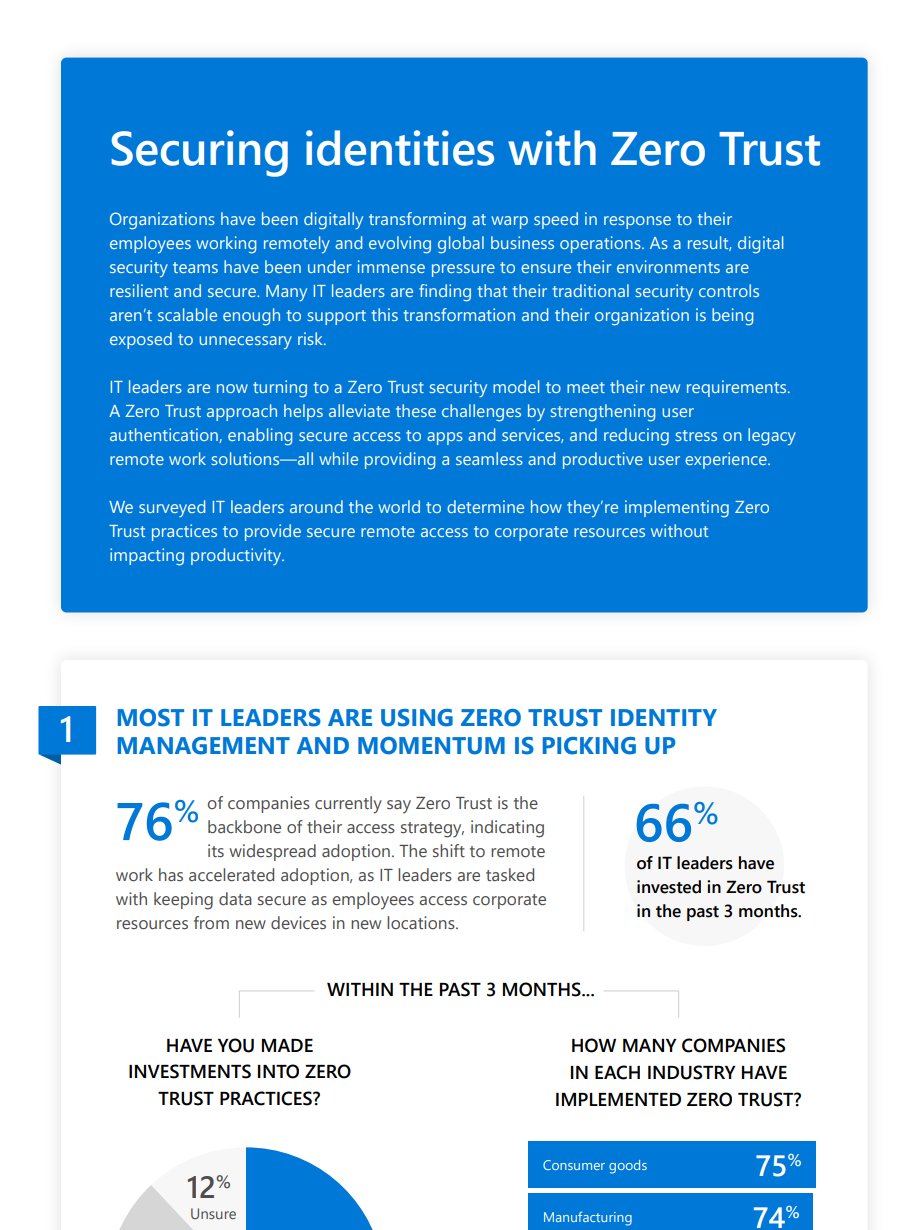
A clickable link to the full PDF infographic to the Zero Trust whitepaper

In this short report, we surveyed IT leaders around the world to determine how they’re implementing Zero Trust practices to protect their identities and ensure their employees have secure access to resources.

  1. Most IT leaders are already using Zero Trust practices with their identity management solutions. While the majority of IT leaders have already implemented Zero Trust practices into their identity and access solution, only a monitory have moved on to more advanced controls that utilize automation and AI-based threat analysis.
  2. Multi-factor authentication (MFA) and Single Sign-On (SSO) are the most common. Additionally, a majority are analyzing risk before granting access—a critical proactive step to preventing unauthorized access to corporate resources.
  3. Identities and devices are the top priority for most organizations. With employees working outside the corporate network and increasingly using personal devices, this is no surprise. However, surprisingly, the majority of IT leaders do not rate identities as the most mature component in their Zero Trust strategy.
  4. Zero Trust is still in infancy. Despite substantial growth in Zero Trust efforts over the past twelve months, only one in ten IT leaders report feeling very confident in their Zero Trust identity management roadmap.

Read the full report for more details.

If you’re looking for how to help prevent endpoints from being the weakest link in your security strategy, check out our Zero Trust deployment guidance for identities.

To learn more about Microsoft Security solutions visit our website.  Bookmark the Security blog to keep up with our expert coverage on security matters. Also, follow us at @MSFTSecurity for the latest news and updates on cybersecurity.

Related posts