Threat intelligence
The Microsoft Threat Intelligence community is made up of world-class experts, security researchers, analysts, and threat hunters who analyze 100 trillion signals daily to discover threats and deliver timely and timely, relevant insight to protect customers. See our latest findings, insights, and guidance.
Refine results
Topic
Products and services
Publish date
-
Microsoft is pleased to announce a powerful new feature in Windows to make your transition to a TLS 1. -
Bring your own LOLBin: Multi-stage, fileless Nodersok campaign delivers rare Node.js-based malware
A new fileless malware campaign we dubbed Nodersok delivers two very unusual LOLBins to turn infected machines into zombie proxies. -
Deep learning rises: New methods for detecting malicious PowerShell
We adopted a deep learning technique that was initially developed for natural language processing and applied to expand Microsoft Defender ATP’s coverage of detecting malicious PowerShell scripts, which continue to be a critical attack vector. -
One simple action you can take to prevent 99.9 percent of attacks on your accounts
Learn about common vulnerabilities and what you can do to protect your company from attacks. -
From unstructured data to actionable intelligence: Using machine learning for threat intelligence
Machine learning and natural language processing can automate the processing of unstructured text for insightful, actionable threat intelligence. -
Protect against BlueKeep
DART offers steps you can take to protect your network from BlueKeep, the “wormable” vulnerability that can create a large-scale outbreak due to its ability to replicate and propagate. -
A case study in industry collaboration: Poisoned RDP vulnerability disclosure and response
Through a cross-company, cross-continent collaboration, we discovered a vulnerability, secured customers, and developed fix, all while learning important lessons that we can share with the industry. -
How Windows Defender Antivirus integrates hardware-based system integrity for informed, extensive endpoint protection
The deep integration of Windows Defender Antivirus with hardware-based isolation capabilities allows the detection of artifacts of attacks that tamper with kernel-mode agents at the hypervisor level. -
New machine learning model sifts through the good to unearth the bad in evasive malware
Most machine learning models are trained on a mix of malicious and clean features. -
Dismantling a fileless campaign: Microsoft Defender ATP’s Antivirus exposes Astaroth attack
Advanced technologies in Microsoft Defender ATP’s Antivirus exposed and defeated a widespread fileless campaign that completely “lived off the land” throughout a complex attack chain that run the info-stealing backdoor Astaroth directly in memory -
Microsoft’s Threat & Vulnerability Management now helps thousands of customers to discover, prioritize, and remediate vulnerabilities in real time
Microsoft’s Threat & Vulnerability Management solution is generally available! -
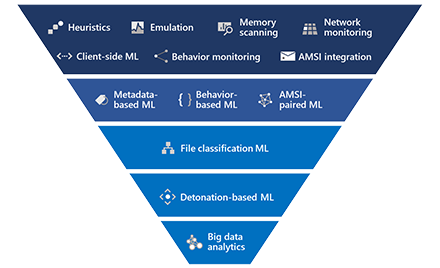
Inside out: Get to know the advanced technologies at the core of Microsoft Defender ATP next generation protection
While Windows Defender Antivirus makes catching 5 billion threats on devices every month look easy, multiple advanced detection and prevention technologies work under the hood to make this happen.