

In today’s rapidly evolving technology landscape, maintaining network reliability is paramount. Our team in Microsoft Digital, the company’s IT organization, keeps the company connected and maintains foundational network services for all our employees and guests.
With an environment comprising 100,000 network devices (including access points) and over 900 buildings (including data centers), which supports 350,000 users and over 1 million connected devices generating 300,000 incidents per year, traditional methods of network management can often be insufficient.
To operate at this scale, we’re building and deploying AI solutions that help us manage our network more efficiently, respond to issues faster, and reduce manual work. This is a critical part of our role as the team that’s responsible for powering, protecting, and transforming our digital employee experience across devices, applications, and hybrid infrastructure at Microsoft.

“As the organization that acts as Customer Zero for the company, we are leading with AI to help power Microsoft and keep things like our network infrastructure secure and reliable. We must aggressively experiment and adopt AI agents to foster innovation and model the future of service engineering.”
Brian Fielder, vice president, Microsoft Digital
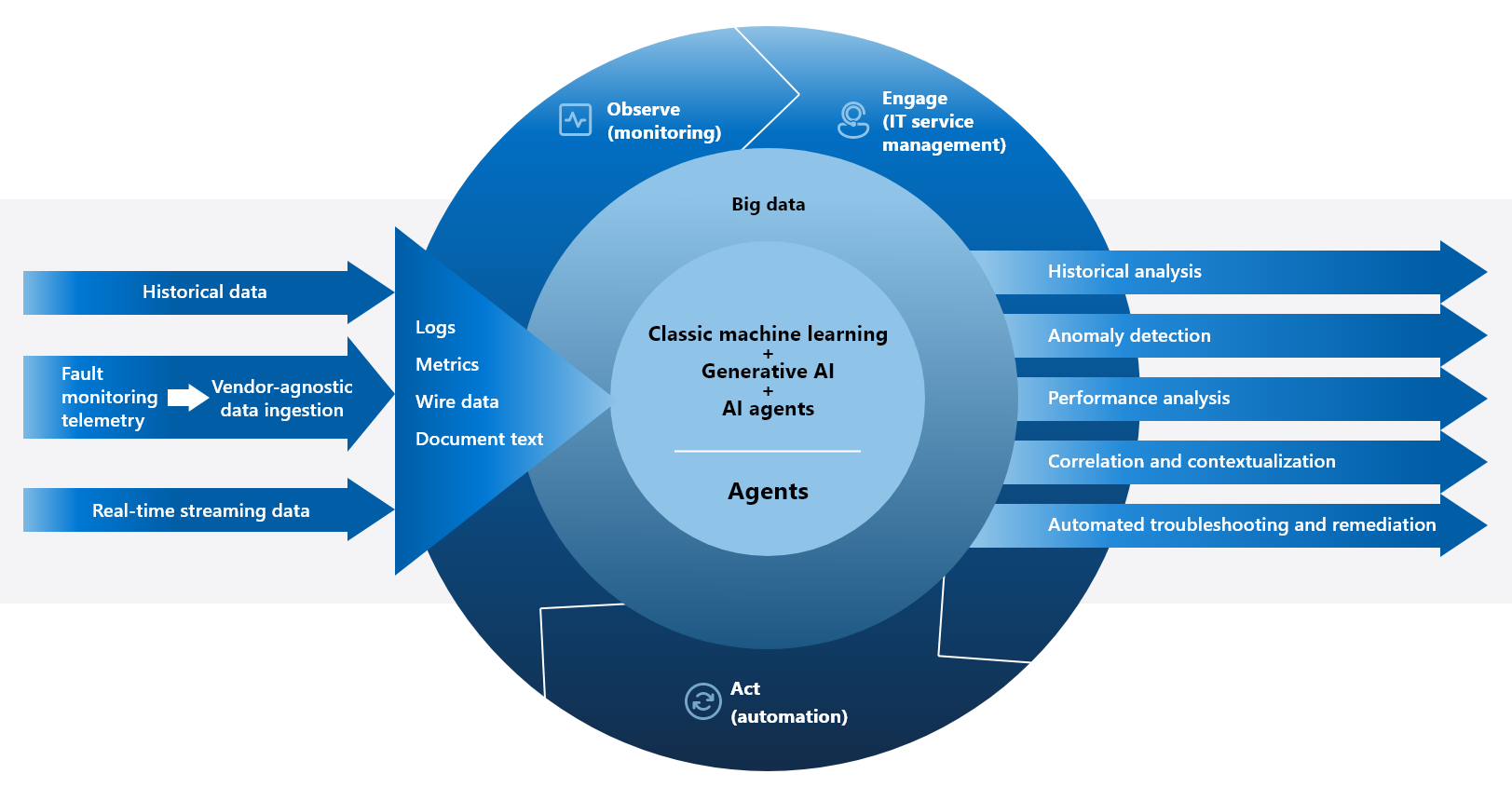
Within Microsoft Digital, our AIOps and Network Infrastructure Copilot (NiC) AI solutions have emerged as transformative new tools for enhancing network performance. These tools take advantage of AI-powered capabilities by turning data and knowledge into powerful insights and, eventually, meaningful actions to run the industry’s most secure and reliable enterprise network. They also share a common data architecture comprised of millions of telemetry points but perform unique AI functions in both running and supporting the network.
AIOps is an automation solution that uses data insights to prevent and resolve network issues before they become impactful. NiC is an interactive experience that helps network practitioners, and a variety of other personas more easily interact in natural language with complex network services to get rapid answers and intelligent suggestions.
“As the organization that acts as Customer Zero for the company, we are leading with AI to help power Microsoft and keep things like our network infrastructure secure and reliable,” says Brian Fielder, vice president of Microsoft Digital. “We must aggressively experiment and adopt AI agents to foster innovation and model the future of service engineering.”
AIOps: Transforming how we deliver operational excellence
AIOps integrates AI into our IT operations by automating and enhancing various aspects of network management. This approach significantly reduces manual intervention, allowing network engineers to focus on higher-value tasks. Key components of AIOps include:
- Automated ticketing and remediation: AIOps automates the creation and resolution of tickets, reducing the time and effort required to manage incidents. This automation is particularly beneficial in environments with high ticket volumes, ensuring timely and efficient resolution of network issues.
- Ticket noise reduction: AIOps uses AI-powered ticket correlation, suppression, and enrichment capabilities to significantly reduce ticketing noise, enabling engineers to concentrate on the most critical issues.
- Automatic remediation: AIOps executes automatic troubleshooting and remediation actions on behalf of engineers to mitigate issues and keep outage duration and the associated business impact to a minimum. This is accomplished based on troubleshooting knowledge and successful remediation steps executed.
- Postmortem report generation: AI-powered tools generate detailed postmortem reports for network incidents, providing insights into the root causes and recommended remediation steps. This capability enhances the learning process and helps prevent future occurrences.
Network Infrastructure Copilot (NiC): The everyday AI assistant
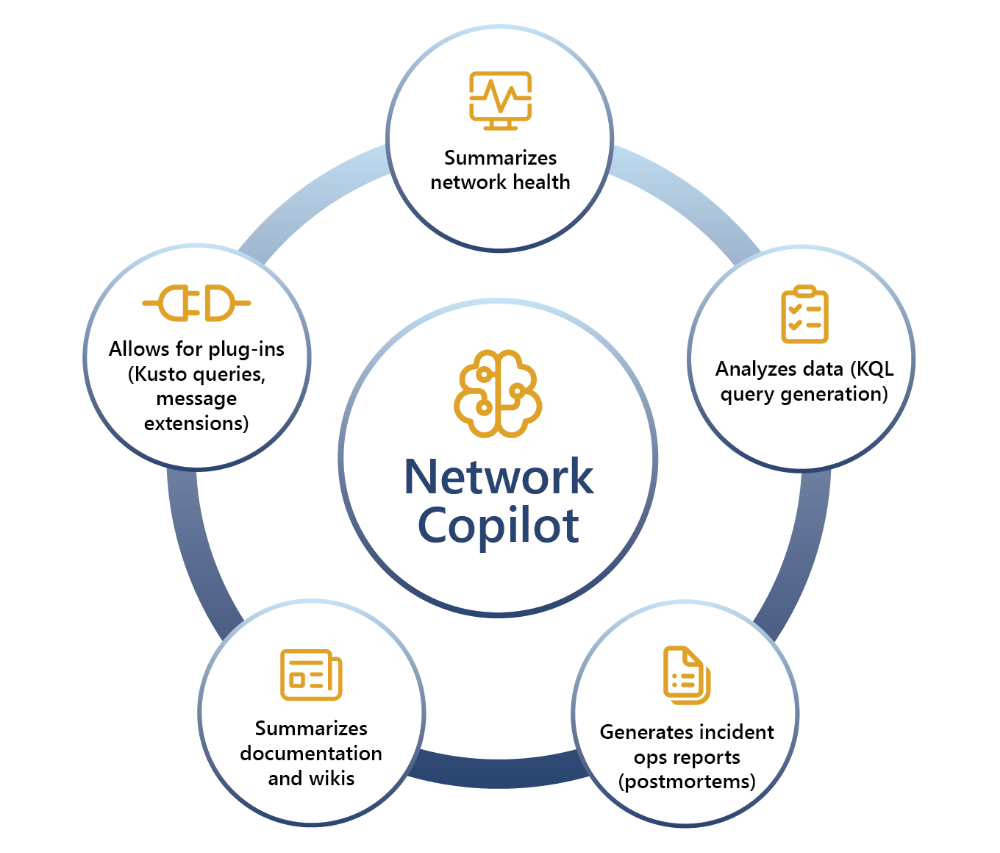
NiC is an AI assistant designed to support network engineers in managing complex network environments. NiC provides powerful data insights and documentation, enabling engineers to design, configure, analyze, and troubleshoot network issues using natural language queries. Key features of NiC include:
- Data insights: NiC helps engineers extract valuable data insights from various sources, such as wikis, SharePoint libraries, troubleshooting guides, and the infrastructure data lake (IDL). This capability streamlines data analysis and enhances decision-making to take impactful actions.
- Network artifacts interpretation: NiC understands key artifacts such as device logs and configurations, providing engineers with concise and relevant information. This capability greatly reduces the cognitive load on engineers to access and process the most critical data and insights required to manage a complex network environment.
- Simplified network observability: NiC enables non-networking personas (such as conference room technicians and facilities managers) to get quick glances at the health and configuration of their services without requiring deep understanding of network protocols and taxonomies.

“NiC and other AIOps agents have dramatically reduced the time engineers spend searching through documentation and other network artifacts to yield actionable insights, slashing effort from 25 minutes to under 5 minutes.”
Phil Suver, principal group product manager, Microsoft Digital
“NiC and other AI Ops agents have dramatically reduced the time engineers spend searching through documentation and other network artifacts to yield actionable insights, slashing effort from 25 minutes to under 5 minutes,” says Phil Suver, a principal group product manager in Microsoft Digital.

“By staying close to our teams’ real needs, we were able to turn AI opportunities into practical solutions, delivering near-term value while laying the groundwork for lasting innovation.”
Anand Meduri, principal PM manager, Microsoft Digital
Driving impact through AIOps and next-gen AI agents
These AI-driven solutions have significantly improved network reliability in several ways:
- Efficiency gains: The automation of routine tasks and the provision of actionable insights have drastically reduced the cognitive load on network engineers. In recent years, network practitioners have cumulatively saved over 20,000 hours on network infrastructure management. These efficiency gains free up engineers to focus on strategic initiatives that further enhance network performance.
- Rapid issue detection and resolution: AI-powered anomaly detection and automated remediation ensure that potential issues are identified and resolved before they impact network performance. This proactive approach minimizes downtime and enhances overall network reliability.
“By staying close to our teams’ real needs, we were able to turn AI opportunities into practical solutions, delivering near-term value while laying the groundwork for lasting innovation,” says Anand Meduri, a principal PM manager for Microsoft Digital.
Lessons learned in building and deploying AIOps agents
To deliver sustainable business value at enterprise scale, we adopted an iterative approach focused on rapid experimentation, measurable outcomes, and continuous learning. As we evolved from automation-centric operations to an agent-driven operating model, three major themes emerged:

“By embedding AIOps and AI agents into our operational fabric, we are transforming manual workflows into autonomous, scalable digital labor. This is accelerating our journey toward a human-led, Frontier Firm future.”
Suvodip Moitra, senior product manager, Microsoft Digital
- Prioritization and value realization: Not every workflow benefits equally from AI. We achieved the greatest impact by focusing on high-volume, repetitive, and time-sensitive operational activities such as incident triage, outage analysis, troubleshooting, and cross-system coordination. Prioritizing these use cases enabled us to demonstrate tangible productivity gains while building confidence in agent-led operations.
- Human-agent collaboration and change management: The transition to agentic operations required more than technology adoption—it demanded new ways of working. Success depended on positioning agents as trusted digital teammates, augmenting engineers rather than replace them. Continuous feedback loops, user engagement, and incremental rollout strategies were critical to help us drive adoption and improve agent effectiveness over time.
- Scalability, autonomous operations, and the Frontier Firm future: As our operational footprint continues to grow, we are moving from automated workflows to a scalable ecosystem of intelligent AI agents that can reason, coordinate, and act across the incident lifecycle. By embedding agents such as Smart Bonding, Outage Insights, and On-Demand Troubleshooting into daily operations, we are reducing human toil, accelerating resolution, and laying the foundation for a Frontier Firm operating model where engineers focus on strategy and innovation, while digital labor drives operational execution at scale.
“By embedding AIOps and AI agents into our operational fabric, we are transforming manual workflows into autonomous, scalable digital labor,” says Suvodip Moitra, a senior product manager in Microsoft Digital. “This is accelerating our journey toward a human-led, Frontier Firm future.”
Key takeaways
As we scaled our AI-driven network operations, we learned important lessons around automation, resilience, adoption, and enterprise readiness:
- Network operations have shifted from reactive response to intelligent automation. The combination of AIOps, AI agents, and Network Infrastructure Copilot (NiC) has evolved network operations from reactive management to intelligent automation, reducing engineer toil through actionable insights, autonomous workflows, and streamlined decision-making.
- AI is accelerating issue resolution while improving reliability. AI-powered correlation, anomaly detection, troubleshooting, and agent-led remediation help identify, diagnose, and resolve issues faster, improving reliability while minimizing operational disruption and downtime.
- Efficient AI adoption depends on more than just technology. Successfully scaling AIOps, NiC, and AI agents requires strong change management, continuous feedback loops, targeted training, and iterative refinement to drive adoption and maximize business value.
- Enterprise scale requires both resilient infrastructure and intelligent agents. Building for enterprise scale requires an architecture capable of supporting growing device and incident volumes, while at the same time enabling a network of intelligent agents that lays the foundation for a Frontier Firm operating model driven by human-led, AI-powered operations.
Try it out
Related links
- Learn how we’re transforming our approach to patch management at Microsoft.
- Take a peek inside the councils steering AI projects at Microsoft.
- Read how we’re keeping our network infrastructure healthy at Microsoft with an employee-built AI agent.
- See how we’re supercharging our network operations with an AI-based unified intelligence.
