
Posted by

video series
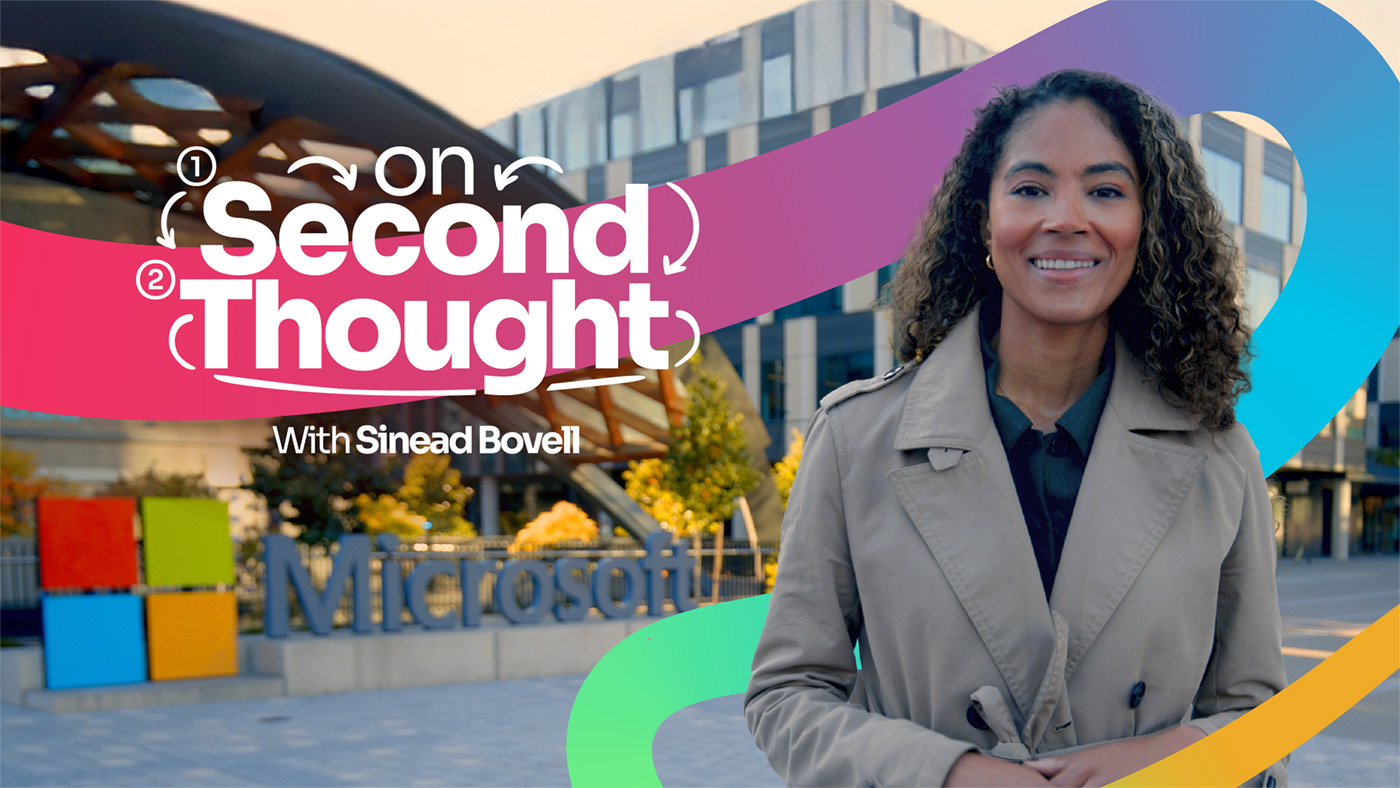
On Second Thought
A video series with Sinead Bovell built around the questions everyone’s asking about AI. With expert voices from across Microsoft, we break down the tension and promise of this rapidly changing technology, exploring what’s evolving and what’s possible.
During an afternoon open house held at the Microsoft Innovation & Policy Center in downtown Washington, customers, academia, and governmental officials will get an opportunity to explore the trends and technologies Microsoft Research expects to change the face of computing.
“At Microsoft, investing in research and development are top priorities as we continue to spark American innovation while creating the jobs and technologies of the future,” says Fred Humphries, Microsoft vice president of U.S. Government Affairs. “From pushing the boundaries of computing beyond the screen to helping make sense of large-scale data sets for scientific discoveries, we’re excited to share the latest innovations from Microsoft Research with the D.C. community at TechFair.”
Attendees of the TechFair will learn more about multiple ways researchers are tackling big-data problems to deliver powerful visual insights. Other research being shown encompasses projects that address challenges in education, health care, and the environment.
One of the research projects at the event literally brings a new dimension to the now-familiar touchscreen. Titled Actuated 3-D Display with Haptic Feedback, the project builds on the touch experience enabled on flat, 2-D surfaces by introducing pressure sensitivity to enable interaction of 3-D environments.
A second TechFair project, (opens in new tab), explains work done at Microsoft Research New York City (opens in new tab) to develop a quantitative notion of what it means when something on social media “goes viral”—and enables visitors to explore how such incidents are diffused across the web.
Other demonstrations on display during the 2013 D.C. TechFair:
-
: How intelligent tutoring systems can enhance the educational experience, in the classroom and online.
-
-
: A 3-D surface-reconstruction technology that enables quick, affordable, easy creation of accurate 3-D renderings of people and objects.
-
: Enables the visual display of geographic and temporal data in 3-D and the creation of “tours” of the data that can be shared with others.
-
: A novel method for capturing and reconstructing dynamic, 3-D scenes in real time.
-
: A web-based visualization system that exploits 3-D hardware acceleration to explore relationships between hundreds of thousands of items.
-
: A novel way of telling a story using interactive information-visualization techniques to create personalized, expressive data charts quickly and easily.
During the session, sponsored by the Computing Research Association, the panelists will discuss their visions for the next generation of new products, user experiences, and technological insights, and they will delve into the IT innovation ecosystem; the role of computing research in industry, academia, and government; and the potential societal value and economic impact of emerging research discoveries.
It will be a full day of activity in D.C., one that is sure to be educational and fascinating all around.