
Using AI to assist in rare disease diagnosis
New research from Microsoft, Drexel, and the Broad explores how generative AI could support genetic professionals in rare disease diagnosis.
Semantic Telemetry helps LLMs run efficiently, reliably, and in near real-time. Learn about the engineering behind that system, including the trade-offs and lessons learned along the way—from batching strategies to token optimization and orchestration.
In this issue: our CHI 2025 & ICLR 2025 contributions, plus research on causal reasoning & LLMs; countering LLM jailbreak attacks; and how people use AI vs. AI-alone. Also, SVP of Microsoft Health Jim Weinstein talks rural healthcare innovation.
Join us at CHI 2025 to explore how AI systems can be used as Tools for Thought as we reimage AI’s role in human thinking. Learn about new research, prototypes, and a workshop on designing AI that supports critical thinking, decision-making, and creativity.
Semantic Telemetry Project data show that people who use AI for more professional and complex tasks are more likely to keep using the tool and to use it more often. Novice AI users engage in simpler tasks, but their usage is becoming more complex.
In this issue: We introduce a new dataset designed to assist renewable energy infrastructure planners, a new method for denoising MRI imagery, and an AI tool for analyzing distant galaxies. Check out our latest research and other updates.Â
In this issue, we examine a new conversation segmentation method that delivers more coherent and personalized agent conversation, and we review efforts to improve MLLMs’ understanding of geologic maps. Check out the latest research and other updates.
New Research | FLASH: Workflow automation agent for diagnosing recurring incidents; METAREFLECTION: Learning instructions for language agents using past reflections; Boosting LLM training efficiency through faster communication between GPUs; and more.
In this issue: Research Forum Ep. 4 explores multimodal AI. Registration is now open; Surveying developers’ AI needs; SuperBench improves cloud AI infrastructure reliability; Virtual Voices: Exploring factors influencing participation in virtual meetings.
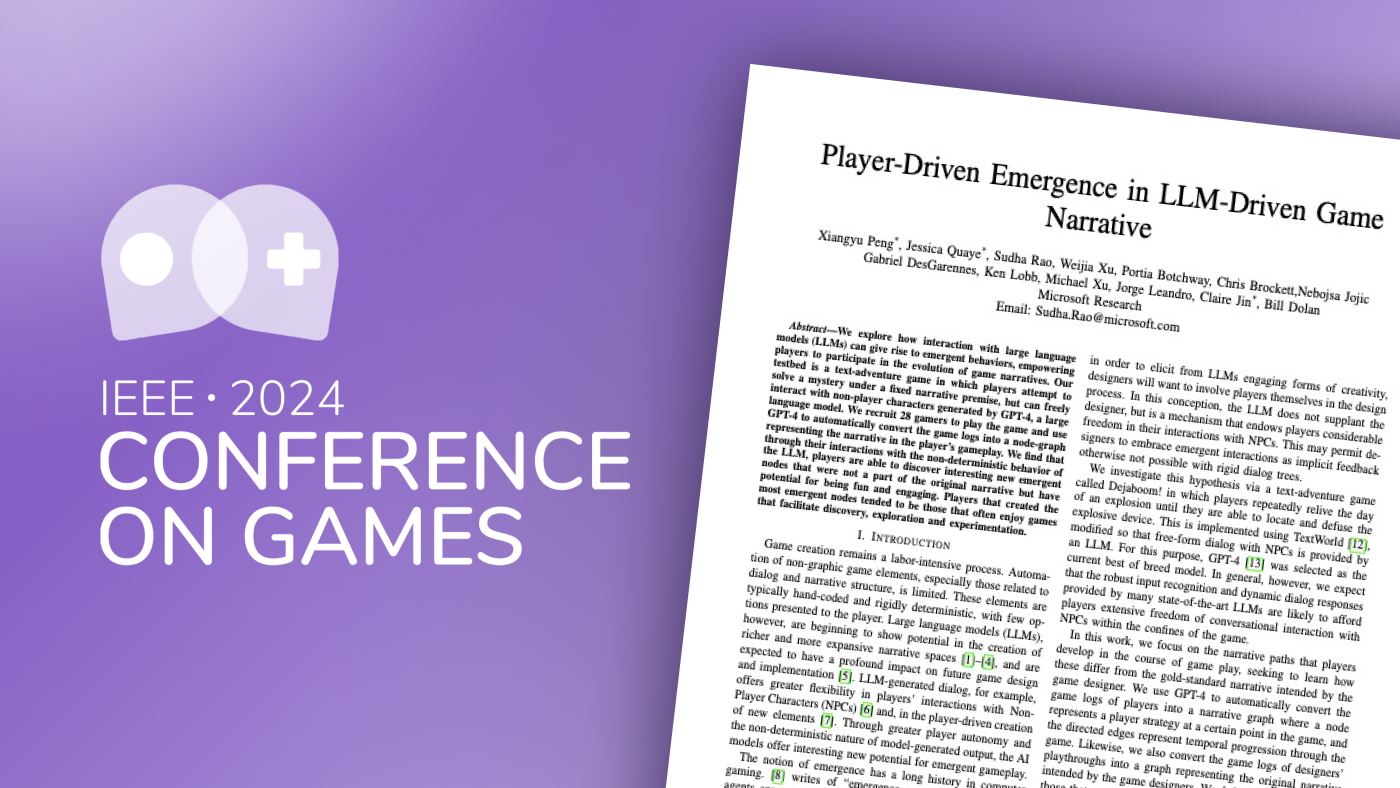
Integrating LLMs in video game development can create dynamic and interactive narratives. By involving players in the narrative design process, LLMs can generate unique player-driven strategies and provide valuable feedback for game designers.
In this issue: Skeleton Posterior-guided OpTimization (SPOT) exhibits potential in various causal discovery tasks; Using visual imagery for an EEG-based brain–computer interface; Developing human-centered AI systems to assist creative professionals.
In this issue: RENC makes 5G vRAN servers more energy efficient; CoExplorer uses AI to keep video meetings on track; Automatic bug detection in LLM-powered text-based games; MAIRA-2: Grounded radiology report generation.
Meet our community of researchers, learn about exciting research topics, and grow your network
Ongoing conversations at the cutting edge of research
Join us for a continuous exchange of ideas about research in the era of general AI