
By Suzanne Ross, Writer, Microsoft Research
Hugues Hoppe is a quiet man. He sits quietly, he talks quietly, and his smile, which he uses often, is as calm as Mona Lisa. For such a quiet man, he’s made himself heard in the world of graphics research.
ACM SIGGRAPH has recognized his achievements with a Computer Graphics Achievement Award for his work in progressive meshes, surface reconstruction, geometry texturing and geometry images. The award is a lifetime achievement award, and is given to researchers who have made significant contributions to the graphics world.

Azure AI Foundry Labs
Get a glimpse of potential future directions for AI, with these experimental technologies from Microsoft Research.
Hoppe has always found computers fascinating, though he didn’t immediately decide to study computer science. “I used to think computers were only a means to an ends, so I went into electrical engineering. But I was drawn to the computer science classes, so I switched over to computer science in graduate school,” said Hoppe.
In those days, he used a laser range scanner to reconstruct digital images. The scanners are still the method of choice today to acquire models of real-world objects.
“They split the laser into a sheet and swung it across the object. A camera off to the side recorded the pattern of the laser on the surface. Through triangulation you could infer the depth of the object. You end up with a dense cloud of points. My original work was reconstructing surfaces from the point clouds,” said Hoppe.
Around the time that Hoppe was starting his career, a group from Stanford University went to Florence to scan Michelangelo’s David. They needed meshes with billions of triangles to reconstruct the David digitally.
“The complexity was so huge that it became unmanageable,” explains Hoppe. “One of my first jobs when I came to Microsoft Research was to figure out a way to simplify this. That was what led to progressive meshes.”
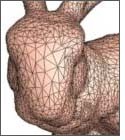 Hoppe’s work in progressive meshes was groundbreaking in the graphics world. Objects in computer graphics are represented by triangles in a mesh pattern. Early work used millions of the triangles, which made rendering an object very slow and expensive.
“The basic idea with progressive meshes was to simplify the geometric model by reducing the number of triangles needed, and thereby improve the speed of rendering. When the computer has to process millions of triangles, the frame rate slows down. This was especially important in the early 90s, when graphics hardware was not as fast as it is today. But it’s still important, because developers want to render as much as they can in a frame. Real-time games require 60 frames per second, which is very fast. Progressive mesh technology allows more characters and more complex environments in a game without losing robustness.”
With progressive meshes, you could simplify the graphic models once, and then store the history of the simplification. Each step in the process applies a tiny perturbation to the mesh. Hoppe’s method records all of the changes so that they can be played backward to reintroduce as much detail as needed.
Further work on progressive meshes produced what Hoppe calls Geo (Geometry) Morphing. This technique allows a smooth transition as the level of detail changes. Before the technique, the image would appear to ‘jump’ as the object was rendered.
This year, Hoppe has three papers accepted at SIGGRAPH, the uber conference for graphics researchers. The one he is most excited about is Geometry ClipMaps (opens in new tab).
“I’m fascinated by rendering large environments and huge worlds. This technique is a way to render terrains that allows you to traverse through the world.”
 Hoppe has produced a giant grid of the United States using elevation data sampled every 30 meters. “The challenge is how to convey this geography to the user very quickly. The concept we’ve come up with is to use regular grids that vary with the distance from the viewer. They mirror real-world geometry – things that are farther away have the same size in screen space as they would in real world space. If we didn’t do that, then the things that were further away would have too much detail. That isn’t necessary, and it would be expensive to produce.
As the viewer ‘flies’ around the world, the grids move and adapt the meshes to the distance from the viewer.
“Before, people tried to adapt to the geometry of the terrain instead of the entire world. So if they had mountains, they would place more triangles in the mountains, and if they had plains they would have fewer triangles. At the time it was advantageous. But the drawback is that you have to update the triangulation every frame. Now that the graphics hardware is faster, the ‘brute force’ approach becomes more appropriate. You no longer have to fine-tune things locally. The geometry clipmap is a regular grid structure, very much like an image, like a digital photograph with a 2D grid of samples.”
Hoppe’s new work is very different from progressive meshes. “Progressive meshes is in the other direction, it’s from a time when graphics hardware was slower. Before, you wanted these highly irregular meshes and the CPU did more of the work than the GPU. Now the technique and philosophy has shifted. You have to be ready to adapt to the hardware changes.”
Another paper that he will present at SIGGRAPH is called Digital Photography with Flash and Non-Flash Pairs. This work studies how two photographs can be combined to produce a better image. Flash pictures can show a lot more detail in a poorly lighted environment. However, there are drawbacks. Flash pictures also create red eyes and the details don’t look as natural as they would in sunlight. By combining the best parts from a flash picture and a non-flash picture, Hoppe’s techniques produce the sharpest image possible.
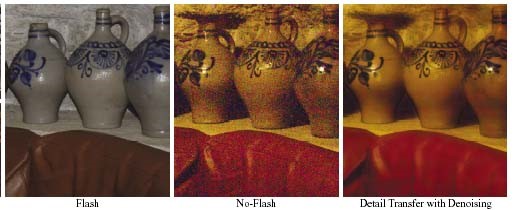 In addition, the technique allows automatic red-eye reduction. Because it’s rare to have an object other than an eye turn red in a flash picture, the program can identify areas that have appeared dark in the non-flash picture, and red in the flash picture. It can then automatically correct red-eye by integrating the non-flash eye into the flash version.
Though Hoppe is well-known in the graphics world for his work in progressive meshes and reconstructing surfaces, he has another claim to fame known mostly to his professors and classmates at the University of Washington.
In the days before Halo and Xbox, Hoppe designed a mesmerizing game he called Dog Fight. Gamers today would scoff at the simple black and white game, but those were the days before progressive meshes and other state-of-the-art techniques.
Students and professors challenged each other to Dog Fight matches after class, and many logged hundreds of hours playing the game. It might even be that Hoppe’s game catapulted computer science students into developing better and better methods to make game-playing faster in more realistic environments.
Hoppe’s award citation praises him for his work in the graphics field over the past ten years. He has co-authored 20 papers at SIGGRAPH, and several of his papers have been considered milestones that have set the trend in the field.

 Graphics and multimedia