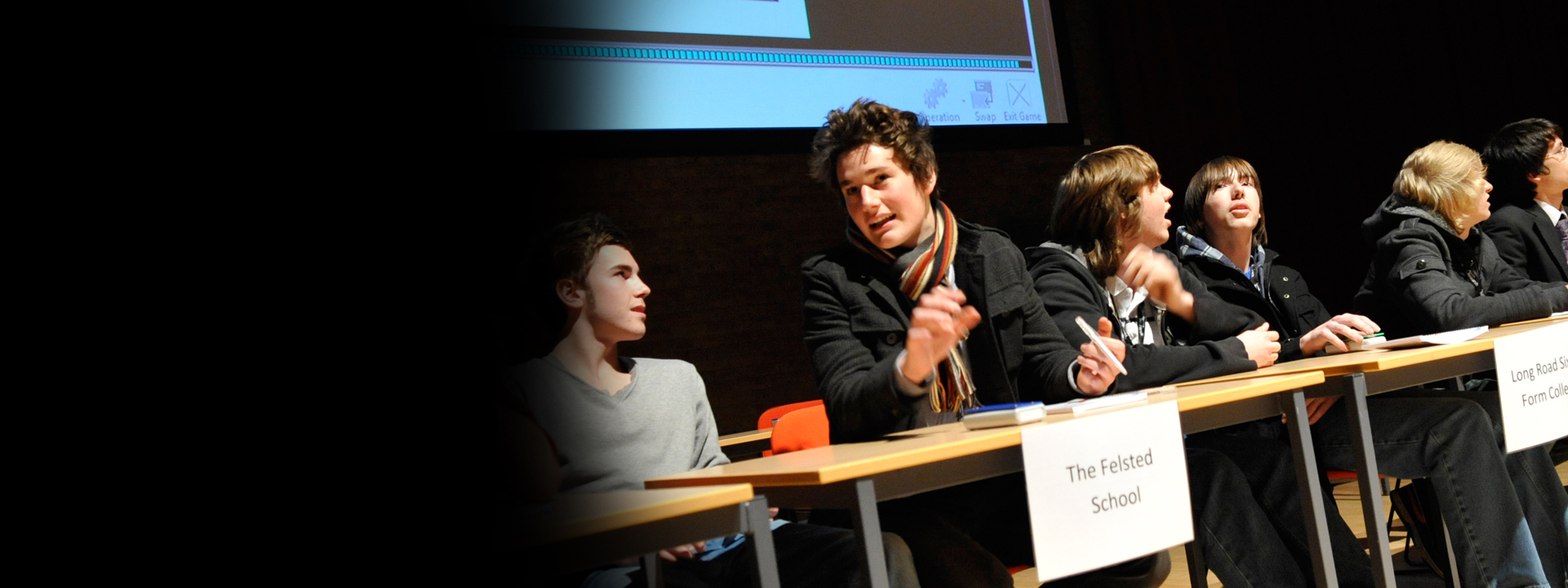
Think Computer Science 2010
Location: West Road Concert Hall, Cambridge
The Magic of Computer Science
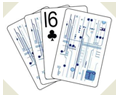 Learn some clever conjuring tricks and try to work out how they are done. Then discover how the same techniques that make the ‘magic’ work are responsible for some of the most interesting computer science applications around.
Kinect for Xbox 360
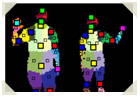 The new gaming experience from Xbox contains technology that was developed at Microsoft Research Cambridge. Principal Researcher Andrew Fitzgibbon will be giving a talk on the science behind Kinect and how Microsoft Research contributed to it. This demo is your opportunity to see the science in action and try out the finished product.
3D Segmentation of Images
 Our researchers are exploring more effective ways of segmenting 2D images, extracting an object from the background and altering the depth of different object parts to create a 3D image. We will demo an application that can produce images that can be inserted in existing 3D scenes or visualised on a 3D display. It is hoped that this application will be the basis of future features in Microsoft Office.
Embracing Uncertainty
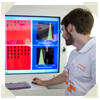 Scientists have worked for decades to try to create intelligence in computers. Traditional approaches relied on hand-crafted solutions and had limited applicability. New techniques being developed at Microsoft Research Cambridge and other institutions around the world are based on computers which can learn for themselves by analysing large sets of data. This capability is known as machine learning. This demo features some of our Machine Learning projects including medical imaging, a movie recommender, a drug trial, LiveObject and background removal.
A Ferromagnetic Interface
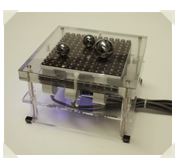 This demo shows a novel hardware device based on ferromagnetic sensing, capable of detecting the presence, position and deformation of any ferrous object placed on or near its surface. Compared to existing sensing technologies, this device has the advantage that users can easily reconfigure the interface, tailoring it to their individual needs. You can interact with the device using a variety of objects to control a virtual sculpting application and also using the device as a musical interface.
Memory Making System
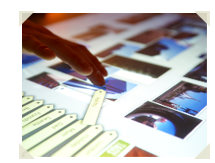 The Memory Making System examines the issue of family archiving and presents a system designed to enable families to capture, manage, create, and store new kinds of digital memorabilia. The system, using a Surface table as its hub, shows how families can upload photos and videos quickly and easily, and also scan in physical memorabilia, such as children’s artwork or a child’s first pair of shoes. The system enables families to view these media in many flexible ways and to create new, compelling kinds of digital objects, such as multimedia scrapbooks and even a digital piñata. We further will show how this system would fit into a larger ecosystem of devices in the home and link to new kinds of media displays.
Terminator: Making sure that programs don’t hang
 Here’s an example of a python program that never terminates:
def loop (x):
print “hogging your machine”
loop(x)
You wouldn’t deliberately want to write such a program. In fact, the software that controls your mouse or keyboard definitely needs to terminate, otherwise your computer would hang or ‘crash’. We’ll demo a tool that proves that industrial software isn’t going to hang.
Designing DNA computers
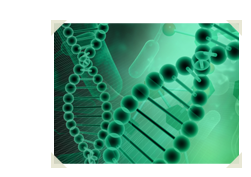 DNA is the primary means of data storage within the cells of our bodies, but it can also be harnessed to perform computations on data. DNA computers could perform highly parallel computations as well as interfacing directly with biological systems such as living cells. This makes them ideal for medical applications such as smart drugs which detect whether a particular cell is infected with a disease and respond in some way, for example by releasing an antidote or killing the cell. We have designed a web-based tool for designing DNA computers and analysing their behaviour.
The F# Programming Language for .NET.
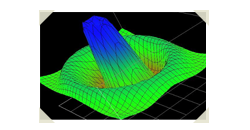 What does F# offer to Computer Science students? First, it is the language. F# combines functional (e.g. OCAML and ML) and object-orientated (e.g. C# and Java) styles of programming. The ML languages are expressive, popular in universities but have been hard to learn. The F# tools help overcome this and make F# both accessible and fun!
Second, F# has direct access to many libraries through the .NET Framework. The combination makes F# a great option for student projects and beyond!
Depth shadows: moving on up from touch screens
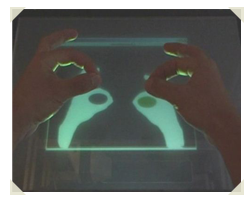 Touch screen technology has boomed in recent years and now features in many of our everyday devices. While interactive surfaces have many unique and compelling qualities, the interactions they support are bound to the display surface. In this demo we present a device where users can switch between interacting on a table top surface to above it, to allow more intuitive manipulation of digital content in three dimensions. Come and see how virtual objects can be ‘picked up’ off the tabletop surface to manipulate their position.
RipOff!
Cooperation and competition are two cornerstones of our social lives, but sometimes they push us in different directions. Researchers at Microsoft Research have come up with an online game called “Ripoff” that demonstrates just that.
In Ripoff, each player is assigned a “weight” (between 0 and 1) and players have to try and form teams with a total weight of at least 1 to win a £1 reward. But there’s a catch! Before the reward is given, the team members have to agree how to share it. Each player chooses their desired share and if these add up to more than £1, the game continues, prompting further negotiation. When negotiations reach the point where the reward shares add up to £1 or less, each player in the team gets their share and the game ends. Sounds easy? Not when it’s all over in seconds!
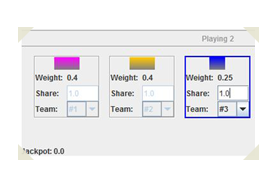
The goal is to get as much money in your jackpot after a large number of games. Come and see whether you’ve got what it takes to ‘Ripoff’ our artificial intelligence software (sorry, no real money is at stake)!
Building Windows Phone 7 Apps
Find out how you can build apps for Windows Phone 7.