
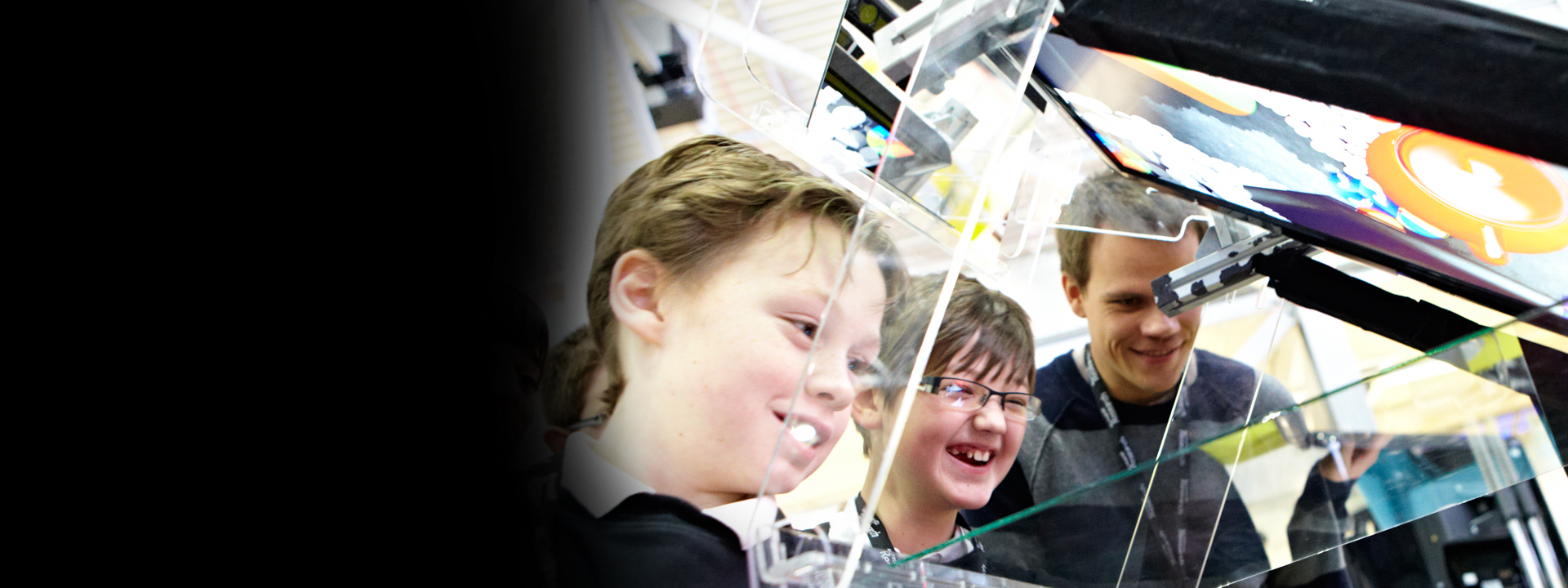
Think Computer Science 2011
Location: Imperial War Museum Duxford
Audio Reactive Particle Generator
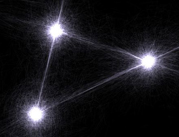 This is a demonstration of a real-time interactive multi-touch particle generator which is reactive to sound. The system, which is put together using different source code online and assembled in openFrameworks, is a fun abstract illustration of how computer generated visuals can react to audio. The system reacts to sound and touch in real-time, animating a vast amount of force-sensitive particles using physics-based commands. Using a multi-touch track pad, it is possible to create ‘magnetic’ nodes that pull these particles towards them. Sound input then affects the direction of the particles perpendicular to the magnetic force of the nodes.
Behavioural Game Theory Experiments on Facebook
 Game theory studies how humans behave in strategic situations. It makes strong assumptions and ignores key aspects such as our emotions, our limited capacity to reason and our biased judgments. Behavioural game theory (BGT) attempts to do better using insights from psychology, sociology and cognitive science. But how can we scale up BGT’s small scale lab experiments to thousands of participants? We propose using Facebook as a large-scale game theory lab, investigating the famous game ‘Colonel Blotto’. Two opposing generals allocate 100 troops across 5 battlefields. Without knowing what your opponent does, how should you allocate your own troops to overwhelm them in as many battlefields as possible? We deployed the Facebook application ‘Project Waterloo’ which allows users to play the game. Based on this data, we analyse how social relations affect players’ strategies. Come see how Facebook can help us understand human behaviour and help you become a master strategist!
Computing the Natural World
 In its short history, the science of ecology has uncovered an amazing amount about different parts of the natural world: most predators are starving most of the time, most plants on land aren’t eaten but most plants in the sea are, animals forage intelligently… but how does this all fit together!? And what does it all mean in terms of what humans are doing to the planet?
Microsoft Research uses large-scale computing to understand the natural world, and predict the consequences of human actions. We are assembling global-scale models of ecosystems, creating tools to track animals in their daily lives, and using statistics to predict the effect of climate change.
Emotionally Intelligent Interfaces
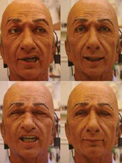 When people talk to each other, they express their feelings through facial expressions, tone of voice, body postures and gestures. They even do this when they are interacting with machines. These hidden signals are an important part of human communication, but most computer systems ignore them. A major challenge for human-computer interaction is to appreciate emotions as part of the context in which man-machine communications are conducted. Much of our time is spent communicating with embedded and conventional computer systems, and these systems need to be equipped with the same emotional intelligence that informs human communications.
One particular application is in monitoring the operators of command-and-control systems. We use remotely-controlled quad-rotor drones for experimental studies. They are more realistic and natural than simulators but still allow the operator to be monitored in a laboratory setting.
We are also interested in computer systems that can display emotional expressions. Our robotic android head (pictured above) has two dozen motors simulating muscles, allowing him to mimic subtle facial expressions. We are currently investigating its use as an intervention for children with autism spectrum conditions.
Presented by: University of Cambridge
Geometry in Action
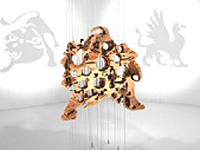 The 3D world around us is complex and often cluttered. We, as humans, find it second nature to easily reason about our surroundings, understand the function and purpose of most objects, and navigate the world accordingly. Performing the same computationally remains challenging. In one area of study, we use a branch of mathematics called geometry to create a range of applications such as intriguing 3-D art pieces, cost-efficient building designs and a better understanding of the growth laws of organic forms, e.g., nautilus or sea-shells.
Presented by: University College London
HoloDesk
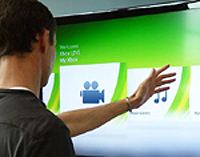 Holodesk is an exciting display that allows you to interact with virtual objects. You can hold a ball in your hands or knock over a tower of blocks without actually touching anything! The system uses a special see-through display, a mirror, a Kinect camera and some novel programming to create the illusion that you are interacting directly with objects. Much excitement has been created by Holodesk, as it has the potential to make futuristic scenes from famous sci-fi movies, a reality.
Kinect-Based Gesture Controlled Media Player
This interactive demo illustrates a real-time gesture recognition system that is based on machine learning and is running on top of the Kinect full body skeletal tracking pipeline. The demo system shows a gesture-controlled media player that recognises 22 separate gestures and maps these to eight control actions such as increasing the volume, stopping the music, and skipping to the next track. This gesture recognition system was deployed in the recently released Xbox game, Kinect Sports: Season Two.
KinectFusion
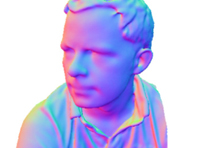 After its release a year ago, Kinect’s potential for use outside of gaming was quickly recognised and the technology has been used in many different ways. KinectFusion explores one of these alternative uses. It can create real-time, high quality 3D models – rapidly scanning environments or people in a way that’s never been so quick, easy or inexpensive. The possibilities for future uses are very exciting. Imagine being able to scan your house and place virtual objects in it so you can interact with them! Come and see how well the system can produce a 3D model of its surroundings and maybe even you!
The Magic of Computer Science
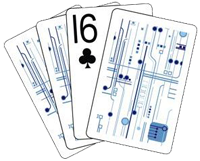 The Magic of Computer Science Learn some clever conjuring tricks and try to work out how they are done. Then discover how the same techniques that make the ‘magic’ work are responsible for some of the most interesting computer science applications around.
Presented by: CS4Fun
Microsoft Student Tools
Check out cool tools and resources and try out a Windows Phone.
-
- www.dreamspark.com: DreamSpark provides professional-level developer and design tools to students and educators around the world at no charge. These Microsoft tools will help you advance your learning and skills through technical design, technology, maths, science, and engineering activities. Schools, Vocational and Trade Schools, Community Colleges, and Universities are all eligible to participate in the DreamSpark program. Simply put, any accredited school around the world is eligible.
- www.facebook.com/microsoftukstudents: Welcome to Microsoft UK Students: the place to talk tech, share your knowledge, and find information to stay ahead of the curve. If you’re looking for the technology that’s making waves across the Web, you’ve come to the right place
Nao Robot Interactions
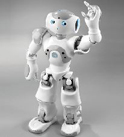 Come and meet and interact with a Nao Robot using Microsoft technologies.
Presented by: Aldebaran Robotics
.NET Gadgeteer
 .NET Gadgeteer is an exciting new platform that allows you to build and program your own gadgets. Even someone with little or no electronics background can build devices made up of components like sensors, lights, switches, displays, communications, motor controllers, and much more. Just pick your components, plug them into a mainboard and program the way they work together.
Secondlight
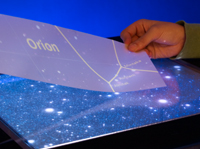 SecondLight is a surface-computing technology that can project images and detect gestures ‘in mid-air’ above the display, in addition to supporting multi-touch interactions on the surface.
It works by using an electrically switchable liquid-crystal diffuser as the rear-projection display surface. This material is continually switched between diffuse and clear states, so quickly that the switching cannot be detected. When it is diffuse, the system behaves like a regular surface computer, but when clear, it is possible to project into the area above the display surface. This enables magical new forms of interaction in which the user interface is no longer bound to the display surface, but becomes part of the real world.
Technology Heirlooms
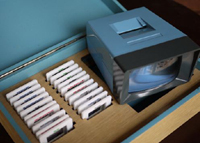 We are showing three prototypes that explore what all the digital things you are creating today – your photos, status updates and other items – will say about you in 30 or 40 years.
What would you want to keep for the future? How will you reminisce about your past with these items when you are older? What kind of digital legacy will you leave behind?
Top Secret
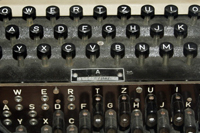 Top Secret Codes and ciphers have been a feature of warfare since the middle ages, but it was not until telegraphic and radio communication became a reality that they really came into their own.
Messages from the German Enigma and Lorenz cipher machines proved very difficult to crack, but eventually machines such as the electro mechanical and electronic Bombe and Colossus helped in the effort and laid the foundations for modern computing. On display will be an original Enigma machine next to the Eurofighter Typhoon, which incorporates some of the latest computer control known as Fly-by-Wire. So come and find out more about the prehistory of computers and their modern applications in aviation.
Presented by: Imperial War Museum Duxford
Where it all began
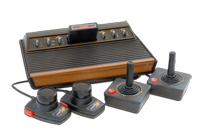 We’re all used to seeing film-like graphics and hearing studio sound quality in our games, but go back just 35 years and most families didn’t even own a computer or a games console! Computers have totally revolutionised our lives and infiltrated nearly every aspect of our working life. Our display gives you the opportunity to experience the machines that started the home computing revolution way back in the seventies! Come and play Space Invaders and Pac man or try your hand at programming the computers of yesteryear…
Presented by: The Centre for Computing History