
Think Computer Science 2013
Location: Imperial War Museum Duxford
Analysing Sporting Performance & Movement
Learn how to use the very powerful, free, open-source Tracker and GeoGebra software to capture sporting movement in football, tennis and racing cars!
Presented by the Cambridge Centre for Innovation in Technological Education
Animating Emotions
When people talk to each other, they express their feelings through facial expressions, tone of voice, body postures and gestures, and they even do this when they are interacting with machines. We will be demonstrating a program that takes a photograph of the user’s face and then animates it to demonstrate different emotions.
Presented by the University of Cambridge Computer Lab
Biological Programs in Stem Cells
You started out life as just single cell – a stem cell – and now you have just shy of a quadrillion adult cells. So, how did you get your heart, your liver, your lungs and your hands? Come and see how Microsoft Research are uncovering the biological program in each and every stem cell.
Build a Digital Camera
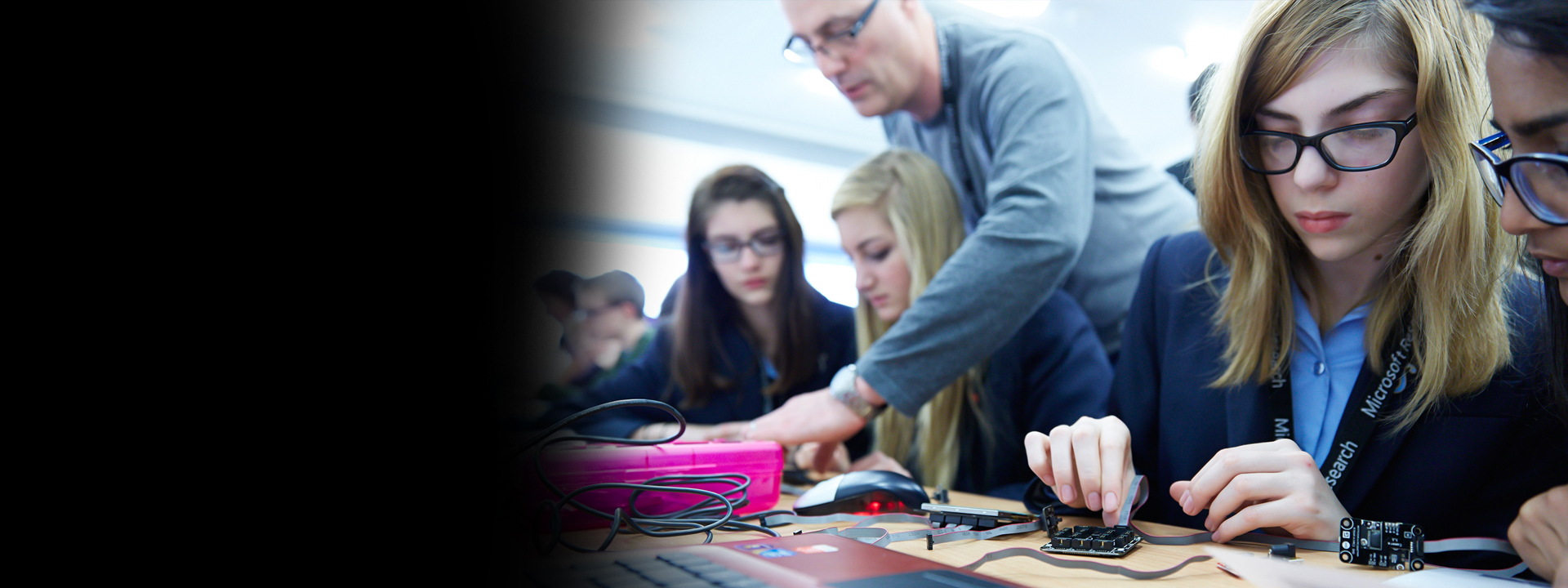
With .Net Gadgeteer you can design and build digital devices. See how to build a digital camera and explore other devices built with .Net Gadgeteer like the Robo-Float, the Underwater Remotely Operated Vehicle and the .Net Gadgeteer Arcade machine.
Computing At School (CAS)
CAS is an organisation which supports teachers who teach, or plan to teach, Computing in school. If you are a teacher, come and find out more about how to get involved with CAS and how CAS can help you.
Presented by the Computing and Schools Network (CAS)
DreamSpark Devices Showcase
See the latest Windows 8 and Windows Phone devices. Learn about DreamSpark, a Microsoft Programme that supports technical education by providing access to Microsoft software for learning, teaching and research purposes.
Freehand Gesture at the Desktop
This is a different kind of user experience for the PC that uses Kinect to recognise hand gestures as input commands. The system, which works alongside the keyboard and mouse is based on research into how people do document work in the physical and digital world.
Monitoring Operators
Much of our time is spent communicating with embedded and conventional computer systems, and these systems need to be equipped with the same emotional intelligence that informs human communications. We use remotely-controlled quad rotor drones for experimental studies of people operating command-and-control systems.
Presented by the University of Cambridge Computer Lab
Peering into the Human Body
See how computers help us to have new flexibility to visualise, locate and recognise parts of the human body so that clinicians can treat patients quicker and more efficiently.
Print Your Own Circuits
See how we instantly print conductive traces onto regular photo paper with a normal inkjet printer, then add electronic components with double-sided tape to quickly build all sorts of electronic circuits.
Robots, Ping Pong Ball Guns and Other Bizarre Contraptions
Join the Cambridge Science Centre, MathWorks and the Cambridge Design Partnership to explore the application of computing and creative engineering. Featuring robotic componentry of the world’s most overly complex machine ever designed to blow out a candle.
Presented by the Cambridge Science Centre and Partners
Sonic Pi
Tools such as the Raspberry Pi are being created to encourage the kind of curiosity for computing, particularly among young people. Sonic Pi is a programming environment for making sounds which turns your Raspberry Pi into a music system so you can learn to code while making sounds and beats – programming has never been such fun!
Presented by the University of Cambridge Computer Lab
Teaching Kinect to Read Your Hands
See the next step in Kinect’s evolution – detecting if your hand is open or closed, allowing the gestural equivalent of touch interactions, such as mouse-clicks. Try out the new feature in a game of Fruit Ninja!
Technology for Nature
Microsoft Research is using technological innovations to help combat the loss of biodiversity. See how we track and analyse the movements of animals with sensing devices and drones!
The Magic of Computer Science
Learn some clever conjuring tricks and try to work out how they are done. Then discover how the same techniques that make the ‘magic’ work are responsible for some of the most interesting computer science applications around.
Presented by CS4FN
Try F# Workshop
Come and Learn How to Code! Visit Website (opens in new tab)
Where it All Began
Our display gives you the opportunity to experience the machines that started the home computing revolution way back in the seventies! Play Space Invaders and Pacman or try your hand at programming the computers of yesteryear…
Presented by the Cambridge Centre for Computing History
Xbox Live Recommendations
Did you know that each Xbox Live user gets a tailored experience? Come and learn how Xbox figures out what you like!