Microsoft Research Blog

Artificial intelligence

  1. Exploiting Sample Uncertainty for Domain Adaptive Person Re-Identification 

    December 16, 2020

    Many unsupervised domain adaptive (UDA) person re-identification (ReID) approaches combine clustering-based pseudo-label prediction with feature fine-tuning. However, because of domain gap, the pseudo-labels are not always reliable and there are noisy/incorrect labels. This would mislead the feature representation learning and deteriorate the performance. In this…

  2. Learning Omni-frequency Region-adaptive Representations for Real Image Super-Resolution. 

    December 11, 2020

    Traditional single image super-resolution (SISR) methods that focus on solving single and uniform degradation (i.e., bicubic down-sampling), typically suffer from poor performance when applied into real-world low-resolution (LR) images due to the complicated realistic degradations. The key to solving this more challenging real image super-resolution…

  3. Identification of Significant Permissions for Efficient Android Malware Detection 

    December 10, 2020 | Hemant Rathore, Sanjay K. Sahay, Ritvik Rajvanshi, and Mohit Sewak

    Since Google unveiled Android OS for smartphones, malware are thriving with 3Vs, i.e. volume, velocity and variety. A recent report indicates that one out of every five business/industry mobile application leaks sensitive personal data. Traditional signature/heuristic based malware detection systems are unable to cope up…

  4. VAEM: a Deep Generative Model for Heterogeneous Mixed Type Data 

    December 10, 2020

    Deep generative models often perform poorly in real-world applications due to the heterogeneity of natural data sets. Heterogeneity arises from data containing different types of features (categorical, ordinal, continuous, etc.) and features of the same type having different marginal distributions. We propose an extension of…

  5. Detection of Malicious Android Applications: Classical Machine Learning vs. Deep Neural Network Integrated with Clustering 

    December 10, 2020 | Hemant Rathore, Sanjay K. Sahay, Shivin Thukral, and Mohit Sewak

    Today anti-malware community is facing challenges due to ever-increasing sophistication and volume of malware attacks developed by adversaries. Traditional malware detection mechanisms are not able to cope-up against next-generation malware attacks. Therefore in this paper, we propose effective and efficient Android malware detection models based…

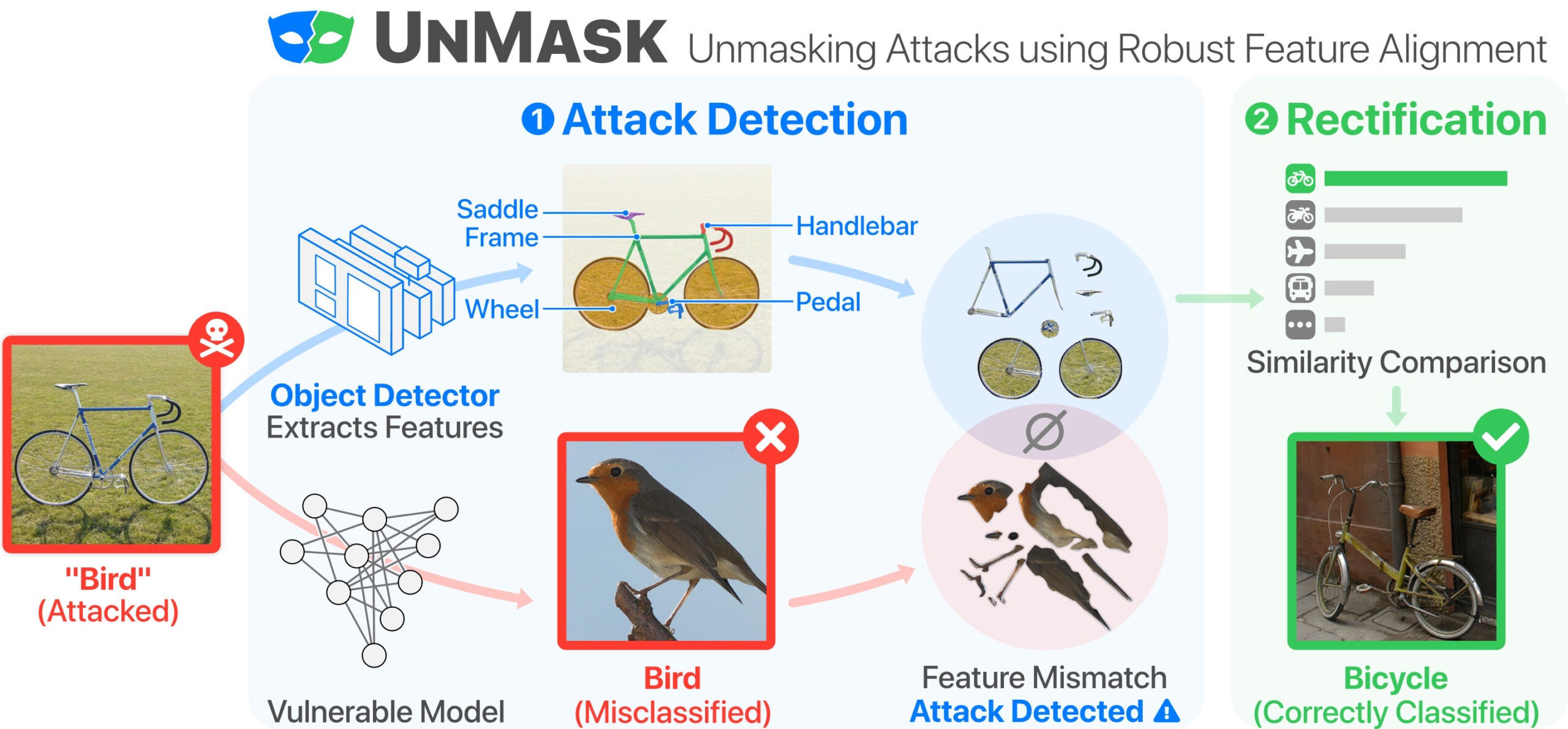
  6. UnMask combats adversarial attacks (in red) through extracting robust features from an image (“Bicycle” at top), and comparing them to expected features of the classification (“Bird” at bottom) from the unprotected model. Low feature overlap signals an attack. UnMask rectifies misclassification using the image’s extracted features. Our approach detects 96.75% of gray-box attacks (at 9.66% false positive rate) and defends the model by correctly classifying up to 93% of adversarial images crafted by Projected Gradient Descent (PGD).

    UnMask: Adversarial Detection and Defense Through Robust Feature Alignment 

    December 9, 2020 | Scott Freitas, Shang-Tse Chen, Zijie J. Wang, and Duen Horng (Polo) Chau

    Recent research has demonstrated that deep learning architectures are vulnerable to adversarial attacks, high-lighting the vital need for defensive techniques to detect and mitigate these attacks before they occur. We present UnMask, an adversarial detection and defense framework based on robust feature alignment. UnMask combats…

  7. Machine Learning for Glacier Monitoring in the Hindu Kush Himalaya 

    December 8, 2020

    Glacier mapping is key to ecological monitoring in the hkh region. Climate change poses a risk to individuals whose livelihoods depend on the health of glacier ecosystems. In this work, we present a machine learning based approach to support ecological monitoring, with a focus on…

  8. Fusing Context Into Knowledge Graph for Commonsense Question Answering 

    December 8, 2020

    Commonsense question answering (QA) requires a model to grasp commonsense and factual knowledge to answer questions about world events. Many prior methods couple language modeling with knowledge graphs (KG). However, although a KG contains rich structural information, it lacks the context to provide a more…

  9. TAP: Text-Aware Pre-training for Text-VQA and Text-Caption 

    December 7, 2020

    In this paper, we propose Text-Aware Pre-training (TAP) for Text-VQA and Text-Caption tasks. These two tasks aim at reading and understanding scene text in images for question answering and image caption generation, respectively. In contrast to the conventional vision-language pre-training that fails to capture scene…