Microsoft Research Blog

English

  1. AutoAdapt: An Automated Domain Adaptation Framework for LLMs 

    March 1, 2026

    Large language models (LLMs) excel in open domains but struggle in specialized settings with limited data and evolving knowledge. Existing domain adaptation practices rely heavily on manual trial-and-error processes, incur significant hyperparameter complexity, and are highly sensitive to data and user preferences, all under the…
  2. StreamWise: Serving Multi-Modal Generation in Real-Time at Scale 

    March 1, 2026

    Advances in multi-modal generative models are enabling new applications, from storytelling to automated media synthesis. Most current workloads generate simple outputs (e.g., image generation from a prompt) in batch mode, often requiring several seconds even for basic results. Serving real-time multi-modal workflows at scale is…

  3. MSCCL++: Rethinking GPU Communication Abstractions for AI Inference 

    March 1, 2026

    AI applications increasingly run on fast-evolving, heterogeneous hardware to maximize performance, but general-purpose libraries lag in supporting these features. Performance-minded programmers often build custom communication stacks that are fast but error-prone and non-portable. This paper introduces MSCCL++, a design methodology for developing high-performance, portable communication…

  4. Memora: A Harmonic Memory Representation Balancing Abstraction and Specificity 

    March 1, 2026

    Agent memory systems must accommodate continuously growing information while supporting efficient, context-aware retrieval for downstream tasks. Abstraction is essential for scaling agent memory, yet it often comes at the cost of specificity, obscuring the fine-grained details required for effective reasoning. We introduce Memora, a harmonic…

  5. KEEP: A KV-Cache-Centric Memory Management System for Efficient Embodied Planning 

    February 27, 2026

    Memory-augmented Large Language Models (LLMs) have demonstrated remarkable capability for complex and long-horizon embodied planning. By keeping track of past experiences and environmental states, memory enables LLMs to maintain a global view, thereby avoiding repetitive exploration. However, existing approaches often store the memory as raw…

  6. Reasoning-Driven Multimodal LLM for Domain Generalization 

    February 27, 2026

    This paper addresses the domain generalization (DG) problem in deep learning. While most DG methods focus on enforcing visual feature invariance, we leverage the reasoning capability of multimodal large language models (MLLMs) and explore the potential of constructing reasoning chains that derives image categories to…

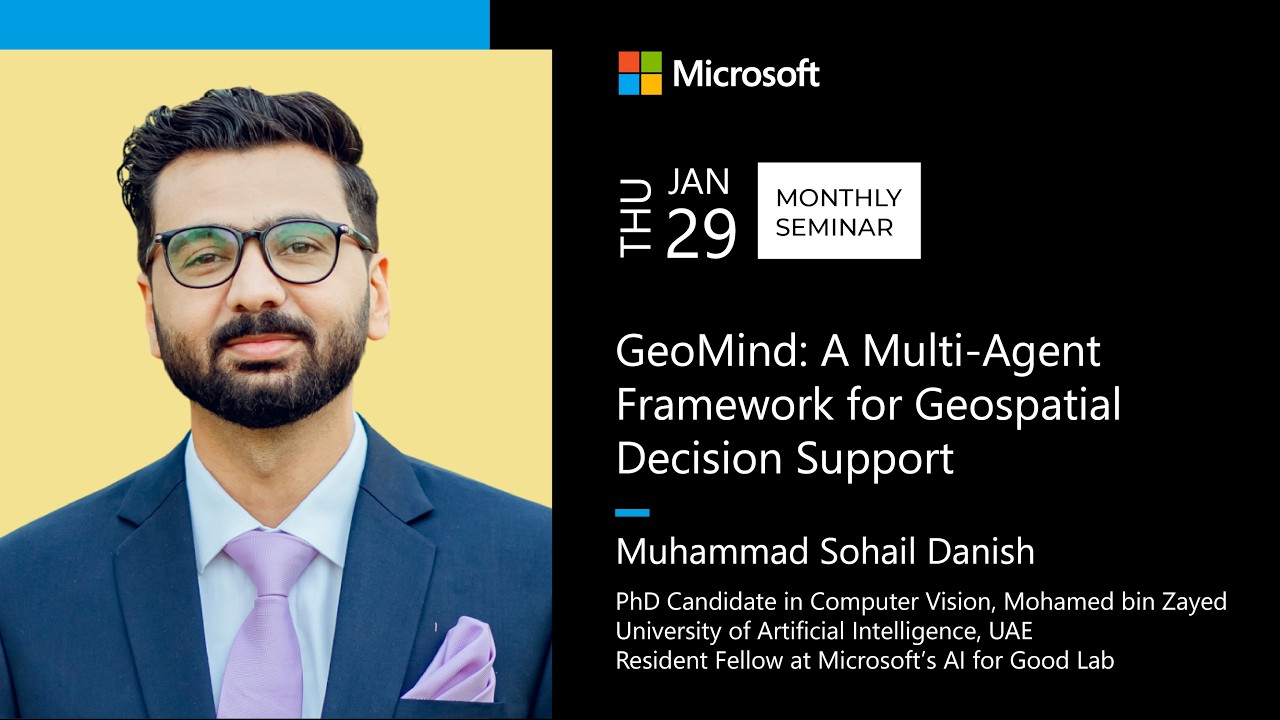
  7. Muhammad Sohail Danish

    GeoMind: A Multi-Agent Framework for Geospatial Decision Support 

    February 26, 2026 | Muhammad Sohail Danish

    Rapid access to actionable geospatial insights is essential during disasters such as floods, wildfires, or earthquakes, where timely decisions can save lives and resources. In many scenarios, especially in low-resource settings or when GIS experts are not immediately available, policymakers, humanitarian responders, and other non-technical…

  8. decorative icons in white on a blue and green gradient background

    CORPGEN advances AI agents for real work 

    February 26, 2026

    By mid-morning, a typical knowledge worker is already juggling a client report, a budget spreadsheet, a slide deck, and an email backlog, all interdependent and all demanding attention at once. For AI agents to be genuinely useful in that environment, they will need to operate…