An Introduction to Chapel: Cray Cascade’s High-Productivity Language
- Brad Chamberlain | Cray Inc.
In 2002, DARPA launched the High Productivity Computing Systems (HPCS) program, with the goal of improving user productivity on High-End Computing systems for the year 2010. Cray was one of three vendors selected for phase II, during which time we’ve been researching ways of improving parallel productivity across the entire system stack. One of these efforts is the development of a new parallel programming language named Chapel. Chapel is designed to support a global view of parallel programming and to help narrow the gulf between mainstream and parallel languages. In this talk, I will introduce the motivations and foundations for Chapel, describe several core Chapel features, and show some sample computations written in Chapel.
Speaker Details
Bradford Chamberlain has been an employee of Cray Inc. since 2002, working on parallel programming models in general and on the design and implementation of the Chapel language in particular. Prior to that, he spent a year at a startup addressing the opposite end of the hardware scale, designing a parallel language for reconfigurable embedded hardware.He received his PhD in Computer Science from the University of Washington in 2001 where he was a member of the ZPL parallel array language project and also dabbled in algorithms for accelerating 3D rendering of complex scenes. He received his Bachelor’s degree in Computer Science from Stanford University in 1992. Somewhere in there, he did a pair of Microsoft internships, working on RPC for Macintoshes and interactive parrot DJs, respectively.
-
-

Jeff Running
-
Watch Next
-
-

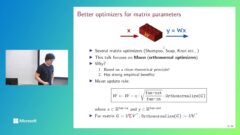
Dion2: A new simple method to shrink matrix in Muon
- Anson Ho,
- Kwangjun Ahn
-
-
-
-
-
-
-
-