Computational tools for biodiversity conservation.
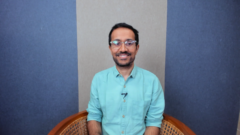
- Piero Visconti | Microsoft Research
We live in the middle of two unprecedented ages. The first is the Information Age; of laptops, smart phones, the internet, ubiquitous computing and an enormous, constant, flux of data about the environment and about us. The second is the Anthropocene – defined by an exceptionally rapid loss of biodiversity caused by human activity. Computational ecology and conservation figuratively connect these two ages by using novel hardware and software tools to make predictions about the planet and to inform conservation-decision making aimed at safeguarding the environment and our wellbeing. In this talk I’ll demonstrate some important applications of computational methods to conservation through my own recent work. These include the use of global search algorithms to identify the regions where the most endemic plant species can be protected at the minimum cost, and to schedule actions for biodiversity conservation that optimally balance cost-effectiveness and likelihood of success in the face of uncertain implementation. I will then present my ongoing and prospective future research at Microsoft which includes optimizing trade-offs between economic activities and biodiversity conservation in the Amazon, and the use of active-learning methods to direct the search and eradication of invasive species or to identify the last refuges of cryptic endangered species. These are a few examples of how computational tools can help us understand and conserve life on earth. I am interested in working with computer scientists, ecologists and conservation practitioners to address the biggest challenges in ecology and conservation.
Speaker Details
After completing a master in Natural Sciences at the University of Rome, I moved to Australia at the University of Queensland for a one-year visiting scholarship, working on graph-theoretic metrics of landscape connectivity and on prioritization of conservation efforts through space and time. The use of decision theory for resource allocation problems in biodiversity conservation sparked my interest ever since, and it has been the subject of my PhD thesis at James Cook University under the supervision of Professor Robert Pressey. During my thesis I developed new methods for dynamic conservation planning, that is, solving scheduling problems in conservation. These involve the identification of what actions to do, where, and when to maximize biodiversity persistence under budgetary constraints and on-going threats to biodiversity. I then moved back to the University of Rome, as a postdoctoral research associate at the Global Mammal Assessment program in Rome. There, I worked on assessing the implications of error and gaps in spatial dataset on assessment of conservation progress and I developed new methods to assess the future land-use and climate change impacts on animal species. This work continued during my first year at MSR Cambridge in the Computational Science lab with Lucas Joppa, and is currently in the second stage of revisions. During my first year at Microsoft I also co-authored a manuscript in Science investigating the global patterns of plant species endemism and identifying the regions collectively hosting the most endemic plants within 17% of land surface area, the global target for protected area expansion by 2020. My research interests are in conservation decision-making under uncertainty, ecological modelling and global change scenarios. I am interested in working with computer scientists, ecologists and conservation practitioners to address the biggest challenges in ecology and conservation.
-
-

Jeff Running
-
Watch Next
-
-

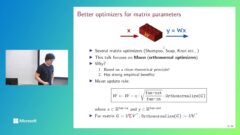
Dion2: A new simple method to shrink matrix in Muon
- Anson Ho,
- Kwangjun Ahn
-
-
-
-
-
-
-
-