Data Triggered Threads – Eliminating Redundant Computation
- Dean Tullsen | University of California San Diego
This talk will introduce a new programming/architectural execution model for parallel threads. Unlike threads in conventional programming models, data-triggered threads are initiated on a change to a memory location. This enables increased parallelism and the elimination of redundant, unnecessary computation. This talk will focus primarily on the latter. We’ll show that 78% of all loads fetch redundant data, leading to a high incidence of redundant computation.
By expressing computation through data-triggered threads, that computation is executed once when the data changes, and is skipped whenever the data does not change. The set of C SPEC benchmarks show performance speedup of up to 5.9X, and averaging 46%.
Speaker Details
Dean Tullsen is a professor in the computer science and engineering department at UCSD. He received his PhD from the University of Washington in 1996, where he introduced the concept of simultaneous multithreading (hyper-threading). He has continued to work in the area of computer architecture and back-end compilation, where with various co-authors he has introduced several new ideas to the research community, including threaded multipath execution, symbiotic job scheduling for multithreaded processors, dynamic critical path prediction, speculative precomputation, heterogeneous multi-core architectures, conjoined core architectures, and event-driven simultaneous code optimization. He is a Fellow of the IEEE, and two-time winner of the SigArch/TCCA ISCA Most Influential Paper Award.
-
-

Jeff Running
-
Watch Next
-
-

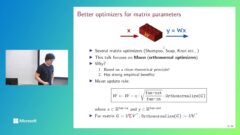
Dion2: A new simple method to shrink matrix in Muon
- Anson Ho,
- Kwangjun Ahn
-
-
-
-
-
-
-
-