On Network (Un)Fairness and Reservations in Cloud Data Centers
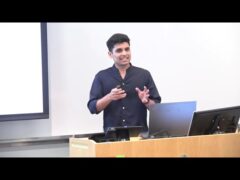
- Ramana Kompella | Purdue University
One of the hot topics in networking research concerns how to share data center networks effectively among many flows and many tenants. In this talk, I will first start with a surprising observation, we call the TCP Outcast problem, that occurs in commodity data center networks. In multi-rooted tree topologies, we observe that sharing the network using TCP can lead to severe unfairness under common traffic patterns. The root cause of this problem lies in a new phenomenon called port blackout that occurs in taildrop switches.
The second part of my talk focuses on network reservations as a way to isolate tenants from each other’s applications in cloud environments. Until now, various abstractions have been proposed for sharing the data center network in the literature. But all existing works assume same network reservations throughout the execution of the job; we consider a new abstraction called the temporally-interleaved virtual cluster (TIVC) that explores time-varying reservations in data center networks. Our TIVC abstraction is motivated from the networking requirements of many applications that exhibit significant temporal diversity in their traffic requirements.
Speaker Details
Ramana Kompella is an Assistant Professor in Purdue University where he conducts research in the Systems and Networking (SyN) Laboratory on various topics related to data center networking, virtualization, cloud computing, latency measurement techniques, fault localization, and scalable router algorithmics.
Prof. Kompella joined Purdue in August of 2007 after obtaining his Ph.D. degree from UCSD. He obtained his Masters degree from Stanford University in 2001 and an B.Tech degree from IIT Bombay in 1999, both in Computer Science. He received the NSF CAREER award in 2011 for his work on high-fidelity latency measurements in data center networks.
-
-

Jeff Running
-
Watch Next
-
Dion2: A new simple method to shrink matrix in Muon
- Anson Ho,
- Kwangjun Ahn
-
-
-
-
-
-
Beyond Swahili: Designing Inclusive AI for Bantu Languages
- Alfred Malengo Kondoro
-
-
-
GeoMind: A Multi-Agent Framework for Geospatial Decision Support
- Muhammad Sohail Danish