Using Efficient Oblivious Computation to Keep Data Private and Obfuscate Programs
- Kartik Nayak | University of Maryland, College Park
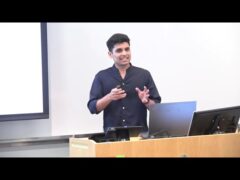
Protecting sensitive user data and proprietary programs are fundamental and important challenges. For instance, when users outsource their private data to the cloud, they risk leakage of the data in the event of a data breach; encrypting their data is not a workable solution since it impedes the cloud provider’s ability to offer user-specific services. When companies execute proprietary programs on third-party cloud providers, they similarly face the risk of leaking trade secrets.
In this talk, I will discuss efficient data-oblivious computation and show how it can be applied to address each of the above. In particular, I will introduce GraphSC, an efficient, parallel, secure-computation framework for running data-mining algorithms on private user data that allows programmers to express computation tasks using the familiar GraphLab abstraction. I will then present HOP, a secure processor designed to obfuscate proprietary programs. I will conclude with an overview of my other ongoing and future research on privacy-preserving computation and blockchains.
Speaker Details
Kartik Nayak is a Computer Science Ph.D. candidate at the University of Maryland, College Park where he is advised by Professors Jonathan Katz and Elaine Shi. His research interests are in the areas of security and applied cryptography, and distributed computing. In applied cryptography, he has focused on efficient data-oblivious computation and its applications to computing on private data and obfuscating programs. In distributed computing, he has focused on the design of efficient permissioned and permissionless blockchains. He obtained an M.S. from the University of Maryland, College Park in 2016, and a Google Ph.D. fellowship in Security and Privacy in 2016.
Watch Next
-
-

Efficient Homomorphic Integer Computer from CKKS
- Jaehyung Kim
-
-
-
Detecting Compromise of Passkey Storage on the Cloud
- Mazharul Islam
-
-
-
-

Attestations over TLS 1.3 and ZKP
- Sofía Celi