
Modernizing child welfare technology the agile way
Technology has come a long way since the Administration for Children and Families (ACF) first published the State Automated Child Welfare Information System (SACWIS) regulations 23 years ago. In 1993, the Internet was still a relatively new phenomenon. The first widely used web browser had just been released, and mobile computing was still a thing of the future.
The current child welfare systems are not improving outcomes for children involved with foster care. Research shows that children in foster care suffer worse outcomes than those who are not involved in the foster care system. For example, children in foster care are not as likely to graduate from high school; however, they are more likely to become unemployed or homeless when they become too old for care.
To modernize these aging child welfare systems, the ACF recently published its much anticipated Comprehensive Child Welfare Information System (CCWIS) final rule, which promotes leveraging technology for innovation and agility to address the issues in child welfare. In a nutshell, the new rules promote the sharing of information between child welfare agencies and contributing organizations such as schools, courts, and other health and human services departments, while giving agencies the flexibility to build systems that are tailored to meet their unique needs.
When the past SACWIS were implemented, child welfare agencies went through a lengthy design period, which required them to identify all of their IT system requirements up-front—and then build a massive system, test it, fix the bugs, and put it into production. The disadvantage of this “waterfall” software development approach is that workers were often forced to wait years before they could take advantage of a new system. In addition, these systems were not designed to account for new requirements, making them inflexible and costly to update.
As child welfare agencies begin modernizing their IT systems, Microsoft can help. We provide state-of-the-art technology, along with an “agile” approach to enable child welfare agencies to obtain rapid results in a cost-effective manner. By partnering with Microsoft, child welfare agencies can take advantage of other capabilities that are not common in older SACWIS systems such as configurable case management and associated workflows, mobile computing, predictive analytics, automated assessments, worker optimization tools, and modern marketing and recruitment capabilities—all of which can dramatically improve case workers’ efficiency and improve the outcomes for children involved with foster care.
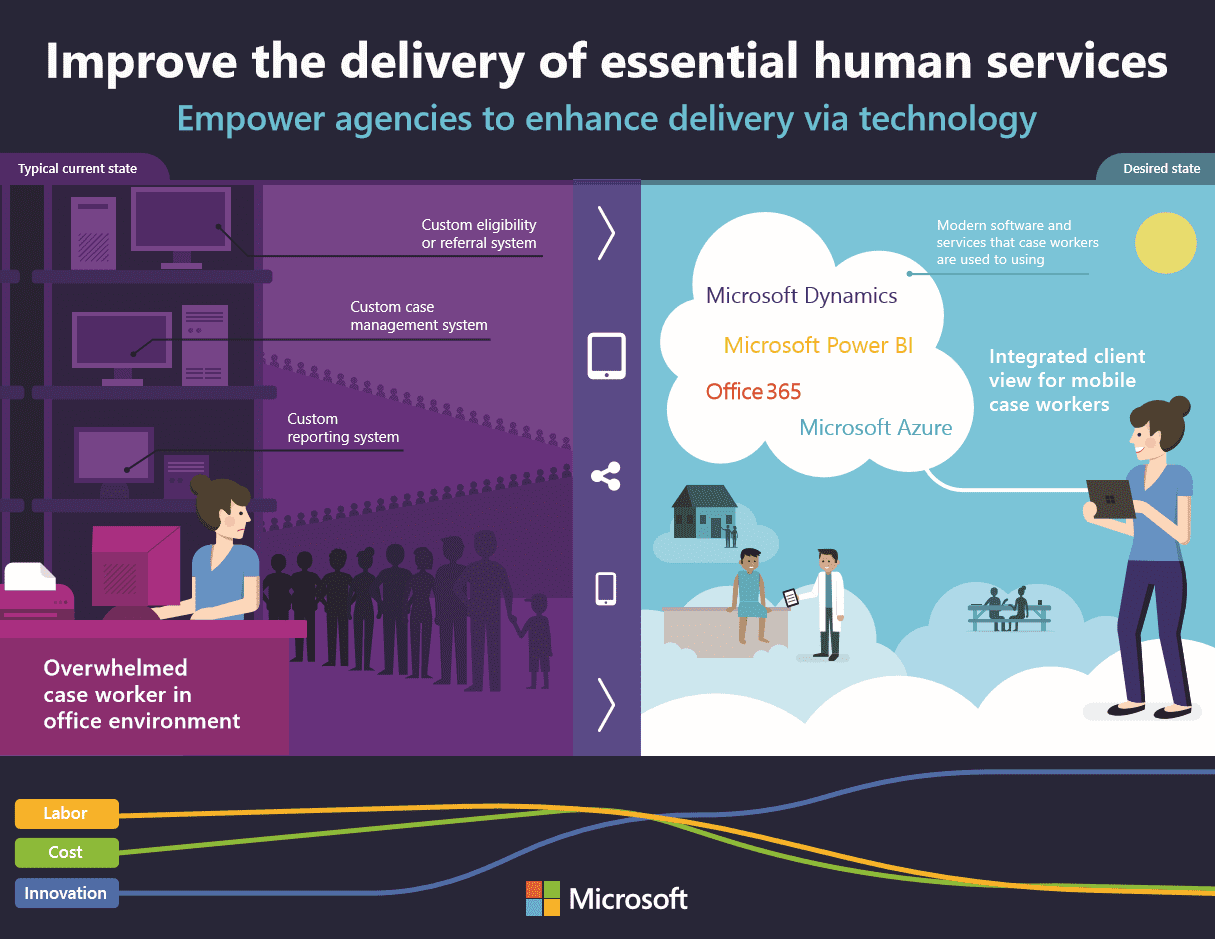
In addition, modern commercial-off-the-shelf products such as Microsoft Dynamics CRM and Microsoft Azure can help child welfare agencies rethink how they modernize their solutions by taking a more flexible, modular approach. Using products such as these, agencies can modernize one business function at a time—rapidly configuring, testing, and deploying a new intake system, for example, or enabling mobile computing capabilities for case workers. The benefits of this agile approach is that workers can begin using new functionality far more quickly. Moreover, child welfare agencies can continually improve their IT systems, while responding more rapidly and flexibly to changes as they occur. Plus, users have the advantage of familiarity because in many cases they’re already using these products for their day-to-day productivity tasks.
To ensure the success of these deployments, Microsoft offers a five-step approach that can help child welfare organizations implement the recommendations of the CCWIS final rule. Microsoft Cloud SureStep Evolve is a proven agile software development methodology that produces results at a pace that works for each individual organization with accountability at every step of the product lifecycle. Agencies that follow this five-phase process will be able to plan ahead, set a clear timeline, avoid common pitfalls, take advantage of strategies for saving time and costs, and obtain the results they seek on time and on budget.
I recently heard a speaker at a technology conference say, “Once you see what’s possible, you can’t settle for what you have.” That statement couldn’t be truer for child welfare agencies that are considering modernizing their solutions. CCWIS offers states the opportunity to work far more efficiently and cost-effectively by modernizing their child welfare systems, and Microsoft provides a fast and flexible approach that gives child welfare agencies the up-to-date tools they need to serve children far more effectively.
To learn more, please read my previous blog post, “Leveraging technology to improve outcomes for vulnerable children and families.” or look into our Case Management ebook. Also, stay tuned for my next blog post describing how predictive analytics can improve child protective service worker decision making.