


The future of design engineering: How Microsoft HoloLens unlocks new possibilities
It’s no secret that technology is playing a larger role than ever before in shaping our world. It’s clearly changed expectations in what we design for consumers and businesses, as they seek solutions and not just products.
And just as today’s technology innovations are helping transform products into a new world of connected solutions, they are also ushering in a new era of how we design. And its possibilities have never been brighter or more-out-of (and into) this world as holographic computing comes alive.
The evolution of digital design
If we stop and think about all the incredible inventions of the Industrial Age—the electric motor, the telephone, the jet engine and Henry Ford’s first Model-T, it’s astonishing to know that they were designed without the use of computers – something we wouldn’t dare consider doing today.
In the late 1960’s French engineer, Pierre Bézier, pioneered UNISURF, the first 3D computer aided design (CAD) application. It proved to be incredibly productive such that by the mid 1970’s, it was the standard for Renault and became the catalyst for an entire industry in 3D CAD software. CAD replaced drawing boards, vellum paper, weighted pencils and ink pens with the keyboard first, then digitizers, the mouse and more recently, touch screens. The method and process of designing has changed for the better by becoming more natural and more intuitive.
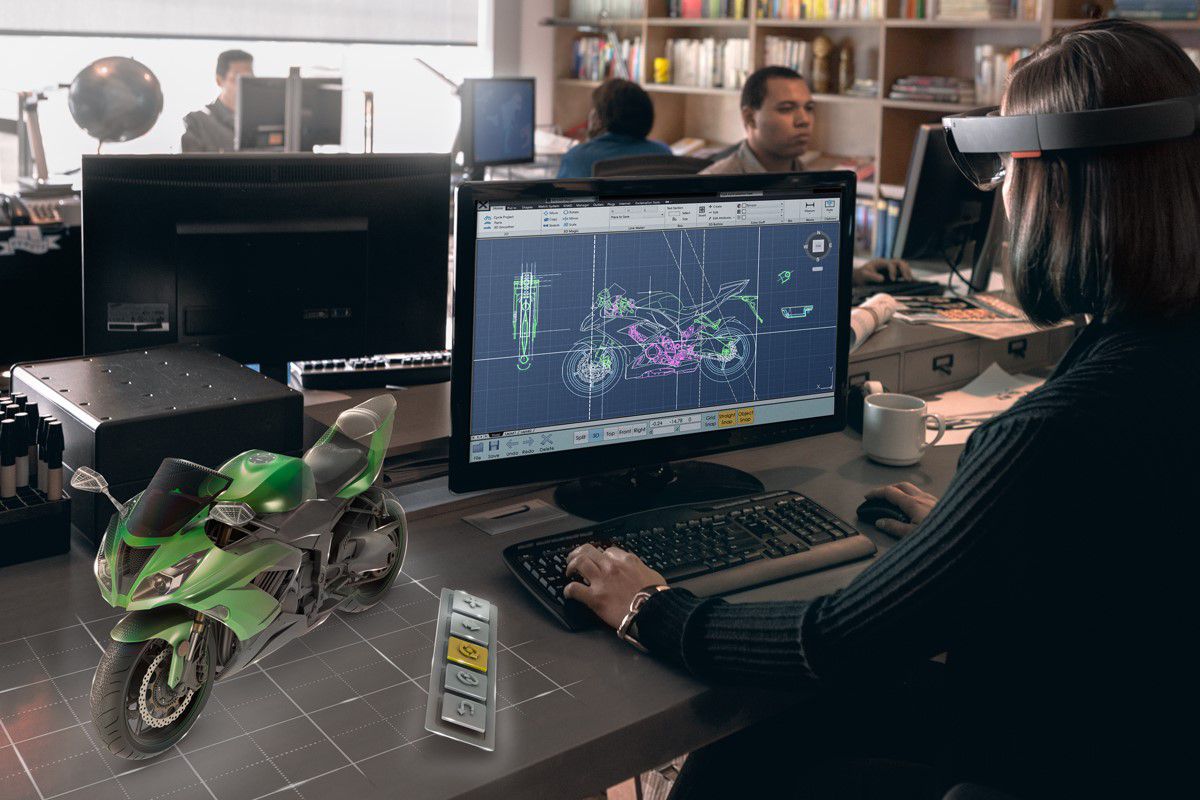
Today there is a new entrant into the history books: holographic computing. It changes the game completely from being stationary in front of a computer monitor to being interactive in almost any environment. It makes designing in 3D a real-to-life experience versus a representation displayed on a 2D screen. It means that design engineers can work in the actual environment where their product will be used!

Transforming the design world with holograms
With Microsoft HoloLens , holograms are no longer just constructs for sci-fi writers. HoloLens is the first fully untethered, see-through holographic computer.

It enables high-definition holograms to come to life in your world, seamlessly integrating with your physical places, spaces, and things. We call this experience mixed reality. With HoloLens, there isn’t a screen to touch or a mouse to click. It understands your movements, vision, and voice, enabling you to interact with content and information in the most natural way possible. You can learn more about the hardware here.
With the ability to interact with three-dimensional holograms in the real world, designers and manufacturers have an exciting new way to work. Here’s my take on the three biggest opportunities for the future of manufacturing.
The possibilities of HoloLens for engineering design
Design. The design opportunities that HoloLens presents are exciting. Design engineers will be able to go beyond traditional 3D presented on a monitor and controlled via mouse or touch, to immersive 3D in the real world using gestures and voice. Holograms allow you to visualize how something will look in the physical world with the benefit of 3D editing and authoring capabilities, mimicking how you would interact with something in real life.
Imagine creating a physical mock-up or prototype using foam, clay and other mediums for modeling: this is what design will be like with HoloLens, but with more tools and less constraints than the real world. You can then share those holograms and collaborate remotely, and excitingly, even turn them into physical objects with HoloStudio’s 3D print compatibility.
Fix. Think of the possibilities for field service and repair of products and machines. Being able to be in an actual situation—standing next to an aircraft or vehicle—and have your digital instructions pinned as holograms in the air around you or a 3D animation within the actual physical context right in front of you. Or go beyond that and bring in a remote colleague or advisor with HoloNotes in Skype and let them see your environment from their tablet or PC to troubleshoot and collaborate on a repair on the spot. They can draw instructions that appear as animations in your world, helping walk you through a new process.
Simulate. New ways to learn is another powerful capability of HoloLens. In both design and field service training scenarios, learning comes alive when you can visualize and examine in 3D, within the actual environment, how a product works, the types of different inspections performed on a product or each of the individual tests required to meet product safety standards. What’s more, you could simulate an unsafe or hazardous environment to practice what you’d do in that situation.

HoloLens and Windows 10
It’s worth noting that HoloLens’ unique capabilities are enabled by Windows 10 . Windows 10 is the first platform to support holographic computing with APIs that enable gaze, gesture, voice, and environmental understanding on an untethered device.
As part of the same core as the Windows 10 family, HoloLens will seamlessly integrate with your existing applications and environment. Think of it as another interface to the same data, where any new information you create will move with you from one environment to another—from tablet to PC to HoloLens—with the same familiar tools you’ve been using for work and collaboration. There just isn’t anything else out there like it!
If you didn’t get a chance to witness the unveiling of HoloLens during Microsoft’s Windows 10 live event, watch it now . So, how do you imagine using HoloLens for design and engineering? I’d love to hear your thoughts in the comments or feel free to add to the conversation on Twitter.


