

The actionable AI playbook: 5 lessons leaders can learn from Transcard’s Virtual CFO
Finance teams operate in a high-stakes environment, with competing priorities, limited hours, and unforgiving risk. Transcard’s answer wasn’t another dashboard. It was a Virtual CFO: AI agents that act, not just advise.
“Leaders wear too many hats,” highlights Jeff Kaufman, Executive Vice President (EVP) of AI and Data Insights at Transcard. “They manage fraud and risk. They make sure hundreds of suppliers are paid on time. They chase customer payments. Large firms have tools to help. But many smaller businesses still rely on spreadsheets. We knew AI could change that.”
To take some of those hats off, Transcard built Virtual CFO – a secure, proactive AI agent that works around the clock, orchestrating multiple AI agents to watch for risks, flag opportunities and anticipate issues before they become problems. It levels the playing field by enabling 24/7 financial automation, accelerating issue resolution and freeing up time to focus on growth.

But the real breakthrough isn’t just automation, it’s re‑imagination. Virtual CFO is a clear example of the future of AI – a roadmap for businesses ready to move forward.
Here are five important lessons from Transcard’s journey worth remembering:
1. Start with the most pressing challenges
For Transcard’s customers, that meant cash flow anxiety, fraud risks and manual payments.
What keeps your customers up at night?
“You need to listen to your customers directly,” explains Jeff Kaufman. “I call it the ‘day in the life.’ Spend time with them, watch what they do and understand their conflicting priorities. That’s how you find the real pain.”
And once you spot the issue, ask whether the process is worth improving.

“Plenty of leaders want AI to automate processes so employees are more efficient. But ask yourself: are you automating broken processes? That reflection matters,” says David Samples, Chief Technology Officer (CTO) at Transcard.
The cycle of improvement only works when the foundation is strong. True transformation means stepping back to create future-ready ways of working, rather than just speeding up old routines.
2. Set non‑negotiables early
Priorities define success. Without them, direction is lost.
Transcard established three essentials before writing a single line of code:
- Accuracy, speed and security – must-haves in financial services
- Customer-first design, shaped by advisory groups and “day-in-the-life” research
- Action APIs, enabling AI recommendations to trigger real tasks
Clear frameworks make innovation faster.
3. Choose partners that accelerate learning
“Once we had our requirements, we knew we needed a partner we could trust to help smooth out the edges,” reflects David Samples.
The right partnerships accelerate progress. For Transcard, Microsoft delivered the AI and cloud foundation, along with workshops to develop the skills and shape the vision. Coretek, their implementation partner, assisted with refining infrastructure and building the AI agents.
Together, these collaborations gave Transcard more confidence to move faster and experiment bolder.
4. Ship in waves, earn trust
Not every customer is ready for automation. That’s why Transcard rolled out in waves, tackling urgent problems first, then adding features as trust grew.
“When a CFO logs in, they always have a top priority: send a payment, check fraud, resolve a hold. You must solve that first. Meet them where they are, then take them one step further,” points out Jeff Kaufman.
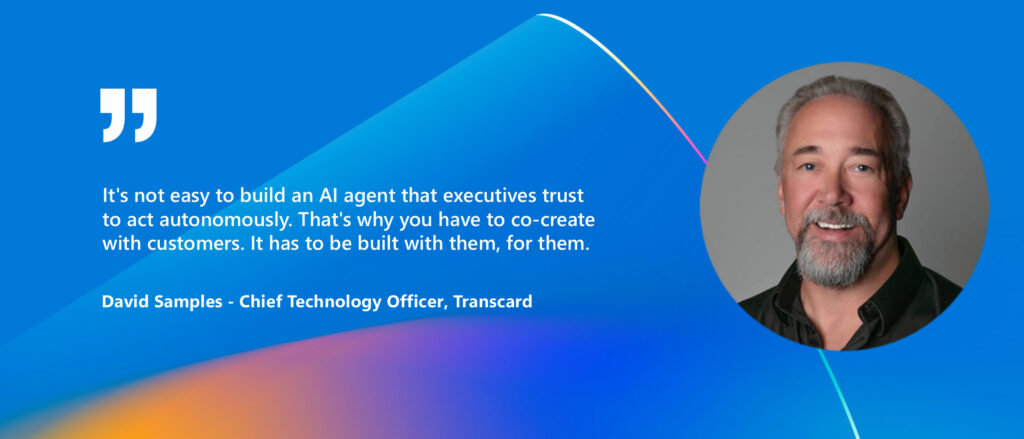
David adds, “It’s not easy to build an AI agent that executives trust to act autonomously. That’s why you have to co-create with customers. It has to be built with them, for them.”
5. Shape for scale, and beyond your industry
For Transcard, Virtual CFO is only the beginning. The organization saw that the same approach could solve challenges across teams, industries and geographies. Their ambition now is to expand the model to help more businesses tackle their toughest obstacles.
“In the digital world, everything is ones and zeros, you can do anything. Don’t box in good ideas because you think the tech won’t work. Start with the idea, then let the tech follow. The real stake in the ground should be: does it add value, and can you make it actionable?” enthuses David.
The bigger picture
Transcard proves that actionable AI is a design choice: focus on the most critical challenges, set the priorities, build for the final mile, and ship in trust‑building waves. Start now and make it cultural.
“Do this Monday” box
Do this Monday
- Pick one finance fire drill (fraud hold, payment exception).
- Define the action you want the agent to take (final mile).
- Write your non‑negotiables (accuracy, security, speed).
- Pilot with a customer advisory group; ship in waves.
Next steps
- Dive deeper: Check out the full Transcard case study.
- Hit play: Experience the Transcard “Virtual CFO” in action – watch now.
- Level up your AI game: Grab your copy of The Art of Practical AI e-book and start building smarter.
It’s your time to become an AI innovator.
“AI is one of those rare technology waves, like the internet, that will reshape industries for decades. To lead, you need to start now. Build the foundation. Make the shift cultural,” concludes Greg Bloh, CEO of Transcard.
Ready to take your AI journey further? Explore the resources designed to help you lead.