Assertion-driven Error Recovery
- Sarfraz Khurshid | University of Texas at Austin
To increase reliability, developers have long used assertions–logical statements that are expected to be true–as lightweight specifications of crucial properties of code. Assertions have predominantly served two purposes: documentation and runtime checking.
We envision a far broader role of assertions where they are the cornerstone of a wide range of analyses that uniformly apply across the spectrum of software design, development, and maintenance, and synergistically promise to bring about a significant increase in reliability.
This talk gives an overview of our ongoing work on assertion-driven development and analyses, and explains the details of how we use assertions for error recovery. Our key insight is to turn violated assertions into recovery routines by using an assertion as a basis of repairing an erroneous program state. Experimental results show that our repair algorithm efficiently handles complex data structures and enables systems to recover from potentially crippling errors.
Speaker Details
Sarfraz Khurshid is an Assistant Professor in the Electrical and Computer Engineering department at the University of Texas at Austin, where he leads the Software Verification and Testing Group. He obtained his PhD in Computer Science from MIT in 2004. He received a BSc in Mathematics and Computer Science from Imperial College London, and read Part III of the Mathematical Tripos at Trinity College Cambridge. His current research focuses on software testing, specification languages, code conformance, model checking, data structure repair, and applications of heuristics in program analysis.
-
-

Jeff Running
-
-
Watch Next
-
-

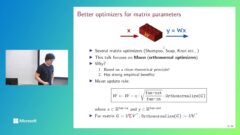
Dion2: A new simple method to shrink matrix in Muon
- Anson Ho,
- Kwangjun Ahn
-
-
-
-
-
-
-
-