A New Era of Resource Responsibility for Sensor Networks
- Matt Welsh | Harvard University
Sensor networks have taken off, but they are still notoriously difficult to program. Our group has deployed sensor networks for volcano monitoring and rehabilitation medicine, and each time we find that tuning the network to achieve the right tradeoff in terms of data quality, battery lifetime, and bandwidth usage is quite painful. To make things worse, resource availability fluctuates over time, as does the load that the application places on those resources. The severely constrained and decentralized nature of sensor networks makes this problem fairly challenging.
In this talk, I will argue that the software for sensor networks should be designed around the fundamental abstraction of resource-aware programming. In this model, the application has direct visibility and control over resources as a first-class primitive. This requires the application code to take responsibility for its own resource management decisions, since it cannot expect a “bailout” from the OS. This approach enables much more effective adaptations to changing conditions, and supports a rich space of resource-management policies.
In this talk, I will present three related systems that leverage this approach: Pixie, a new sensor node operating system; Lance, a network-wide resource management plane; and Mercury, a platform for maximizing data quality in a wearable sensor network. I will present examples and evaluations based on our real-world deployments.
Speaker Details
Matt Welsh is an Associate Professor of Computer Science at Harvard University, where he has been since 2003. His research interests involve operating system, network, and language support for complex distributed systems. He received his Ph.D. and M.S. degrees from U.C. Berkeley and his B.S. from Cornell University. He is also the co-founder of AID Networks, an early-stage company developing wireless sensor platforms for emergency medicine.
Watch Next
-
-
-
-
-
-
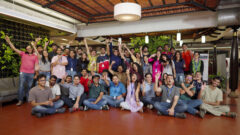
Microsoft Research India - The lab culture
- P. Anandan,
- Indrani Medhi Thies,
- B. Ashok
-
-
-
-

Storing data for thousands of years | Microsoft Project Silica
- Erika Aranas,
- Richard Black,
- Ariel Gomez Diaz