
News & features

Going deep on deep learning with Dr. Jianfeng Gao
Dr. Jianfeng Gao is a veteran computer scientist, an IEEE Fellow and the current head of the Deep Learning Group at Microsoft Research. He and his team are exploring novel approaches to advancing the state-of-the-art on deep learning in areas…

Next-generation architectures bridge gap between neural and symbolic representations with neural symbols
| Paul Smolensky
In both language and mathematics, symbols and their mutual relationships play a central role. The equation x = 1/y asserts the symbols x and y—that is, what they stand for—are related reciprocally; Kim saw the movie asserts that Kim and…
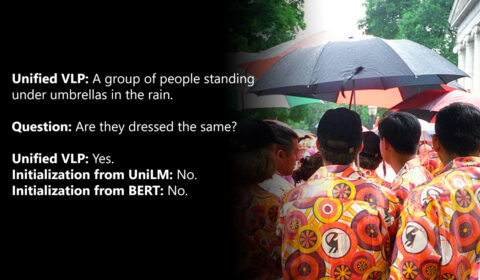
Expanding scene and language understanding with large-scale pre-training and a unified architecture
| Hamid Palangi
Making sense of the world around us is a skill we as human beings begin to learn from an early age. Though there is still much to know about the process, we can see that people learn a lot, both…
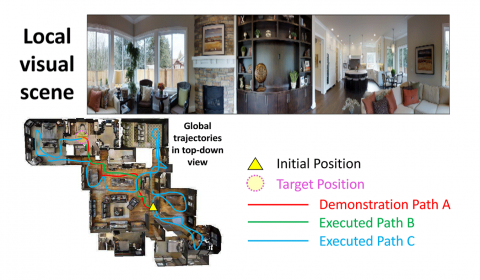
See what we mean – Visually grounded natural language navigation is going places
How do humans communicate efficiently? The common belief is that the words humans use to communicate – such as dog, for instance – invoke similar understanding of the physical concepts. Indeed, there exists a common conception about the physical appearance…
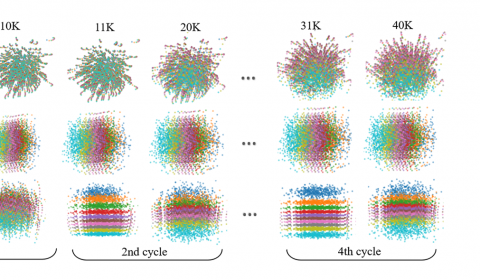
Less pain, more gain: A simple method for VAE training with less of that KL-vanishing agony
| Chunyuan Li
There is a growing interest in exploring the use of variational auto-encoders (VAE), a deep latent variable model, for text generation. Compared to the standard RNN-based language model that generates sentences one word at a time without the explicit guidance…

Towards universal language embeddings
| Jianfeng Gao
Language embedding is a process of mapping symbolic natural language text (for example, words, phrases and sentences) to semantic vector representations. This is fundamental to deep learning approaches to natural language understanding (NLU). It is highly desirable to learn language…

Getting efficient with “What-happens-if …”
| Adith Swaminathan and Emre Kiciman
Causal inference studies the relationship between causes and effects. For example, one kind of question that causal inference can answer is the “What-happens-if …” question. What happens if I take a specific medication? What happens if I raise the price…

Making intelligence intelligible with Dr. Rich Caruana
Episode 26, May 30, 2018 – Dr. Rich Caruana talks about how the rise of deep neural networks has made understanding machine predictions more difficult for humans, and discusses an interesting class of smaller, more interpretable models that may help…

Neural Program Synthesis and the Quest to Democratize Programming with Dr. Rishabh Singh
Episode 10, January 31, 2018 – We can program computers to do almost anything. But what about programming computers to… program computers? That’s a task that Dr. Rishabh Singh, and the team in the Cognition group at Microsoft Research, are…