Microsoft Research Blog

English

  1. Combinatorial Rising Bandits 

    April 1, 2026

    Combinatorial online learning is a fundamental task for selecting the optimal action (or super arm) as a combination of base arms in sequential interactions with systems providing stochastic  rewards. It is applicable to diverse domains such as robotics, social advertising, network routing, and recommendation systems.…

  2. VeriStruct: AI-assisted Automated Verification of Data-Structure Modules in Verus 

    April 1, 2026

    We introduce VeriStruct, a novel framework that extends AI-assisted automated verification from single functions to more complex data structure modules in Verus. VeriStruct employs a planner module to orchestrate the systematic generation of abstractions, type invariants, specifications, and proof code. To address the challenge that…

  3. AI and the Self: Exploring Identity, Agency, and Relational Personhood 

    April 1, 2026

    HCI research has a strong background of engaging with identity, values, and lived experience [1, 11], and has started to explore the role of technology in contexts such as stroke, bereavement, and dementia [7, 10, 13, 15, 17, 21]. By personhood, we mean the recognition…

  4. NetArena: Dynamic Benchmarks for AI Agents in Network Automation 

    April 1, 2026

    As AI agents expand into high-stakes domains like network system operations, evaluating their real-world reliability becomes increasingly critical. However, existing benchmarks risk contamination due to static design, show high statistical variance from limited dataset size, and fail to reflect the complexity of production environments. We…

  5. Reimagining Participatory Agile Development in Community-Industry Partnerships 

    April 1, 2026 | Calvin A. Liang, Emily Tseng, Elizabeth Fetterolf, and Mary L. Gray

    Computing’s ubiquity and accumulation of capital have positioned modern tech giants to be key players in society’s responses to crises. Fulfilling this potential, however, requires methods and incentives for the industry to meaningfully support communities (“community-industry partnerships”). This paper examines one such partnership: an effort…

  6. Lipschitz Bandits with Stochastic Delayed Feedback 

    April 1, 2026 | Zhongxuan Liu, Yue Kang, and Thomas C. M. Lee

    The Lipschitz bandit problem extends stochastic bandits to a continuous action set defined over a metric space, where the expected reward function satisfies a Lipschitz condition. In this work, we introduce a new problem of Lipschitz bandit in the presence of stochastic delayed feedback, where…

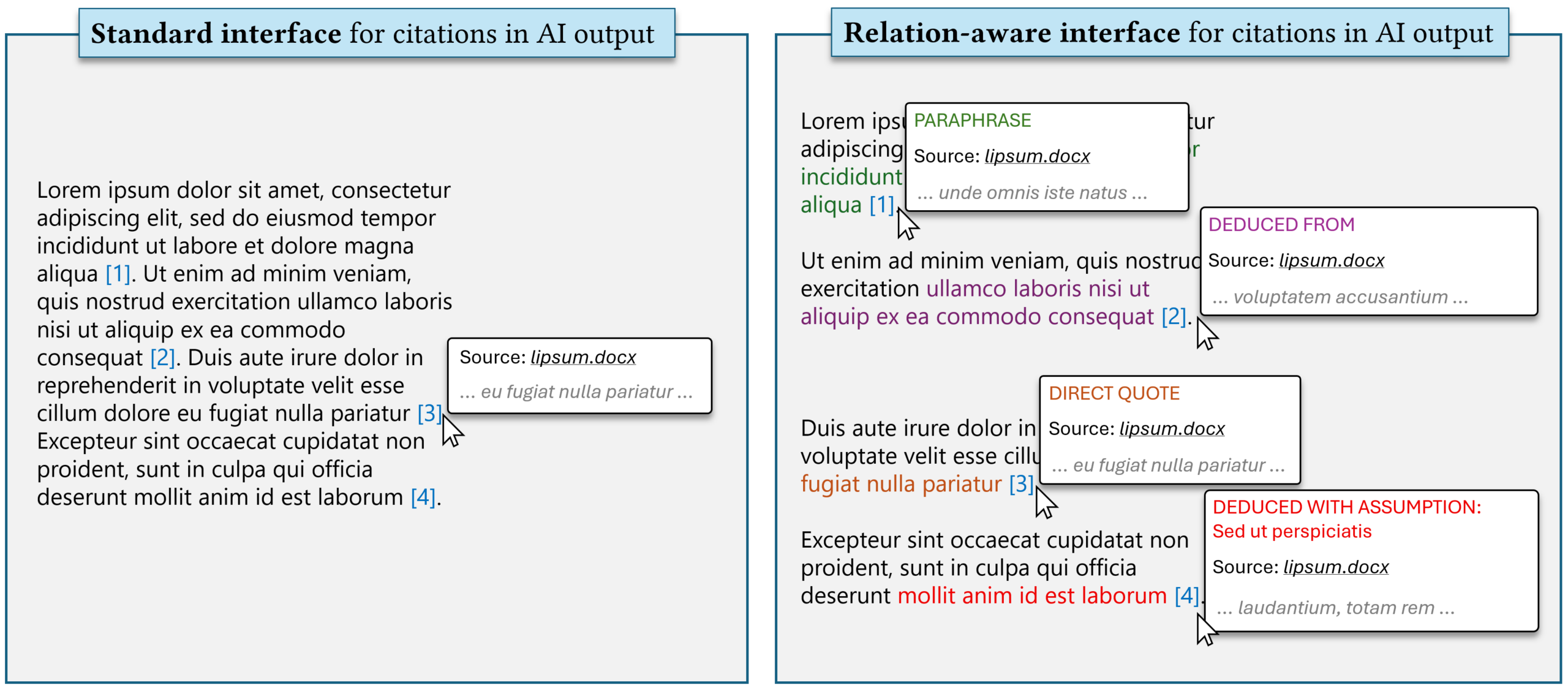
  7. Left: standard citation-enabled responses from a language model. Right: a hypothetical interface that distinguishes between different types of syntactic manipulation (e.g. direct quote vs. paraphrase) and interpretation (e.g. induction, deduction, deduction subject to assumptions) involved in the production of language model output. We propose the development of a taxonomy of reader-centric \emph{support relations} that would enable such interfaces, thereby leading to better critical engagement of readers with language model output and understanding of how it relates to the sources.

    From Binary Groundedness to Support Relations: Towards a Reader-Centred Taxonomy for Comprehension of AI Output 

    April 1, 2026 | Advait Sarkar, Christian Poelitz, and Viktor Kewenig

    Generative AI tools often answer questions using source documents, e.g., through retrieval augmented generation. Current groundedness and hallucination evaluations largely frame the relationship between an answer and its sources as binary (the answer is either supported or unsupported). However, this obscures both the syntactic moves…

  8. blue decorative background

    People-Centric AI Workshop 

    March 26, 2026

    This workshop is invite-only. For inquiries please contact maryattemily@microsoft.com Microsoft Research recently launched People‑Centric AI (PAI), a new research initiative focused on advancing AI that is grounded in human values, societal impact, and inclusive innovation. This workshop brings together a multidisciplinary community of regional experts…

  9. QoServe : Breaking the Silos of LLM Inference Serving 

    March 22, 2026

    The widespread adoption of Large Language Models (LLMs) has enabled diverse applications with very different latency requirements. Existing LLM serving frameworks rely on siloed infrastructure with coarse-grained workload segregation -- interactive and batch -- leading to inefficient resource utilization and limited support for fine-grained Quality-of-Service…