Microsoft Research Blog

Artificial intelligence

  1. ReClor: A Reading Comprehension Dataset Requiring Logical Reasoning 

    April 29, 2020 | Weihao Yu, Zihang Jiang, Yanfei Dong, and Jiashi Feng

    Recent powerful pre-trained language models have achieved remarkable performance on most of the popular datasets for reading comprehension. It is time to introduce more challenging datasets to push the development of this field towards more comprehensive reasoning of text. In this paper, we introduce a…
  2. Fast and Memory-Efficient Neural Code Completion 

    April 28, 2020

    Code completion is one of the most widely used features of modern integrated development environments (IDEs). Deep learning has recently made significant progress in the statistical prediction of source code. However, state-of-the-art neural network models consume prohibitively large amounts of memory, causing computational burden to…

  3. A general approach to progressive learning 

    April 26, 2020

    In biological learning, data are used to improve performance simultaneously on the current task, as well as previously encountered and as yet unencountered tasks. In contrast, classical machine learning starts from a blank slate, or tabula rasa, using data only for the single task at…

  4. Curriculum Pre-training for End-to-End Speech Translation 

    April 21, 2020

    End-to-end speech translation poses a heavy burden on the encoder because it has to transcribe, understand, and learn cross-lingual semantics simultaneously. To obtain a powerful encoder, traditional methods pre-train it on ASR data to capture speech features. However, we argue that pre-training the encoder only…

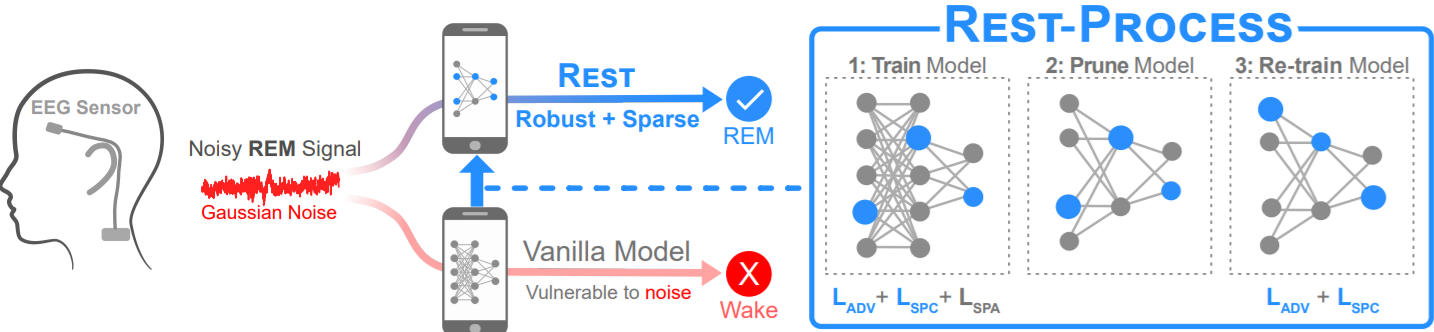
  5. Rest Overview: (from left) When a noisy EEG signal belonging to the REM (rapid eye movement) sleep stage enters a traditional neural network which is vulnerable to noise, it gets wrongly classified as a Wake sleep stage. On the other hand, the same signal is correctly classified as the REM sleep stage by the Rest model which is both robust and sparse. (From right) Rest is a three step process involving (1) training the model with adversarial training, spectral regularization and sparsity regularization (2) pruning the model and (3) re-training the compact model.

    REST: Robust and Efficient Neural Networks for Sleep Monitoring in the Wild 

    April 19, 2020

    In recent years, significant attention has been devoted towards integrating deep learning technologies in the healthcare domain. However, to safely and practically deploy deep learning models for home health monitoring, two significant challenges must be addressed: the models should be (1) robust against noise; and…

  6. DPVis: Visual Analytics With Hidden Markov Models for Disease Progression Pathways. 

    April 6, 2020

    Clinical researchers use disease progression models to understand patient status and characterize progression patterns from longitudinal health records. One approach for disease progression modeling is to describe patient status using a small number of states that represent distinctive distributions over a set of observed measures.…

  7. Improving Entity Linking by Modeling Latent Entity Type Information. 

    April 3, 2020 | Shuang Chen, Jinpeng Wang, Feng Jiang, and Chin-Yew Lin

    Existing state of the art neural entity linking models employ attention-based bag-of-words context model and pre-trained entity embeddings bootstrapped from word embeddings to assess topic level context compatibility. However, the latent entity type information in the immediate context of the mention is neglected, which causes…

  8. A Dataset for Low-Resource Stylized Sequence-to-Sequence Generation 

    April 3, 2020 | Yu Wu, Yunli Wang, and Shujie Liu

    Low-resource stylized sequence-to-sequence (S2S) generation is in high demand. However, its development is hindered by the datasets which have limitations on scale and automatic evaluation methods. We construct two large-scale, multiple-reference datasets for low-resource stylized S2S, the Machine Translation Formality Corpus (MTFC) that is easy…

  9. Region Normalization for Image Inpainting 

    April 3, 2020

    Feature Normalization (FN) is an important technique to help neural network training, which typically normalizes features across spatial dimensions. Most previous image inpainting methods apply FN in their networks without considering the impact of the corrupted regions of the input image on normalization, e.g. mean…

  10. Model Watermarking for Image Processing Networks. 

    April 2, 2020

    Deep learning has achieved tremendous success in numerous industrial applications. As training a good model often needs massive high-quality data and computation resources, the learned models often have significant business values. However, these valuable deep models are exposed to a huge risk of infringements. For…