
Texterial: A Text-as-Material Interaction Paradigm for LLM-Mediated Writing
- Jocelyn Shen ,
- Nicolai Marquardt ,
- Hugo Romat ,
- Ken Hinckley ,
- Nathalie Henry Riche ,
- Fanny Chevalier
ACM CHI Conference on Human Factors in Computing Systems (CHI 2026) |
Published by ACM | Organized by ACM
Honorable Mention Award
Download BibTex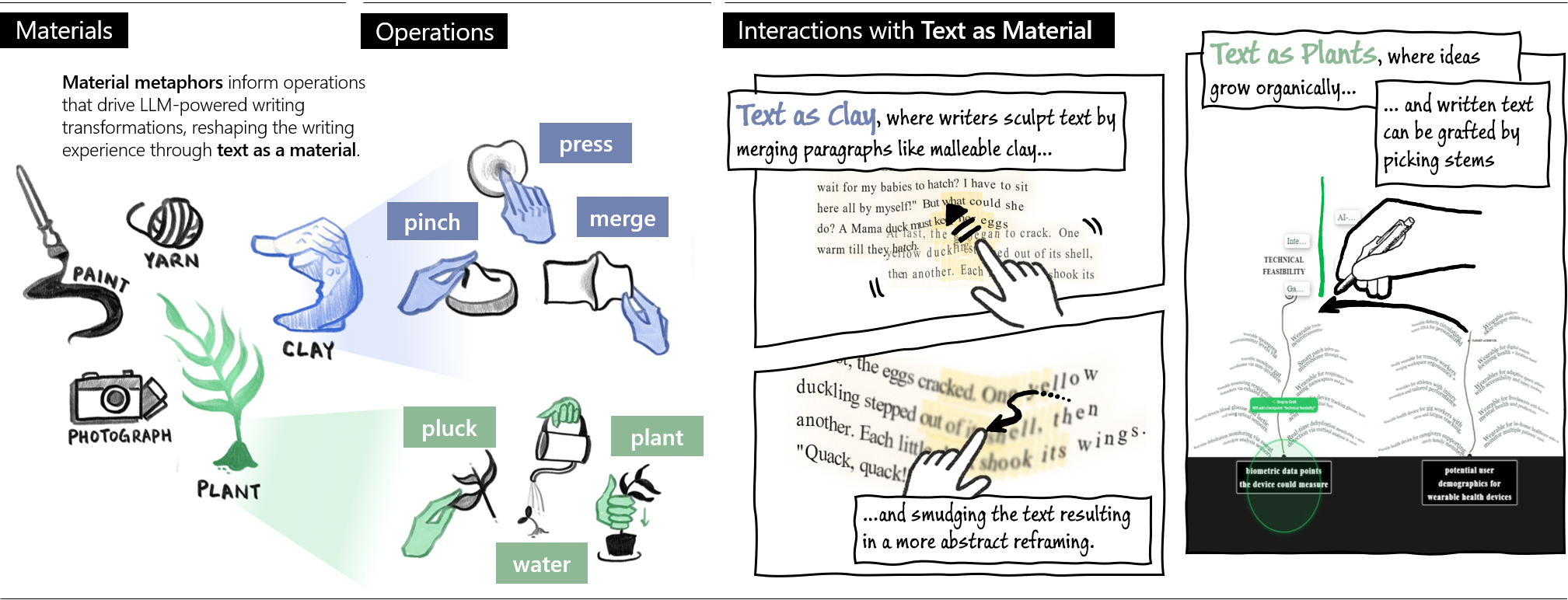
We explore how materials can inspire new interactions with text. Building on insights from a formative study, we propose Texterial, a conceptual {framework} and prototype implementations that treat text-as-material. Our work uses materiality to foster a new way of interacting with generative AI.
Abstract: What if text could be sculpted and refined like clay — or cultivated and pruned like a plant? Texterial reimagines text as a material that users can grow, sculpt, and transform. Current generative-AI models enable rich text operations, yet rigid, linear interfaces often mask such capabilities. We explore how the text-as-material metaphor can reveal AI-enabled operations, reshape the writing process, and foster compelling user experiences. A formative study shows that users readily reason with text-as-material, informing a conceptual framework that explains how material metaphors shift mental models and bridge gulfs of envisioning, execution, and evaluation in LLM-mediated writing. We present the design and evaluation of two technical probes: Text as Clay, where users refine text through gestural sculpting, and Text as Plants, where ideas grow serendipitously over time. This work expands the design space of writing tools by treating text as a living, malleable medium.