


Human-computer interaction
Redefining human experiences through innovations in research, design, and technology.


Video
Towards Mainstream Brain-Computer Interfaces (BCIs)
For decades, various companies, people, and institutes have worked on Brain-Computer Interface (BCI) systems aimed at healthy users, including pilots, drivers, soldiers, and the public at large. Advancements such as dry electrodes, wireless EEG amplifiers,…

Project
Technology for Mental Health and Well-Being Interventions
In the mental health context, this means that we strive to reduce the gap between people who suffer from mental illness, whether it is diagnosed, long-term, or situational, and the tools and interventions that can…
Group
Visualization and Interaction for Business and Entertainment (VIBE)
The Visualization and Interaction for Business and Entertainment (VIBE) group conducts research in the areas of: artificial emotion intelligence (AEI), information visualization in machine learning and big data; and human-computer interaction (HCI) in software engineering.
Group
Technology and Empowerment | India
Technology and Empowerment (TEM) is a research umbrella at Microsoft Research India. We build and study socio-technical systems that seek to have a meaningful impact on the daily lives of underserved people and communities.
Project
Image Accessibility
Digital imagery pervades modern life. More than a billion images per day are produced and uploaded to social media sites, and we also encounter digital images within websites, apps, digital documents, and eBooks. Engaging with…
Video
InChorus: Designing Consistent Multimodal Interactions for Data Visualization on Tablet Devices
InChorus employs multimodal interactions that function consistently across different visualizations, supporting common operations during visual data analysis. InChorus synergistically combines multiple forms of input (i.e., pen, touch, & speech) to allow people to stay in…
Project
Microsoft Academic
Microsoft Academic is a project exploring how to assist human conducting scientific research by leveraging machine’s cognitive power in memory, computation, sensing, attention, and endurance.
Video
Virtual reality without vision: A haptic and auditory white cane to navigate complex virtual worlds
Video Figure accompanying CHI 2020 paper, demonstrating a novel haptic device that allows a white cane user to interact with a large, complex virtual environment. Full paper is available at https://aka.ms/VRWhiteCane Current Virtual Reality (VR)…

Video
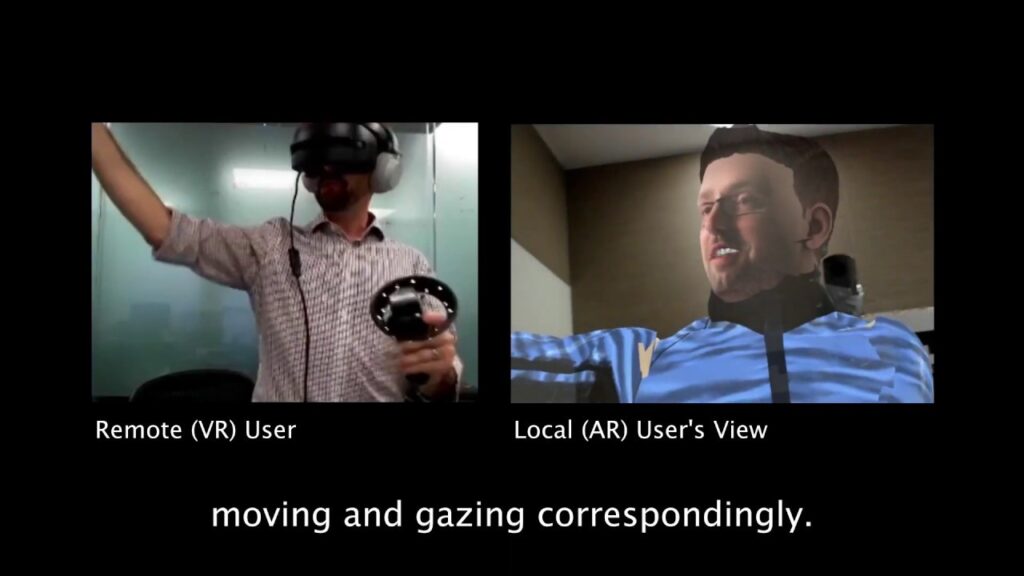
VROOM: Virtual Robot Overlay for Online Meetings – Video Figure
Telepresence robots allow remote users to freely explore a space they are not in, and provide a physical embodiment in that space. However, they lack a compelling representation of the remote user in the local…
Project
Accessible Mixed Reality
This project considers how to design emerging Mixed Reality technologies (including AR and VR) so that they are usable by and useful to people of all abilities. Too often, the accessibility of technology to people…