
Energy-efficient Scheduling in the Non-clairvoyant Model
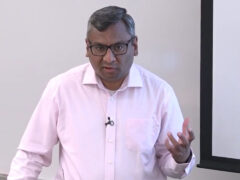
- Debmalya Panigrahi | Duke University
A fundamental problem in energy-efficient computing is to schedule multiple jobs released over time on a single machine with adjustable speed so as to minimize the sum of flow-time (delay) and energy. Note that the two objectives are in conflict: higher speeds reduce flow-time at the cost of increased energy consumption. In this talk, motivated by datacenter applications, I will consider the non-clairvoyant version of this problem where the density (importance) of a job is known when the job arrives but its volume (processing length) is known only after the job has been completely processed. Using a novel technique called incremental analysis, we give a constant-competitive algorithm for this problem, which is the first non-trivial result for the non-clairvoyant setting. (Based on joint work with Yossi Azar, Nikhil Devanur, and Zhiyi Huang, recipient of the “Best paper” award in SPAA 2015.)
Speaker Details
Debmalya Panigrahi is an Assistant Professor of Computer Science at Duke University. He is interested in the design and analysis of efficient algorithms for combinatorial optimization and Internet applications. He received his PhD from MIT in 2012, where he was an MIT Presidential Fellow.
-
-

Debmalya Panigrahi
-

Jeff Running
-

Series: Microsoft Research Talks
-

Decoding the Human Brain – A Neurosurgeon’s Experience
- Dr. Pascal O. Zinn
-
-
-
-
-
-

Challenges in Evolving a Successful Database Product (SQL Server) to a Cloud Service (SQL Azure)
- Hanuma Kodavalla,
- Phil Bernstein
-

Improving text prediction accuracy using neurophysiology
- Sophia Mehdizadeh
-

Tongue-Gesture Recognition in Head-Mounted Displays
- Tan Gemicioglu
-

DIABLo: a Deep Individual-Agnostic Binaural Localizer
- Shoken Kaneko
-
-
-
-

Audio-based Toxic Language Detection
- Midia Yousefi
-
-
From SqueezeNet to SqueezeBERT: Developing Efficient Deep Neural Networks
- Forrest Iandola,
- Sujeeth Bharadwaj
-

Hope Speech and Help Speech: Surfacing Positivity Amidst Hate
- Ashique Khudabukhsh
-
-
-

Towards Mainstream Brain-Computer Interfaces (BCIs)
- Brendan Allison
-
-
-
-
Learning Structured Models for Safe Robot Control
- Subramanian Ramamoorthy
-


