Network Formation in the Presence of Contagious Risk
- Robert Kleinberg | Cornell University
There are a number of domains where agents must collectively form a network in the face of the following trade-off: each agent receives benefits from the direct links it forms to others, but these links expose it to the risk of being hit by a cascading failure that might spread over multi-step paths. Financial contagion, epidemic disease, and the exposure of covert organizations to discovery are all settings in which such issues have been articulated.
Here we formulate the problem in terms of strategic network formation, and provide asymptotically tight bounds on the welfare of both optimal and stable networks. We find that socially optimal networks are, in a precise sense, situated just beyond a phase transition in the behavior of the cascading failures, and that stable graphs lie slightly further beyond this phase transition, at a point where most of the available welfare has been lost. Our analysis enables us to explore such issues as the trade-offs between clustered and anonymous market structures, and it exposes a fundamental sense in which very small amounts of “over-linking” in networks with contagious risk can have strong consequences for the welfare of the participants.
Joint work with Larry Blume, David Easley, Jon Kleinberg, and Eva Tardos
Speaker Details
Bobby Kleinberg is an Assistant Professor of Computer Science at Cornell University. His research studies the design and analysis of algorithms, and their applications to electronic commerce, networking, information retrieval, and other areas. Prior to receiving his doctorate from MIT in 2005, Kleinberg spent three years at Akamai Technologies, where he assisted in designing the world’s largest Internet Content Delivery Network. He is the recipient of a Microsoft Research New Faculty Fellowship, an Alfred P. Sloan Foundation Fellowship, and an NSF CAREER Award.
-
-

Jeff Running
-
Robert Kleinberg
Principal Researcher
-
Watch Next
-
-

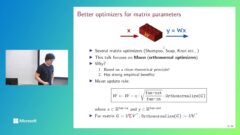
Dion2: A new simple method to shrink matrix in Muon
- Anson Ho,
- Kwangjun Ahn
-
-
-
-
-
-
-
-