
Designing and Enabling a Symphony of Devices
- Daniel Wigdor | University of Toronto
That the era of ubiquitous computing is beginning cannot be disputed. Desktops, laptops, smartphones, and tablets are pervasive and commonplace. To date, development has been largely differentiated by platform; iOS and Android for phones and tablets, and OSX and Windows for desktops and laptops. Past efforts to overcome this have concentrated on providing a ‘write once, run everywhere’ replication of experiences across form factors. These efforts have, in some sense, missed the point: the opportunity is not simply to provide a replicated experience, but rather to enable applications to easily span form factors.
We address this gap with ongoing research termed the Symphony of Devices. The Symphony creates different, topology-appropriate experiences as the number of screens and devices grows and shrinks, and as nearby displays and input devices are annexed. The Netflix of the future is not one that can simply play the same movie on multiple devices, but one where any device can serve as a remote control and feature a supplementary information display for the screen showing the film. The calendar application of the future will allow a user to browse a single calendar, and then add another user’s device to easily view overlapping availability.
In this talk, Daniel will present work from his team on field studies of existing multi-device workflows, user experiences (1, 2), and, most critically, developer tools which allow the automatic reallocation of application functionality across available devices.
Speaker Details
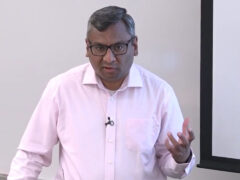
Daniel Wigdor is an assistant professor of computer science and co-director of the Dynamic Graphics Project at the University of Toronto. His research is in the area of human-computer interaction, with major focuses on the architecture of highly-performant UI’s, on development methods for ubiquitous computing, and on post-WIMP interaction methods. Before joining the faculty at U of T in 2011, Daniel was a researcher at Microsoft Research, the user experience architect of the Microsoft Surface Table, and a company-wide expert in user interfaces for new technologies. Simultaneously, he served as an affiliate assistant professor in both the Department of Computer Science & Engineering and the Information School at the University of Washington. Prior to 2008, he was a fellow at the Initiative in Innovative Computing at Harvard University, and conducted research as part of the DiamondSpace project at Mitsubishi Electric Research Labs. He is co-founder of Iota Wireless, a startup dedicated to the commercialization of his research in mobile-phone gestural interaction, and of Tactual Labs, a startup dedicated to the commercialization of his research in high-performance, low-latency user input. For his research, he has been awarded an Ontario Early Researcher Award, as well as best paper awards or honorable mentions at CHI 2014, Graphics Interface 2013, CHI 2011, and UIST 2004. Two of his projects were selected as the People’s Choice Best Talks at CHI 2014.
Daniel is the co-author of Brave NUI World
-
-

Daniel Wigdor
-
Jeff Running
-
Series: Microsoft Research Talks
-

Decoding the Human Brain – A Neurosurgeon’s Experience
- Dr. Pascal O. Zinn
-
-
-
-
-
-

Challenges in Evolving a Successful Database Product (SQL Server) to a Cloud Service (SQL Azure)
- Hanuma Kodavalla,
- Phil Bernstein
-

Improving text prediction accuracy using neurophysiology
- Sophia Mehdizadeh
-

Tongue-Gesture Recognition in Head-Mounted Displays
- Tan Gemicioglu
-

DIABLo: a Deep Individual-Agnostic Binaural Localizer
- Shoken Kaneko
-
-
-
-

Audio-based Toxic Language Detection
- Midia Yousefi
-
-
From SqueezeNet to SqueezeBERT: Developing Efficient Deep Neural Networks
- Forrest Iandola,
- Sujeeth Bharadwaj
-

Hope Speech and Help Speech: Surfacing Positivity Amidst Hate
- Ashique Khudabukhsh
-
-
-

Towards Mainstream Brain-Computer Interfaces (BCIs)
- Brendan Allison
-
-
-
-
Learning Structured Models for Safe Robot Control
- Subramanian Ramamoorthy
-


