

Microsoft Research Cambridge
News & features

Research Focus: Week of May 7, 2025
In this issue: New research on compound AI systems and causal verification of the Confidential Consortium Framework; release of Phi-4-reasoning; enriching tabular data with semantic structure, and more.

The Future of AI in Knowledge Work: Tools for Thought at CHI 2025
| Sean Rintel, Leon Reicherts, Lev Tankelevitch, Advait Sarkar, Pratik Ghosh, and Richard Banks
Join us at CHI 2025 to explore how AI systems can be used as Tools for Thought as we reimage AI’s role in human thinking. Learn about new research, prototypes, and a workshop on designing AI that supports critical thinking,…
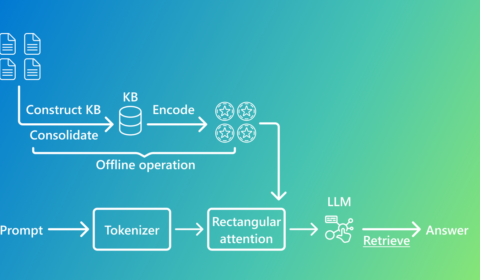
Introducing KBLaM: Bringing plug-and-play external knowledge to LLMs
| Taketomo Isazawa, Xi Wang, Liana Mikaelyan, Mathew Salvaris, and James Hensman
Introducing KBLaM, an approach that encodes and stores structured knowledge within an LLM itself. By integrating knowledge without retraining, it offers a scalable alternative to traditional methods.
In the news | IEEE Spectrum
Microsoft’s Muse AI Edits Video Games on the Fly: Muse is a proof of concept for more consistent AI gameplay
“They have trained what’s essentially a neural game engine that has unprecedented temporal coherence and fidelity,” says Julian Togelius, an associate professor of computer science at New York University and co-founder of AI game testing company Modl.ai. “That has wide…

Introducing Muse: Our first generative AI model designed for gameplay ideation
| Katja Hofmann
Today Nature published Microsoft’s research detailing our WHAM, an AI model that generates video game visuals & controller actions. We are releasing the model weights, sample data, & WHAM Demonstrator on Azure AI Foundry, enabling researchers to build on the…

In the news | Science News Explores
High-speed lasers write data — to last millennia — inside glass
The library, robot, laser, microscope and platters of glass are all part of a research program named Project Silica. Richard Black directs this project at Microsoft Research in Cambridge, England. “Project Silica is a new approach to storing data,” he…

Research Focus: Week of January 27, 2025
In this issue: A new approach to multimodal pretraining for remote sensing; Managed-retention memory for the AI era; Improving detection of macular telangiectasia type 2; Generalizing symbolic automata.

Research Focus: Week of January 13, 2025
In this edition: Privacy enhancements for multiparty deep learning; using smaller, open-source models to provide relevance judgments; new tool uses AI, data to automate innovation and development; Yasuyuki Matsushita named IEEE 2025 Computer Society Fellow.
In the news | Science News Explores
A new frontier awaits — computing with light
In the guts of a new type of computer, a bunch of tiny LEDs emit a green glow. Those lights have a job to do. They’re performing calculations. Right now, this math is telling the computer how to identify handwritten…