

Microsoft Research Cambridge
News & features
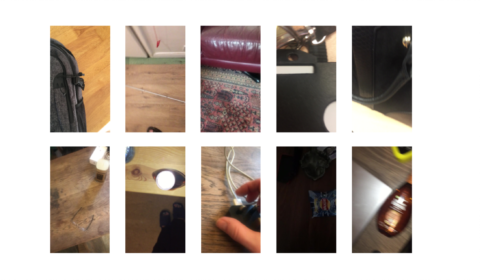
Where’s my stuff? Developing AI with help from people who are blind or low vision to meet their needs
| Simone Stumpf, Cecily Morrison, Daniela Massiceti, Ed Cutrell, and Lida Theodorou
Microsoft AI for Accessibility is funding the ORBIT research project, which is enlisting the help of people who are blind or low vision to build a new dataset. People who are blind or low vision can contribute to the project…
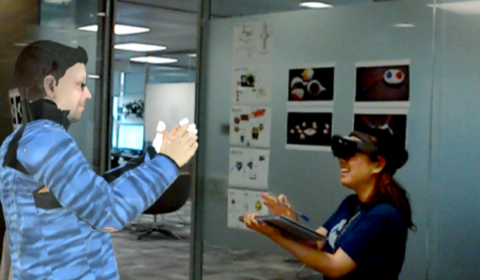
VROOM: Giving body to telepresence
| Brennan Jones
Editor’s Note: This post was written collaboratively by Brennan Jones, Sunny Zhang, Priscilla Wong, and Sean Rintel and told from the first-person perspective of Brennan Jones. One of my life missions is to connect people, and I’ve been pursuing this…
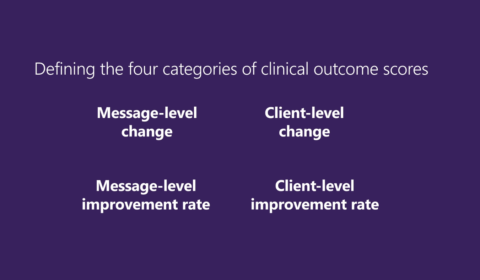
Data-driven insights for more effective, personalized care in online mental health interventions
| Anja Thieme and Danielle Belgrave
Increases in the occurrence and global effect of mental illness have made the prevention and treatment of mental health problems a public health priority. To address the need for more access to mental health treatment, digital psychotherapy programs, such as…

AI Residency: Gaining skills in machine learning through mentorship and real-world applications
| Patricia Gillespie
In September last year, the Microsoft AI Residency program graduated its first class. The second class is already settled in and undertaking an exciting range of projects, and recruitment for the third class is underway! The AI Residency program is…
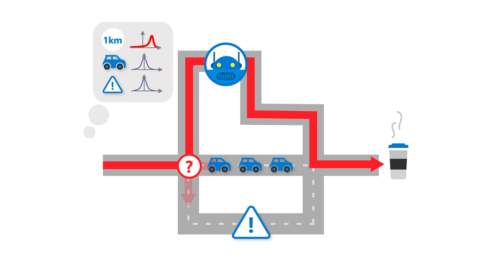
The road less traveled: With Successor Uncertainties, RL agents become better informed explorers
| Sebastian Tschiatschek and Katja Hofmann
Imagine moving to a new city. You want to get from your new home to your new job. Unfamiliar with the area, you ask your co-workers for the best route, and as far as you can tell … they’re right!…

Icebreaker: New model with novel element-wise information acquisition method reduces cost and data needed to train machine learning models
| Cheng Zhang and Sebastian Tschiatschek
In many real-life scenarios, obtaining information is costly, and getting fully observed data is almost impossible. For example, in the recruiting world, obtaining relevant information (in other words, a feature value) for a company could mean performing time-consuming interviews. The…

Optics for the cloud: storage in the zettabyte era with Dr. Ant Rowstron and Mark Russinovich
Remember when a hard drive that could hold a terabyte of data was a big deal? Well, we’re now in an era where peta-, exa- and even zetta-bytes are the bytes of the day, and it turns out it’s hard to fit…
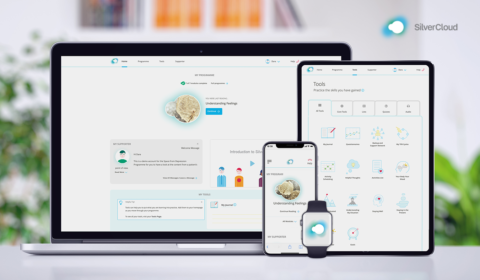
Microsoft collaborates with SilverCloud Health to develop AI for improved mental health
| Danielle Belgrave and Anja Thieme
One in four of us, at some point in our lives, will be affected by a mental health condition. Good mental health and well-being are fundamental to our general health and quality of life. It enables us to build resilience…

Efficient inference for dynamical models using variational autoencoders
| Neil Dalchau
Dynamical systems theory provides a mathematical framework for studying how complex systems evolve over time, such as the neurons in our brains, the global climate system, or engineered cells. But predicting how these systems will behave in the future or…