Microsoft Research Blog

English

  1. Research Intern – AI Safety & Reliability for LLM Systems 

    February 10, 2026

    This Research Internship focuses on improving the reliability and trustworthiness of artificial intelligence (AI) systems that support complex, real-world decision-making. The Research Intern will study how large language model (LLM)–based assistants behave when relevant information is incomplete or unevenly available and explore methods for detecting…


  2. Doug Burger elected to National Academy of Engineering 

    February 10, 2026 | Doug Burger

    Academy membership honors individuals who have made outstanding contributions to engineering research, practice, or education. Burger was elected for accelerating cloud-scale computing and networking infrastructures with field-programmable systems.

  3. overhead view of two people talking while relaxing in an office lounge area

    Collab AI Research 

    February 9, 2026

    How Microsoft is using science and research to invent the future of collaboration Collaboration is a central feature of how work gets done, involving coordination across people, tasks, and information sources. As AI systems increasingly contribute to shared workflows—synthesizing discussions, generating alternatives, maintaining context, and…

  4. Collab AI group header | two people conversing with another person displayed on a virtual mobile device

    From One to Many 

    February 9, 2026

    By Jaime Teevan, Chief Scientist & Technical Fellow In recent years we’ve all lived through the transition to cloud computing, a sudden shift to remote work, and now the rapid rise of AI. Each individually has felt like a seismic event, but in reality they…

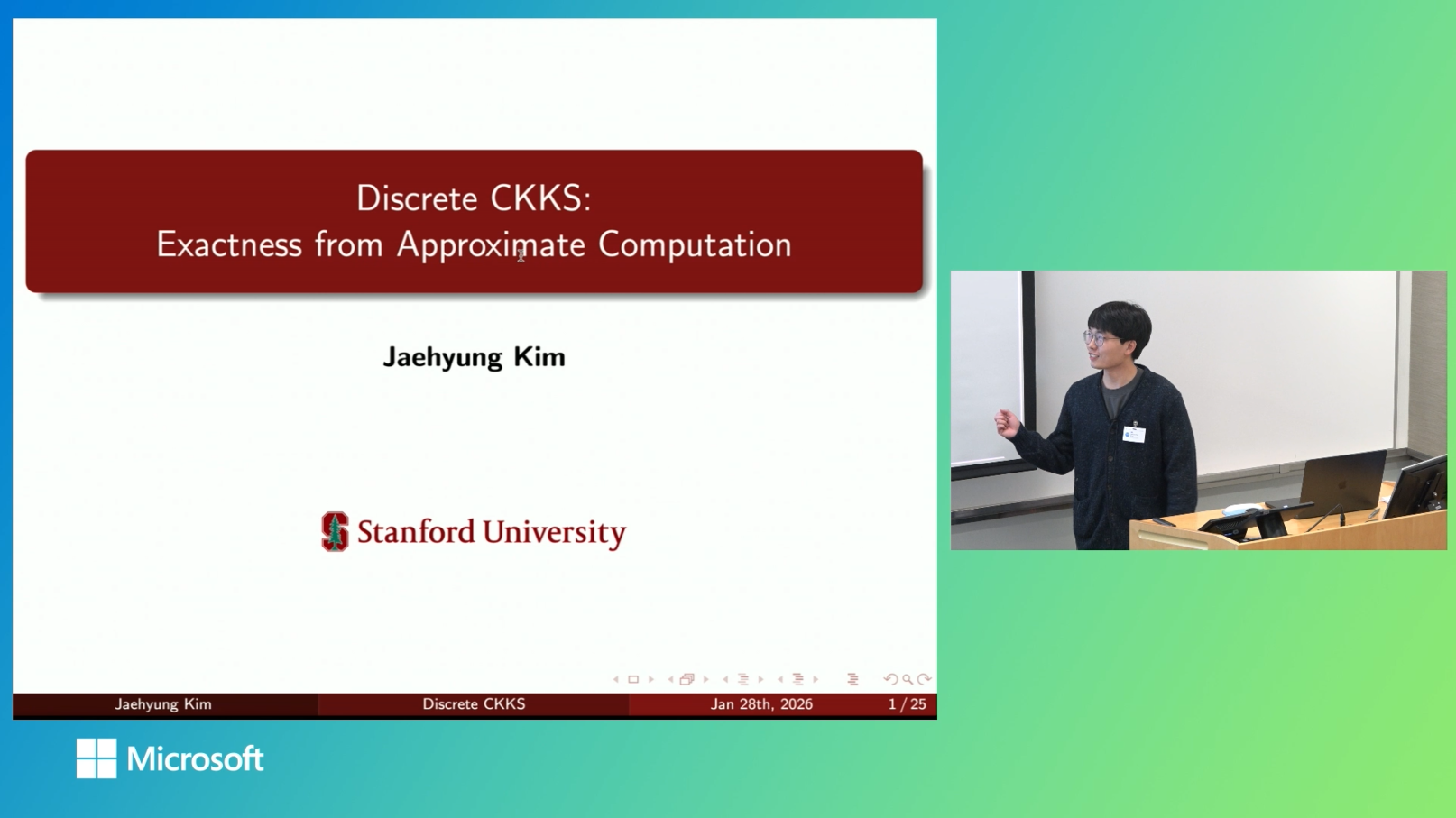
  5. Jaehyung Kim giving a presentation at Microsoft Research

    Efficient Homomorphic Integer Computer from CKKS 

    February 9, 2026 | Jaehyung Kim

    Fully homomorphic encryption (FHE) has evolved from Gentry’s original blueprint into a diverse family of practical schemes, including BGV/BFV for exact arithmetic, DM/CGGI-style schemes for fast binary computation, and CKKS for high-throughput approximate arithmetic. I will begin with a brief overview of this evolution and…

  6. Senior Researcher – Deep Learning and Optimization – Microsoft Research 

    February 9, 2026

    Are you passionate about innovating and tackling challenging research problems at the intersection of Artificial Intelligence (AI) and optimization? Joining MLO as a Senior Researcher - Deep Learning and Optimization - Microsoft Research offers a unique opportunity to work on groundbreaking projects, make a tangible…

  7. ARO: A New Lens On Matrix Optimization For Large Models 

    February 9, 2026

    Matrix-based optimizers have attracted growing interest for improving LLM training efficiency, with significant progress centered on orthogonalization/whitening based methods. While yielding substantial performance gains, a fundamental question arises: can we develop new paradigms beyond orthogonalization, pushing the efficiency frontier further? We present \textbf{Adaptively Rotated Optimization…

  8. GOT-Edit: Geometry-Aware Generic Object Tracking via Online Model Editing 

    February 8, 2026 | Shih-Fang Chen, Jun-Cheng Chen, I-Hong Jhuo, and Yen-Yu Lin

    Human perception for effective object tracking in a 2D video stream arises from the implicit use of prior 3D knowledge combined with semantic reasoning. In contrast, most generic object tracking (GOT) methods primarily rely on 2D features of the target and its surroundings while neglecting…

  9. Beyond Correctness: Learning Robust Reasoning via Transfer 

    February 8, 2026 | Hyunseok Lee, Soheil Abbasloo, Jihoon Tack, and Jinwoo Shin

    Reinforcement Learning with Verifiable Rewards (RLVR) has recently strengthened LLM reasoning, but its focus on final answer correctness leaves a critical gap: it does not ensure the robustness of the reasoning process itself. We adopt a simple philosophical view, robust reasoning should remain useful beyond…

  10. Welfarist Formulations for Diverse Similarity Search 

    February 8, 2026 | Siddharth Barman, Nirjhar Das, Shivam Gupta, and Kirankumar Shiragur

    Nearest Neighbor Search (NNS) is a fundamental problem in data structures with wide-ranging applications, such as web search, recommendation systems, and, more recently, retrieval-augmented generations (RAG). In such recent applications, in addition to the relevance (similarity) of the returned neighbors, diversity among the neighbors is…