Microsoft Research Blog

English

  1. Uncertain Pointer: Situated Feedforward Visualizations for Ambiguity-Aware AR Target Selection 

    April 13, 2026 | Ching-Yi Tsai, Nicole Tacconi, Andrew D. Wilson, and Parastoo Abtahi

    Target disambiguation is crucial in resolving input ambiguity in augmented reality (AR), especially for queries over distant objects or cluttered scenes on the go. Yet, visual feedforward techniques that support this process remain underexplored. We present Uncertain Pointer, a systematic exploration of feedforward visualizations that…

  2. background pattern

    Microsoft at CHI 2026 

    April 13, 2026

    Microsoft Research is proud to be a sponsor of ACM CHI conference on Human Factors in Computing Systems (opens in new tab), the leading international conference on Human-Computer Interaction. CHI 2026 will take place in Barcelona at the Centre de Convencions Internacional de Barcelona (opens…

  3. Latent-DARM: Bridging Discrete Diffusion and Autoregressive Models for Reasoning 

    April 1, 2026

    Most multi-agent systems rely exclusively on autoregressive language models (ARMs) that are based on sequential generation. Although effective for fluent text, ARMs limit global reasoning and plan revision. On the other hand, Discrete Diffusion Language Models (DDLMs) enable non-sequential, globally revisable generation and have shown…

  4. Learning to Generate Unit Test via Adversarial Reinforcement Learning 

    April 1, 2026 | Dongjun Lee, Changho Hwang, and Kimin Lee

    Unit testing is a core practice in programming, enabling systematic evaluation of programs produced by human developers or large language models (LLMs). Given the challenges in writing comprehensive unit tests, LLMs have been employed to automate unit test generation, yet methods for training LLMs to…

  5. What does Generative UI mean for HCI Practice? 

    April 1, 2026

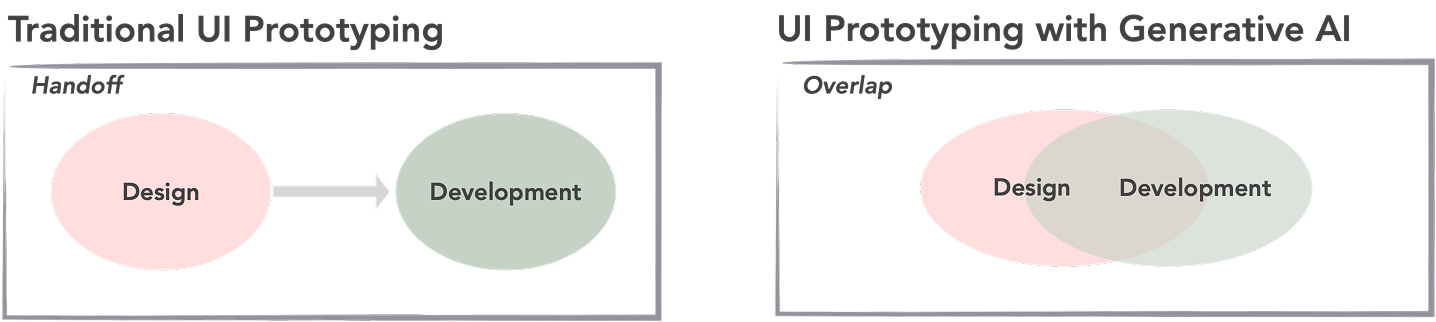
    The increasing capability of AI models to generate user interfaces has the potential to transform HCI and design practice. We invite researchers, designers, developers, and practitioners to explore how generative UI – interfaces created by AI models – will reshape design methods, workflows, and user…

  6. Engaging Communities Meaningfully in Defining Disability Representation for AI Image Generation 

    April 1, 2026

    Media representations of people with disabilities profoundly influence societal perceptions, yet have historically been absent, stereotyped, or inaccurate. As AI-generated visual media becomes increasingly prevalent, there is a critical opportunity to address these misrepresentations. Responding to the lack of collectively negotiated representation standards, this paper…

  7. “Helping Me Versus Doing It for Me”: Designing for Agency in LLM-Infused Writing Tools for Science Journalism 

    April 1, 2026 | Sachita Nishal, Mina Lee, Nicholas Diakopoulos, and Jennifer Wortman Vaughan

    Journalists rely on their agency—the ability to exercise independent judgment in alignment with their values—to fulfill their democratic social role. In this study, we investigate how LLM-infused writing tools reshape journalists’ agency in editorial decision making. In interviews with 20 science journalists, we presented four…

  8. Combinatorial Rising Bandits 

    April 1, 2026

    Combinatorial online learning is a fundamental task for selecting the optimal action (or super arm) as a combination of base arms in sequential interactions with systems providing stochastic  rewards. It is applicable to diverse domains such as robotics, social advertising, network routing, and recommendation systems.…