
Security, privacy, and cryptography


Video
The Worst Form Including All Those Others: Canada’s Experiments with Online Voting
Although Canada is quickly becoming a world leader in the use of online voting, a vacuum of cybersecurity standards, regulation, and public awareness has left online voting vendors largely to set their own bar for…

Video
How Not to Prove Your Election Outcome
Earlier this year we (Lewis, Pereira and Teague) examined the source code for the SwissPost e-voting system, intended to be used for Swiss elections in May. The system was in the process of certification for…

Podcast
HE compilers for Private AI and other game changers with Dr. Olli Saarikivi
Episode 87, August 28, 2019- As computing moves to the cloud, there is an increasing need for privacy in AI. In an ideal world, users would have the ability to compute on encrypted data without…

Video
Homomorphic Encryption with Microsoft SEAL
Since the invention of its first scheme in 2009, homomorphic encryption has been making it possible to perform computations on encrypted data, providing an opportunity to offer greater security assurances to customers using and storing…
Webinar
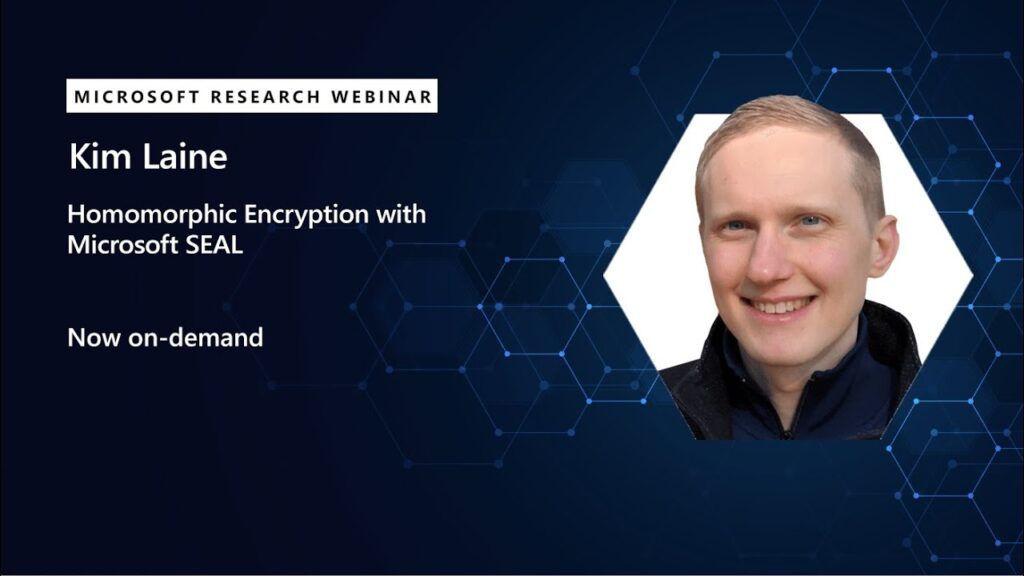
Homomorphic Encryption with Microsoft SEAL Webinar
In this webinar led by researcher Kim Laine of the Cryptography and Privacy Research group at Microsoft, you’ll learn how SEAL can help software engineers develop data storage and computation services that customers can feel safe using because…

Publication
Reusable Non-Interactive Secure Computation
Video
Reproducible Codes and Cryptographic Applications
In this talk I will present a work in progress on structured linear block codes. The investigation starts from well-known examples and generalizes them to a wide class of codes that we call reproducible codes.…