Compositional Data Access and Manipulation
- Simon Peyton Jones, Microsoft
(opens in new tab)
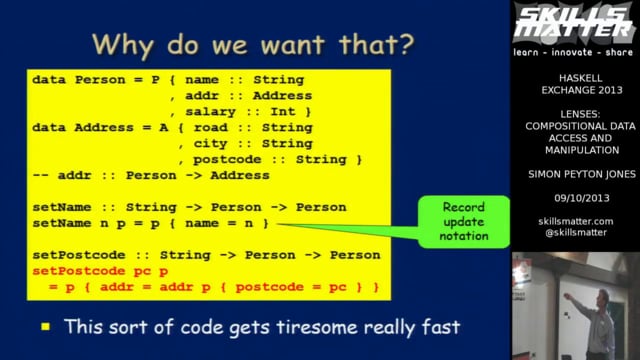
Click to view presentation (opens in new tab) (registration required)Haskell lets you write beautiful, modular code. Rather than waffle generally, I’ll use this talk to look at a particular example, Edward Kmett’s lovely lens library. Lenses have been called “jQuery for data types”: they give you a way to poke around in the guts of some large aggregate structure. Lenses compose (so you can make big lenses by gluing together little ones), and they exploit type classes to allow a remarkable degree of flexibility (get, set, fold, traverse, etc). I won’t assume that you already know Haskell; indeed one of my goals is to give you a sense of what Haskell is like without dragging you through a basic tutorial. So please come even if, perhaps especially if, you don’t already know Haskell. Come prepared to read lots of code and ask lots of questions.
-
-

Simon Peyton Jones
(Former) Senior Principal Researcher
-
-
Watch Next
-
-
-

Episode 1: Tackling complex healthcare challenges
- Jonathan M. Carlson,
- Will Guyman,
- Matthew Lungren
-

Episode 2: A multi-disciplinary approach
- Jonathan M. Carlson,
- Will Guyman,
- Matthew Lungren
-

Episode 3: Collaborating faster
- Jonathan M. Carlson,
- Will Guyman,
- Matthew Lungren
-

Episode 4: A distribution channel for AI innovation
- Jonathan M. Carlson,
- Will Guyman,
- Matthew Lungren
-

Episode 5: Breakthroughs in AI
- Jonathan M. Carlson,
- Will Guyman,
- Matthew Lungren
-

Episode 6: Healthcare Agent Orchestrator
- Jonathan M. Carlson,
- Will Guyman,
- Matthew Lungren
-

Episode 7: The road ahead
- Jonathan M. Carlson,
- Will Guyman,
- Matthew Lungren
-
Using Optimization and LLMs to Enhance Cloud Supply Chain Operations
- Beibin Li,
- Konstantina Mellou,
- Ishai Menache