
Microsoft Research Blog

Research Focus: Week of April 1, 2024 

April 3, 2024
In this issue: New research helps COMET embrace African languages; FeatUp improves deep features, a computer vision research cornerstone; LLMs in the Imaginarium: Tool Learning through Simulated Trial and Error; Benchmarking LLMs across languages and more.
Recent Posts

  1. Research Focus April 1, 2024

    Research Focus: Week of April 1, 2024 

    April 3, 2024

    In this issue: New research helps COMET embrace African languages; FeatUp improves deep features, a computer vision research cornerstone; LLMs in the Imaginarium: Tool Learning through Simulated Trial and Error; Benchmarking LLMs across languages and more.

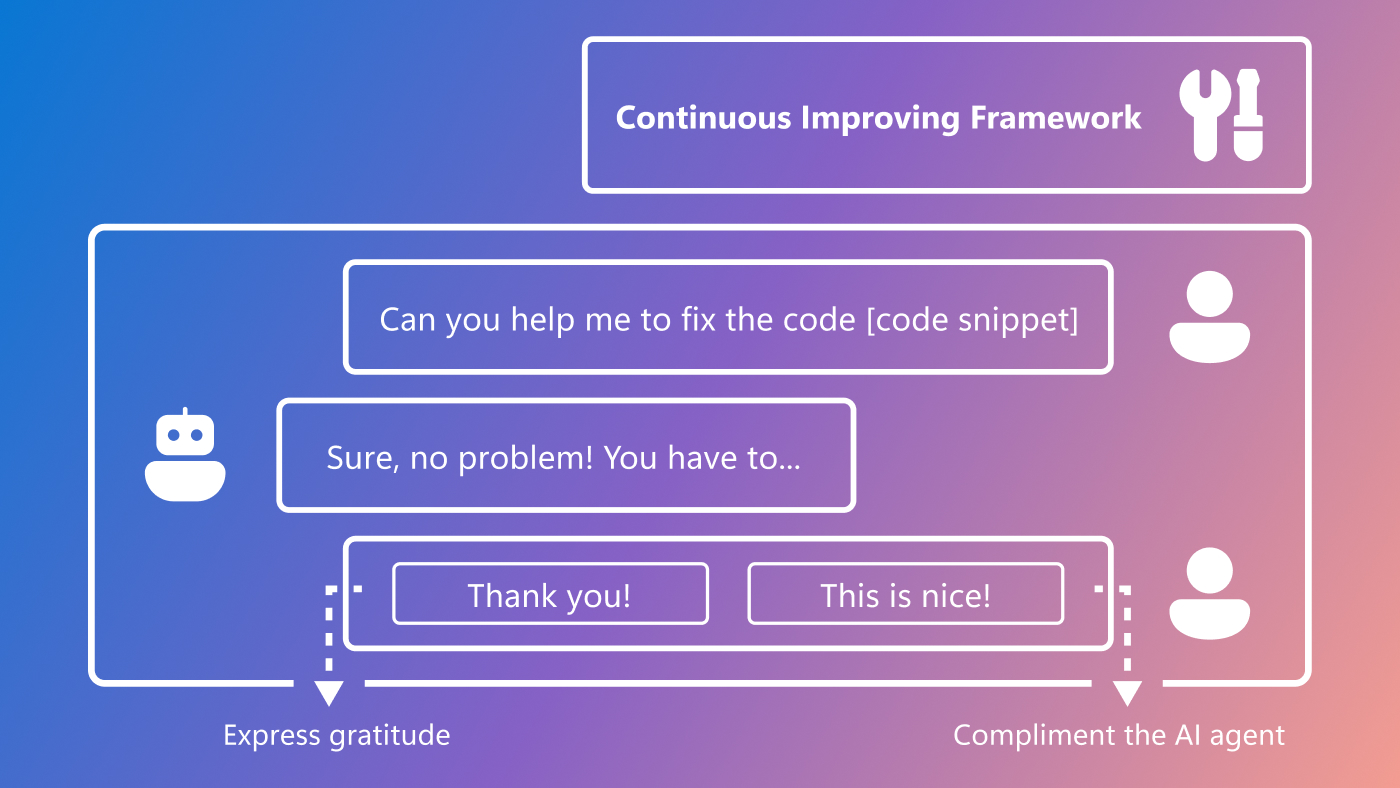
  2. flowchart showing how AI learns from user interactions

    Learning from interaction with Microsoft Copilot (web) 

    March 27, 2024

    Microsoft researchers are taking a comprehensive and dynamic approach to help Copilot (web) continuously learn from interaction and feedback, improving the AI system and making it increasingly useful for consumers. Learn more.

  3. Research Focus March 20, 2024

    Research Focus: Week of March 18, 2024 

    March 20, 2024

    Welcome to Research Focus, a series of blog posts that highlights notable publications, events, code/datasets, new hires and other milestones from across the research community at Microsoft. Large language models (LLMs) have shown impressive capabilities, yet they still struggle with math reasoning. In a recent…

  4. white icons of first aid kit, DNA strand, laptop monitor with overlapping eye, and microscope on a blue and green gradient background

    Scaling early detection of esophageal cancer with AI 

    March 11, 2024 | Anton Schwaighofer and Javier Alvarez-Valle

    Microsoft Research and Cyted have collaborated to build novel AI models (opens in new tab) to scale the early detection of esophageal cancer. The AI-supported methods demonstrated the same diagnostic performance as the existing manual workflow, potentially reducing the pathologist's workload by up to 63%.…

  5. Research Focus March 4, 2024

    Research Focus: Week of March 4, 2024 

    March 6, 2024

    In this issue: Generative kaleidoscopic networks; Text diffusion with reinforced conditioning; PRISE – Learning temporal action abstractions as a sequence compression problem.

  6. The general model architecture of ViSNet. (a) Model sketch of ViSNet. ViSNet embeds the 3D structures of molecules and extracts the geometric information through a series of ViSNet blocks and outputs the molecule properties such as energy, forces, and HOMO-LUMO gap through an output block. (b) Flowchart of one ViSNet Block. One ViSNet block consists of two modules: i) Scalar2Vec, responsible for attaching scalar embeddings to vectors.; ii) Vec2Scalar. The inputs of Scalar2Vec are the node embedding, edge embedding, direction unit and the relative positions between two atoms.

    ViSNet: A general molecular geometry modeling framework for predicting molecular properties and simulating molecular dynamics 

    February 29, 2024 | Tong Wang, Bin Shao, and Tie-Yan Liu

    Molecular geometry modeling is a powerful tool for understanding the intricate relationships between molecular structure and biological activity – a field known as structure-activity relationships (SAR). The main premise of SAR is that the biological activity of a molecule is dictated by its specific chemical…

Explore More

  • Events & conferences

    Events & conferences 

    Meet our community of researchers, learn about exciting research topics, and grow your network

  • Podcasts

    Podcasts 

    Ongoing conversations at the cutting edge of research

  • Microsoft Research Forum

    Microsoft Research Forum 

    Join us for a continuous exchange of ideas about research in the era of general AI