Rick Rashid & Founding Microsoft Research
- Rick Rashid, Microsoft
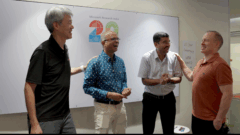
We were delighted to host a fabulous talk from the founder of Microsoft Research, Rick Rashid! Rick shared lessons learned throughout his career, his motivation and inspiration for creating and designing Microsoft Research, as well as challenges and perspectives on today’s research opportunities, AI, and innovation. We also had time for Q&A.
Speaker bio
Richard Rashid is the founder of Microsoft Research, which he created and led from 1991–2013. From its inception, Microsoft Research was designed as an open research system with the world’s most prominent researchers in academia, industry, and government to advance the state of computing and to help secure the future of Microsoft. Under Rashid’s leadership, Microsoft Research grew to be the world’s most prominent industry research organization, conducting research across all key areas including systems, networking, machine learning, security, search, graphics, human-computer interaction, and artificial intelligence, across major regions including Asia/China, India, Europe, and the US.
Rashid was born in Fort Madison, Iowa, and graduated from Stanford University in 1974 with degrees in mathematics and comparative literature. He then received a Master of Science and a Ph.D. in computer science from the University of Rochester, finishing in 1980. While at Rochester, he and Gene Ball wrote what was probably one of the earliest networked multiplayer computer games, Alto Trek, for Xerox Alto computers.
Before joining Microsoft in 1991, Rashid had been the developer of the Mach kernel during his tenure as a professor of computer science at Carnegie Mellon University. The Mach multiprocessor operating system kernel developed by Rashid has had a lasting influence on the design of modern operating systems, including Windows NT, and remained at the core of several operating systems such as NeXTSTEP, GNU Hurd, macOS, iOS, OSF/1, and Tru64 UNIX. Rashid’s Mach kernel pioneered the concepts of microkernel architecture, and its impact can be traced throughout today’s computing landscape, with hundreds of millions of people still using Mach-based operating systems decades after its creation. The Mach project popularized and refined concepts in virtual memory management, hardware abstraction, binary-code compatibility, and process management. These concepts advanced the state of operating systems and led to their practical and widespread adoption.
Rashid has authored a number of patents in areas such as data compression, networking, and operating systems. In 2000, he became senior vice president of Microsoft.
Rashid was elected a member of the National Academy of Engineering in 2003 for advances in operating systems and leadership in industrial research.
Rashid has five children, lives in a number of cool houses with his amazing wife Terri, and his favorite “power hobbies” include Star Trek and running marathons!
-
-

Rick Rashid
Emeritus Researcher
-
-

Watch Next
-
-
-

More is Less: Extra Features in Contactless Payments Break Security
- Tom Chothia,
- George Pavlides
-

Microsoft as Customer Zero: Empowering Research Teams with AI
- Nathan Evans,
- Evelyne Viegas,
- Chenglong Wang
-
-

1st Annual Fusion Summit: Research Lightning Talks
- Shruti Rajurkar,
- Tian Xie,
- Matthew Horton
-
-
-
-

MARI Grand Seminar - Large Language Models and Low Resource Languages
- Monojit Choudhury,
- Edward Ombui,
- Sunayana Sitaram