Research Focus: Week of January 27, 2025
In this issue: A new approach to multimodal pretraining for remote sensing; Managed-retention memory for the AI era; Improving detection of macular telangiectasia type 2; Generalizing symbolic automata.
In this edition: Privacy enhancements for multiparty deep learning; using smaller, open-source models to provide relevance judgments; new tool uses AI, data to automate innovation and development; Yasuyuki Matsushita named IEEE 2025 Computer Society Fellow.
Microsoft researchers introduce MatterGen, a model that can discover new materials tailored to specific needs—like efficient solar cells or CO2 recycling—advancing progress beyond trial-and-error experiments.
Announcing AutoGen 0.4, fully reimagined library for building advanced agentic AI systems, developed to improve code quality and robustness. Its asynchronous, event-driven architecture is designed to support dynamic, scalable workflows.
AIOpsLab is an open-source framework designed to evaluate and improve AI agents for cloud operations, offering standardized, scalable benchmarks for real-world testing, enhancing cloud system reliability.
NeoMem: hardware/software co-design for CXL-native memory tiering; Chimera: accurate retrosynthesis prediction by ensembling models with diverse inductive biases; GA4GH task execution API enables multicloud task execution.
PromptWizard from Microsoft Research is now open source. It is designed to automate and simplify AI prompt optimization, combining iterative LLM feedback with efficient exploration and refinement techniques to create highly effective prompts in minutes.
GraphRAG helps advance AI use in complex domains like science. Thanks to enthusiastic adoption and community engagement, we’ve upgraded the pre-release version. Check out the major ergonomic and structural updates in GraphRAG 1.0.
Can a new SOS-RMT protocol enable more efficient CL-MPC?; A fair-by-design, cloud-based algorithmic trading platform; LLM2CLIP unlocks richer visual representation; New technique enhances Low-Rank Adaptation’s expressiveness, generalization capabilities.
Microsoft Research presents a new large market model and Financial Market Simulation Engine (MarS) to help empower financial researchers with enhanced efficiency and more accurate insights for downstream tasks in financial markets.
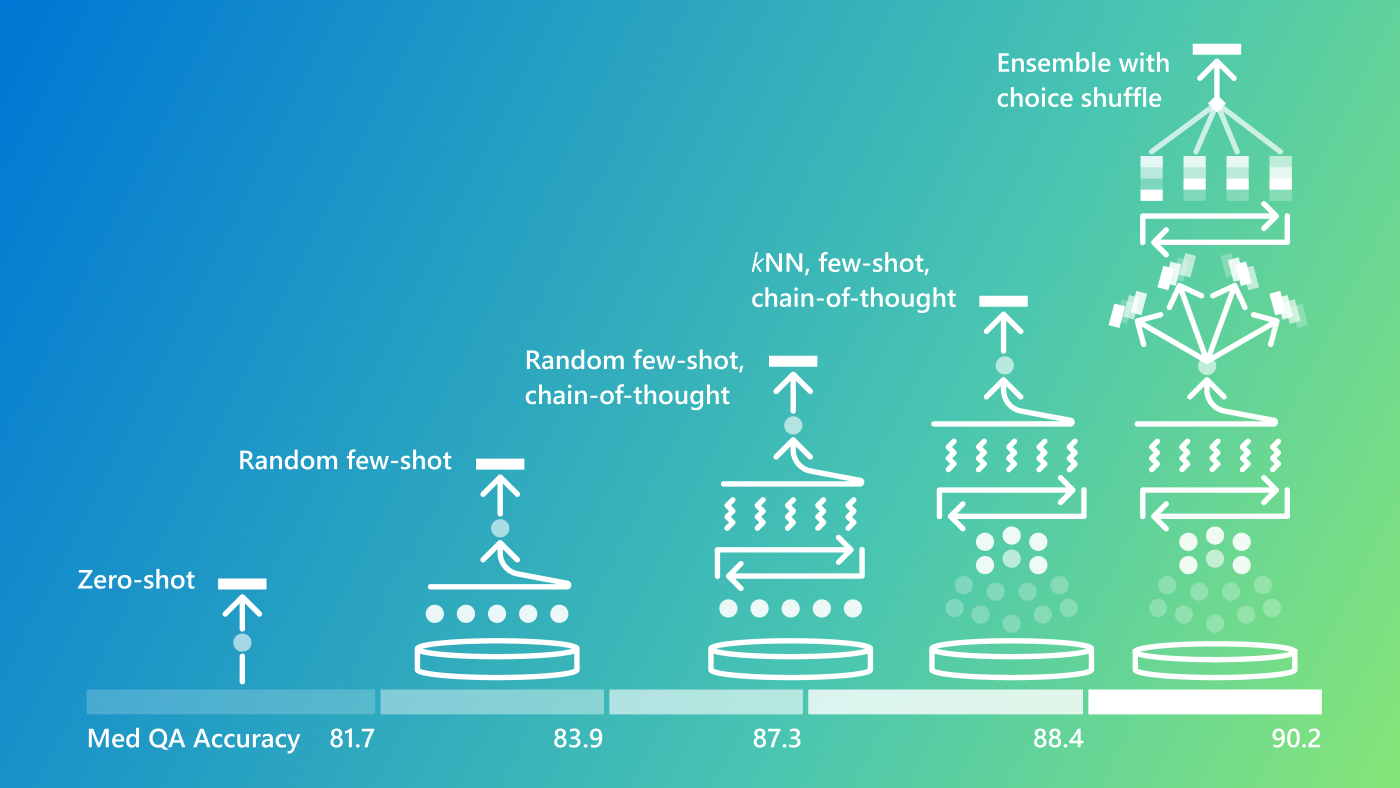
Discover the most effective run-time strategies on the OpenAI o1-preview model, improving accuracy in medical language tasks.
TamGen uses generative AI to design new drug candidate compounds to treat TB, going beyond traditional methods by generating novel chemical structures. Learn how a collaboration with the Global Health Drug Discovery Institute is making this possible.